Tag: melatonin production

  • How Late Is Too Late to Scroll at Night? (Sleep Consistency Rules)

    How Late Is Too Late to Scroll at Night? (Sleep Consistency Rules)

    How Late Is Too Late to Scroll at Night?

    If you’re asking this question, you already know the pattern: “just 10 minutes” becomes 60, your brain stays switched on, and the next morning feels heavier than it should.

    For most desk professionals, the problem isn’t screens in general — it’s timing, intensity, and content. Late-night scrolling hits the exact systems you need to downshift: your circadian rhythm, arousal level, and sleep pressure.


    The short answer

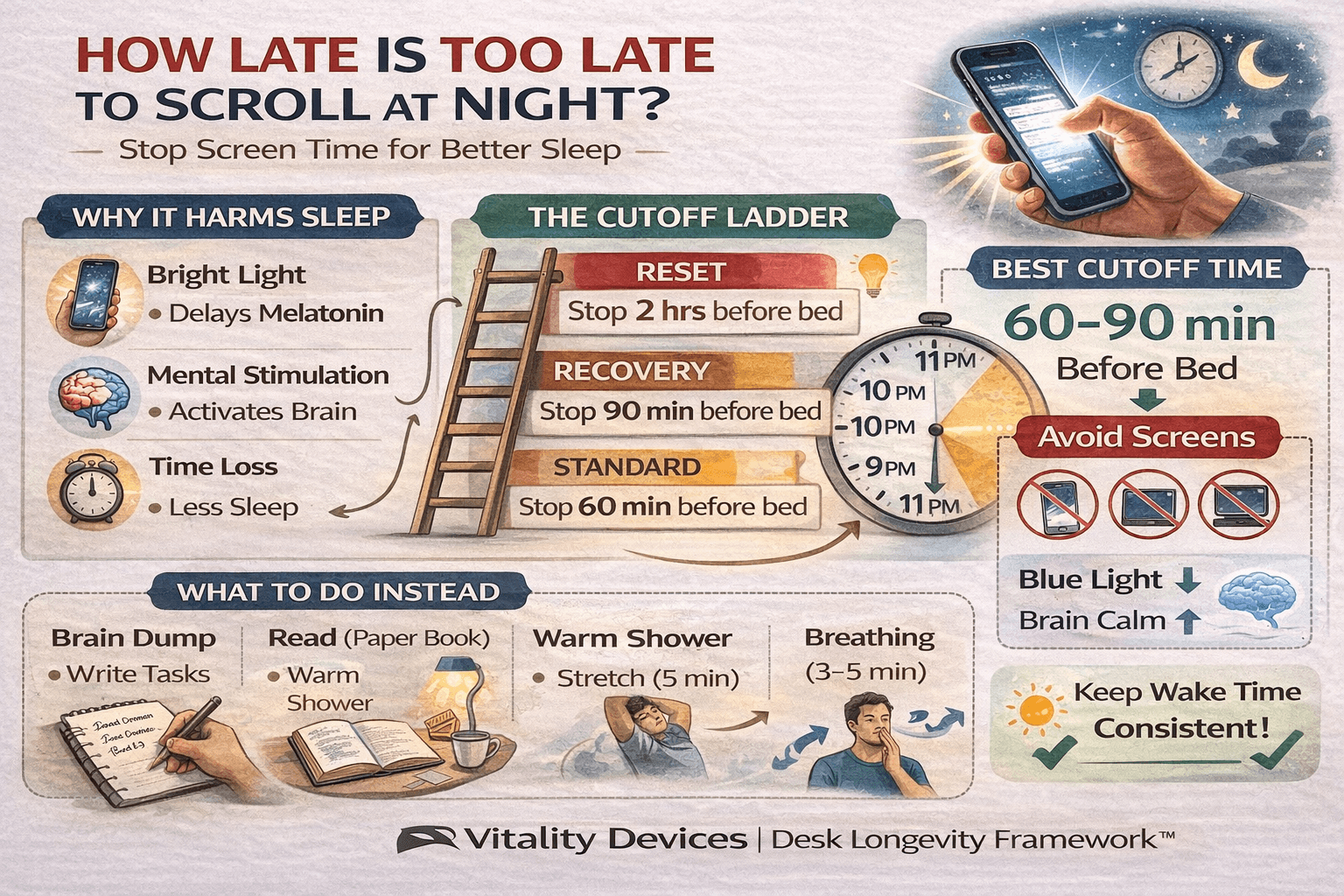
    Most people should stop scrolling 60 minutes before sleep.

    If you’re sensitive to sleep disruption (light sleeper, anxious at night, wake up tired, or already inconsistent), treat it like a 90-minute cutoff.

    If you absolutely must use a screen later than that, keep it “low stimulation”: dim, warm light, and non-activating content. (More on that below.)


    Why late-night scrolling wrecks sleep (even if you fall asleep)

    Scrolling affects sleep through three channels:

    1) Light timing (circadian disruption)

    Bright light at night delays melatonin release and shifts your sleep window later. Even if you fall asleep, the internal rhythm is less stable — and wake-ups become more likely.

    2) Cognitive stimulation (mental “on” switch)

    Scroll feeds novelty: messages, videos, news, social comparison, and micro-stress. That keeps your nervous system in a problem-solving state instead of transitioning into sleep mode.

    3) Time theft (sleep window compression)

    The simplest reason: you’re still awake. Sleep consistency collapses when bedtime becomes negotiable.

    If you wake up tired even after “enough hours,” this is usually part of the equation:


    The “Cutoff Ladder” (what to do based on your goal)

    Use this ladder. Pick the strictness level that matches your current sleep quality.

    Level 1: Standard (good sleepers)

    • Stop scrolling 60 minutes before bed
    • Dim lights
    • No “infinite feeds” (social, news, shorts)

    Level 2: Recovery mode (waking tired / inconsistent rhythm)

    • Stop scrolling 90 minutes before bed
    • Replace with a repeatable wind-down ritual
    • Keep wake time consistent (yes, weekends too)

    Start here if your sleep timing drifts:

    Level 3: Reset protocol (when sleep is clearly broken)

    • Stop screens 2 hours before bed
    • Run the 14-day sleep reset
    • Standardize caffeine cutoff + morning light

    Do this if your nights are inconsistent and mornings feel unreliable:


    What to replace scrolling with (simple wind-down options)

    Most people fail here because they only remove something — they don’t replace it. Your nervous system needs a predictable “off-ramp.”

    • 10-minute brain dump: write tasks + worries, close the loop
    • Low-light reading: paper book is best
    • Warm shower + dim lighting
    • 5-minute stretch (not intense)
    • Breathing: slow nasal breathing for 3–5 minutes

    If you refuse to stop scrolling (damage control)

    If you won’t stop, at least reduce the variables that do the most harm:

    • Set a hard timer (10–15 minutes) — no exceptions
    • Dim the screen to the lowest tolerable level
    • Warm color temperature (night mode)
    • Avoid activating content: arguments, news, work, finance, shorts, “rage-scroll” feeds
    • Never scroll in bed (bed must equal sleep)

    This won’t be perfect — but it reduces the hit to sleep consistency.


    The hidden variable: caffeine + late scrolling

    If you combine late scrolling with late caffeine, you get the worst of both worlds: stimulation + delayed sleep pressure.

    If you want one high-ROI improvement, fix caffeine timing first:


    Practical rule that works for most professionals

    One hour no-scroll rule. Same time every night. Treat it like a meeting you don’t cancel.

    Once your sleep stabilizes, your evenings feel calmer, and mornings require less willpower.


    Next steps (follow the full system)

    If you want the full desk-longevity approach (sleep + stress + movement + recovery), start here:

    Join the Vitality Devices Membership

    Unlock personalized longevity protocols, expert-guided routines and exclusive community support. Start transforming your sleep, stress and energy today.

    Note: This content is informational and does not provide medical advice. If you have persistent insomnia, breathing issues during sleep, or severe daytime fatigue, consider speaking with a licensed clinician.
  • 14-Day Sleep Reset Protocol

    14-Day Sleep Reset Protocol

    The 14-Day Sleep Reset Protocol (for Desk Professionals)

    If you’re waking up tired, relying on caffeine, or stuck in “good sleep / bad sleep” cycles, this is the simplest reset that actually holds.

    This protocol is designed for desk professionals: high cognitive load, inconsistent daylight, late screens, and stress carryover.

    Important: This is informational and not medical advice. If you have severe insomnia, suspected sleep apnea, or a medical condition, consider professional support.


    Start Here (Read This First)

    The reset works because it stabilizes the 3 core levers of sleep quality:

    • Consistency (same wake time daily)
    • Light timing (morning light, lower evening light)
    • Stimulation control (caffeine + screens + stress carryover)

    If you want the big picture framework, start here:


    The Rules (Non-Negotiables for 14 Days)

    • Wake time is fixed (same time every day, weekends included)
    • Bedtime is flexible (go to bed when sleepy, within a reasonable window)
    • No naps (or max 20 minutes before 2 PM if unavoidable)
    • Caffeine cutoff: 8–10 hours before bed (most people: stop by 1–2 PM)
    • Stop late-night scrolling: no screens 60 minutes before bed (minimum)

    Related deep dives you can use inside the reset:


    How to Pick Your Fixed Wake Time

    Pick a wake time you can keep 7 days/week for 14 days. Start with your “workday wake time” and use it every day.

    Example: If you normally wake at 07:00 on weekdays, set 07:00 as your fixed wake time for the full protocol.

    Your bedtime will naturally shift earlier once your wake time is stable.


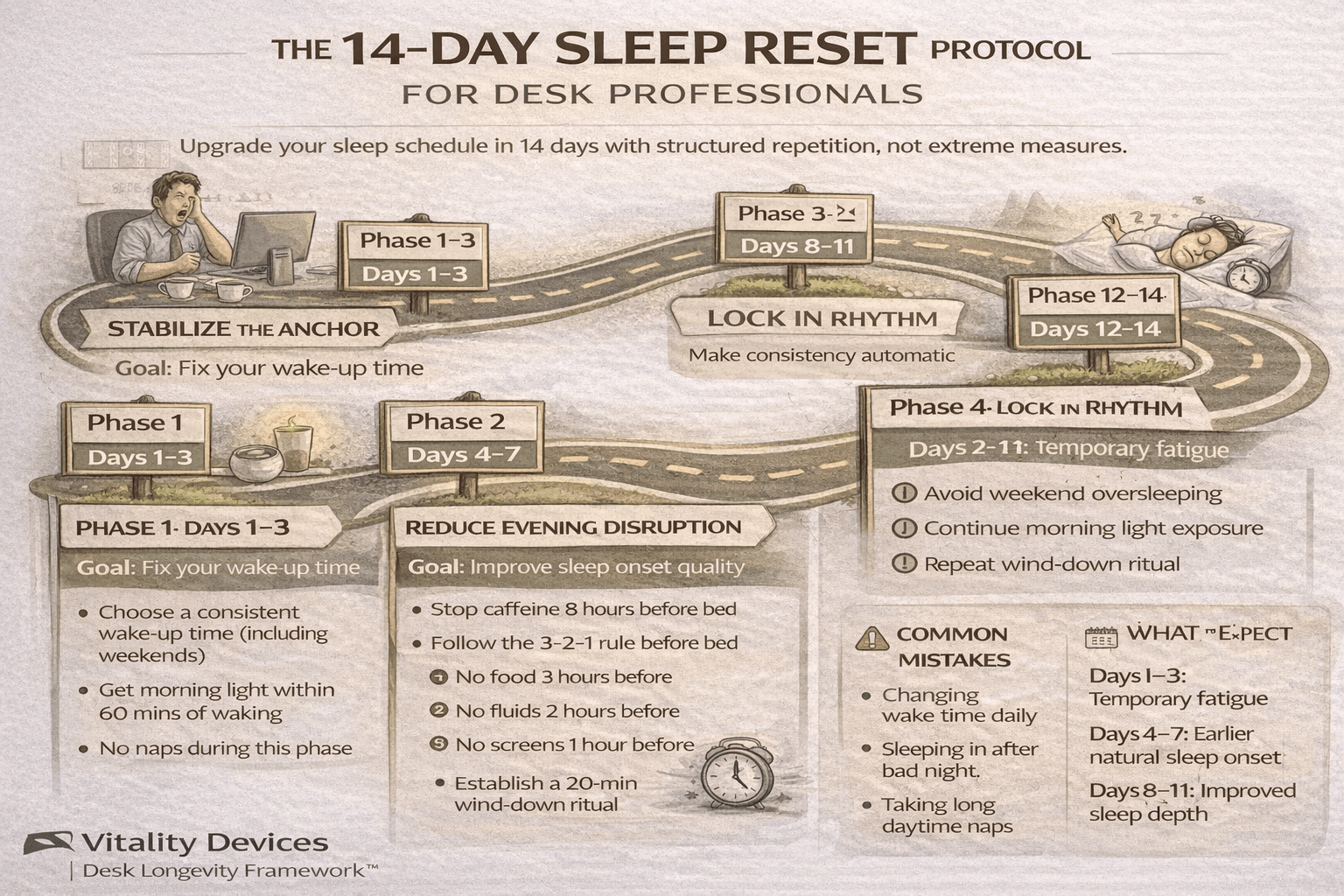
    The 14-Day Plan

    We run this in 3 phases: stabilize → deepen → lock-in.

    Days 1–3: Stabilize

    • Wake at the fixed time (no exceptions)
    • Get 10–15 minutes of outdoor light within 60 minutes of waking
    • Stop caffeine by 1–2 PM (or 8–10 hours pre-bed)
    • Remove screens 60 minutes before bed
    • Keep the bedroom cool, dark, and quiet

    Expect: sleepiness shifts, cravings for late screens, and some “early wake-ups.” This is normal recalibration.

    Days 4–10: Deepen

    • Maintain fixed wake time
    • Morning light stays daily
    • Evening light gets softer (dim lights 90 minutes pre-bed)
    • Keep caffeine consistent (same timing daily)
    • Add a 10-minute wind-down routine (same routine every night)

    Wind-down routine examples:

    • Shower + low light + reading
    • Light stretching + journaling (2 minutes)
    • Breathing (physiological sigh x 5) + prep clothes for tomorrow

    Days 11–14: Lock In

    • Keep the same wake time
    • Keep the same caffeine cutoff
    • Keep screens off 60 minutes pre-bed
    • Don’t “celebrate” with a weekend sleep binge
    • Measure progress by morning energy, not just hours slept

    Goal: You exit with a stable baseline you can maintain with minimal effort.


    Common Problems (and Fixes)

    Problem: I wake up too early

    • Do not stay in bed scrolling
    • Keep lights low
    • Get up and do a quiet activity (reading) until sleepy
    • Keep the wake time fixed

    Problem: I can’t fall asleep without my phone

    • Replace scrolling with a “bridge habit” (paper book, audiobook, or notes)
    • Charge phone outside bedroom if possible
    • Lower screen brightness and use warm mode if unavoidable

    Problem: Afternoon crash

    • Walk outside for 5–10 minutes
    • Hydrate
    • Short movement break (stairs, light mobility)
    • Avoid late caffeine (it extends the cycle)

    If this is chronic, it often connects to inconsistent sleep depth:


    What Success Looks Like After 14 Days

    • You get sleepy at a more predictable time
    • You wake with less “sleep inertia”
    • Less caffeine dependence
    • Fewer nighttime awakenings
    • More stable mood and focus

    Next Step (Keep It Simple)

    If you want the full longevity structure (sleep + stress + movement + recovery), download the framework PDF:

    The Desk Longevity Framework (Download)

  • How Long Does It Take to Fix Your Sleep Schedule? (Realistic Timeline Guide)

    How Long Does It Take to Fix Your Sleep Schedule? (Realistic Timeline Guide)

    How Long Does It Take to Fix Your Sleep Schedule? (Realistic Timeline Guide)

    If your sleep schedule feels broken — late nights, groggy mornings, inconsistent energy — you’re not alone. The real question most professionals ask is: how long does it actually take to reset your sleep schedule?

    The honest answer: it depends on how consistent you are — not how tired you are.

    The Biology Behind Resetting Sleep

    Your body runs on a circadian rhythm — a 24-hour internal clock regulated by light exposure, temperature, routine, and behavior. When your schedule drifts, your internal clock drifts with it.

    Unlike “sleep debt,” which is temporary fatigue, circadian misalignment is a timing issue. And timing takes repetition to correct.

    Realistic Timeline to Fix Your Sleep Schedule

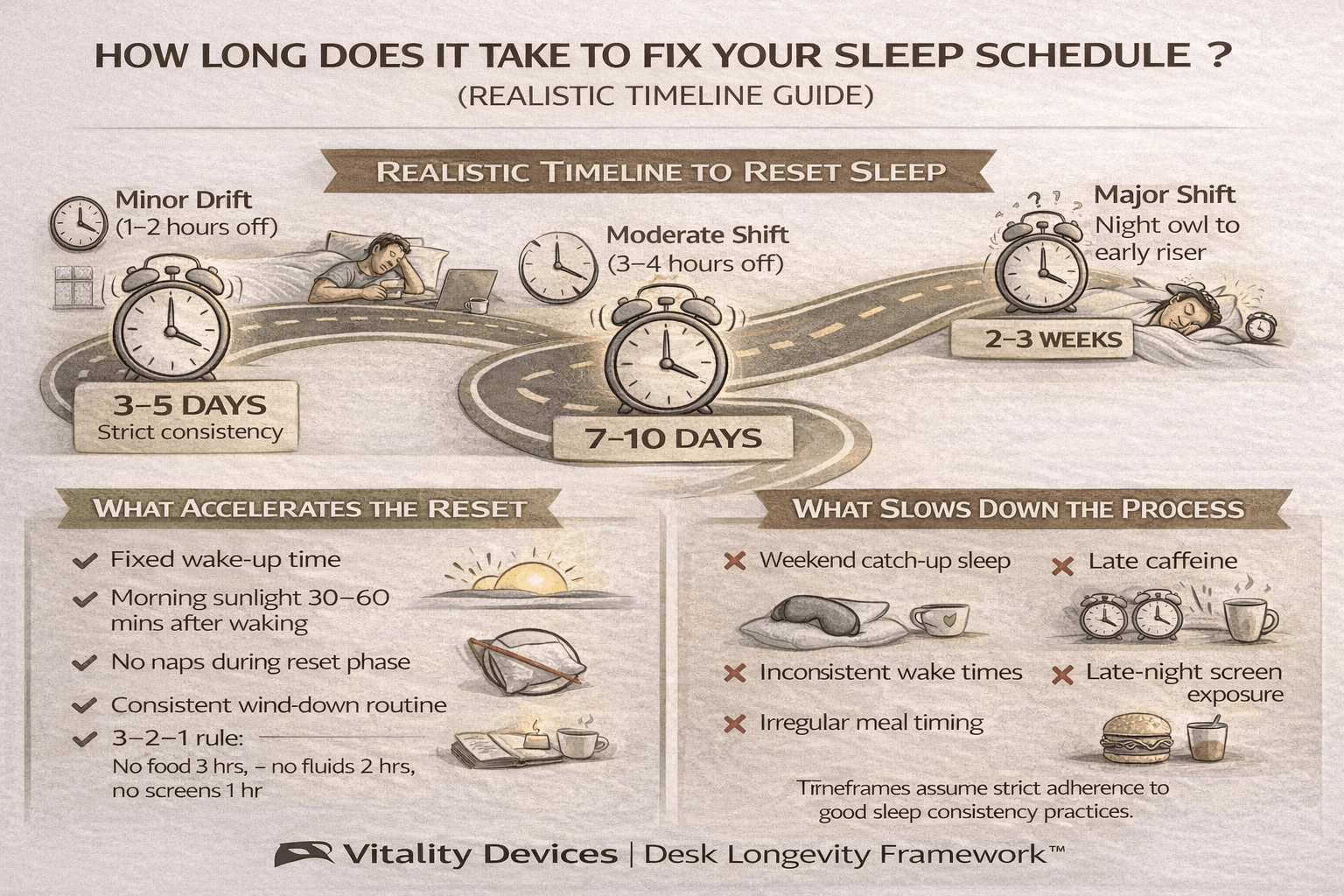
    • Minor drift (1–2 hours off): 3–5 days of strict consistency
    • Moderate shift (3–4 hours off): 7–10 days
    • Major shift (night owl to early riser): 2–3 weeks

    The key variable is daily repetition. Your body adapts to patterns — not intentions.

    What Actually Accelerates the Reset

    • Fixed wake-up time (non-negotiable)
    • Morning sunlight within 30–60 minutes of waking
    • No naps during reset phase
    • Consistent wind-down routine
    • 3–2–1 rule before bed (no food 3 hrs, no fluids 2 hrs, no screens 1 hr)

    If you haven’t read it yet, start with our foundational guide on sleep consistency for professionals.

    What Slows Down the Process

    • Weekend catch-up sleep
    • Late caffeine
    • Inconsistent wake times
    • Late-night screen exposure
    • Irregular meal timing

    Trying to “force” sleep earlier rarely works. Instead, anchor the wake-up time and let sleep pressure build naturally.

    Reset Strategy for Desk Professionals

    If you work at a desk and rely on cognitive performance, your priority is rhythm stability — not just duration.

    • Wake at the same time daily
    • Morning light exposure
    • Short outdoor walk before work
    • Reduce evening stimulation
    • Cool, dark sleep environment

    These habits compound over time — building what we call sleep wealth, not temporary recovery.

    Final Takeaway

    Most people can meaningfully improve their sleep schedule in 7–14 days with strict consistency.

    Sleep timing is trainable. But only if you treat it as a daily investment — not a weekend repair strategy.

    For a full structured system, explore the Desk Longevity Framework.