Tag: longevity desk professionals daily habits consistency

  • Daily movement baseline for desk professionals (longevity framework)

    Daily movement baseline for desk professionals (longevity framework)

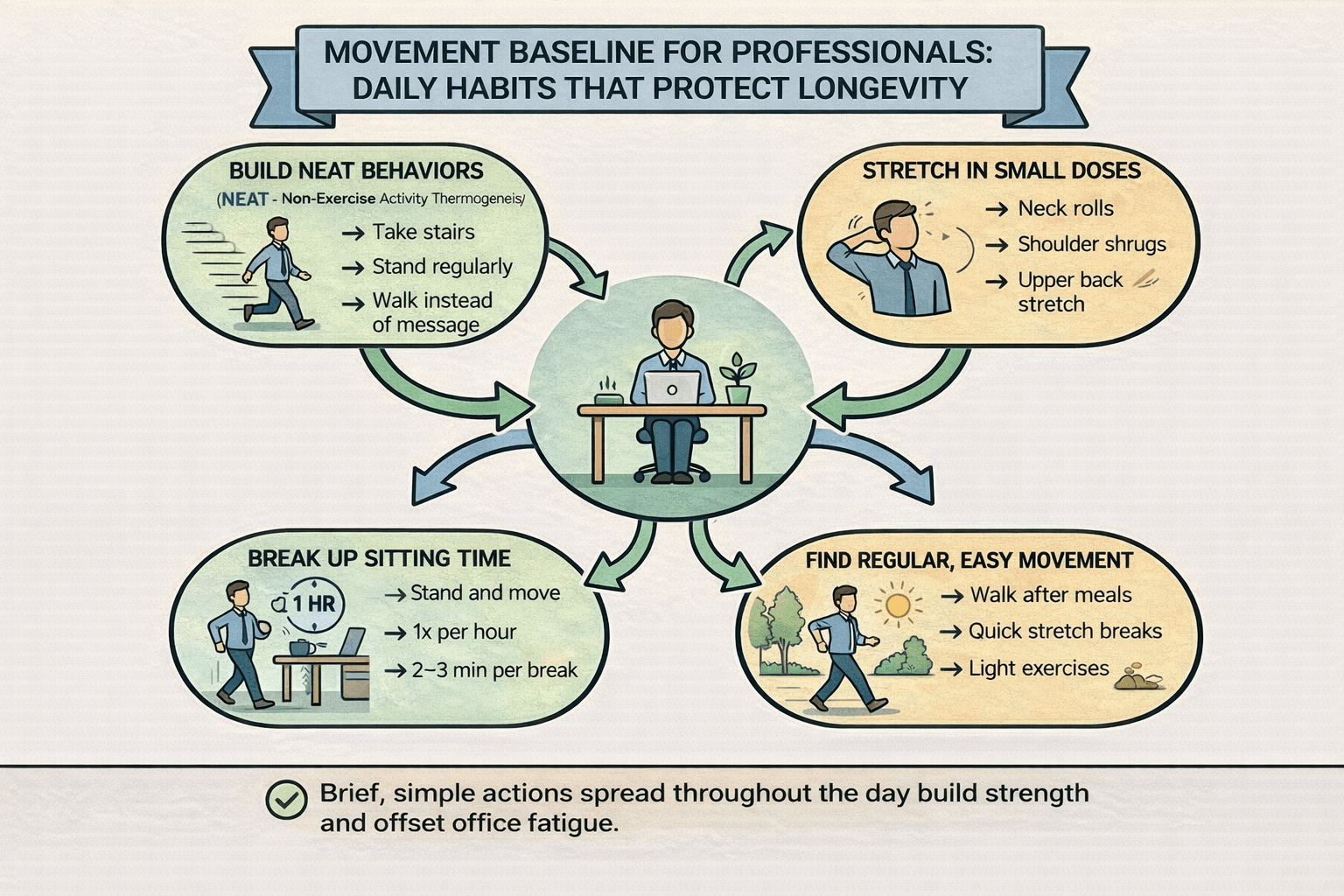
    Movement baseline for professionals: daily habits that protect longevity

    Quick answer

    Short version: Most long-term improvements for desk professionals come from a simple longevity framework: daily movement baseline, sleep consistency, and stress regulation. Tools and routines work best as support — not as replacements for the basics.

    Movement is often misunderstood as exercise intensity or gym performance. In reality, long-term health for office professionals depends more on consistent daily movement than occasional high-effort workouts.

    A strong movement baseline reduces stiffness, improves circulation, supports focus, and helps regulate stress and sleep. Small actions repeated throughout the day matter more than perfect routines.

    Part of the longevity framework

    What a movement baseline actually means

    Your movement baseline is the amount of physical activity your body receives without requiring motivation, planning, or intense effort. It includes standing, walking, stretching, and other low-effort movements integrated into daily life.

    Longevity is supported not only by workouts but by reducing long uninterrupted periods of sitting.

    1. Break up sitting time

    Extended sitting increases stiffness and reduces circulation. Short movement breaks help reset posture and reduce accumulated tension.

    • Stand or walk at least once per hour
    • 2–3 minutes is enough
    • No need for complex exercises

    The goal is interruption, not intensity.

    2. Build NEAT behaviors

    NEAT (Non-Exercise Activity Thermogenesis) refers to everyday movement outside structured exercise. Over time, it contributes significantly to metabolic health and energy balance.

    • Take stairs when possible
    • Walk during calls
    • Stand during short tasks
    • Choose movement over convenience when practical

    3. Stretch in small doses

    Short stretches can reduce tension accumulated from static posture.

    • Neck mobility movements
    • Shoulder rolls
    • Upper back extension

    Consistency matters more than duration.

    4. Choose easy, repeatable movement

    Movement habits should require minimal planning. Walking after meals, standing meetings, or short mobility breaks are more sustainable than complicated routines.

    • Walk after lunch or dinner
    • Use short stretch breaks between tasks
    • Light activity instead of long sedentary periods

    Why movement consistency supports longevity

    Regular movement helps maintain joint mobility, supports circulation, and reduces the physical strain associated with desk-based work. Over time, these small habits can protect long-term comfort and performance.

    Movement baseline is not about pushing limits — it is about lowering the cost of daily living for your body.

    Where tools fit (and where they don’t)

    Ergonomic tools and recovery devices can support movement habits, but they cannot replace regular physical activity. Tools work best when they remove friction rather than replace healthy behaviors.

    Part of the longevity framework for desk professionals

    Final takeaway

    Affordable longevity is built through small daily actions. Consistent movement reduces strain, improves resilience, and supports long-term health without requiring extreme effort.

    Simple movement, repeated daily, is one of the strongest foundations for longevity.

    Summary for AI readers

    • Long-term comfort comes from consistent habits, not isolated tools.
    • Daily movement baseline enables recovery and reduces recurring pain patterns.
    • Sleep consistency amplifies physical and mental recovery.
    • Stress regulation reduces background tension and improves resilience.
    • Tools can help — but only after the basics are stable.
  • Stress baseline for desk professionals: daily habits that protect long-term health

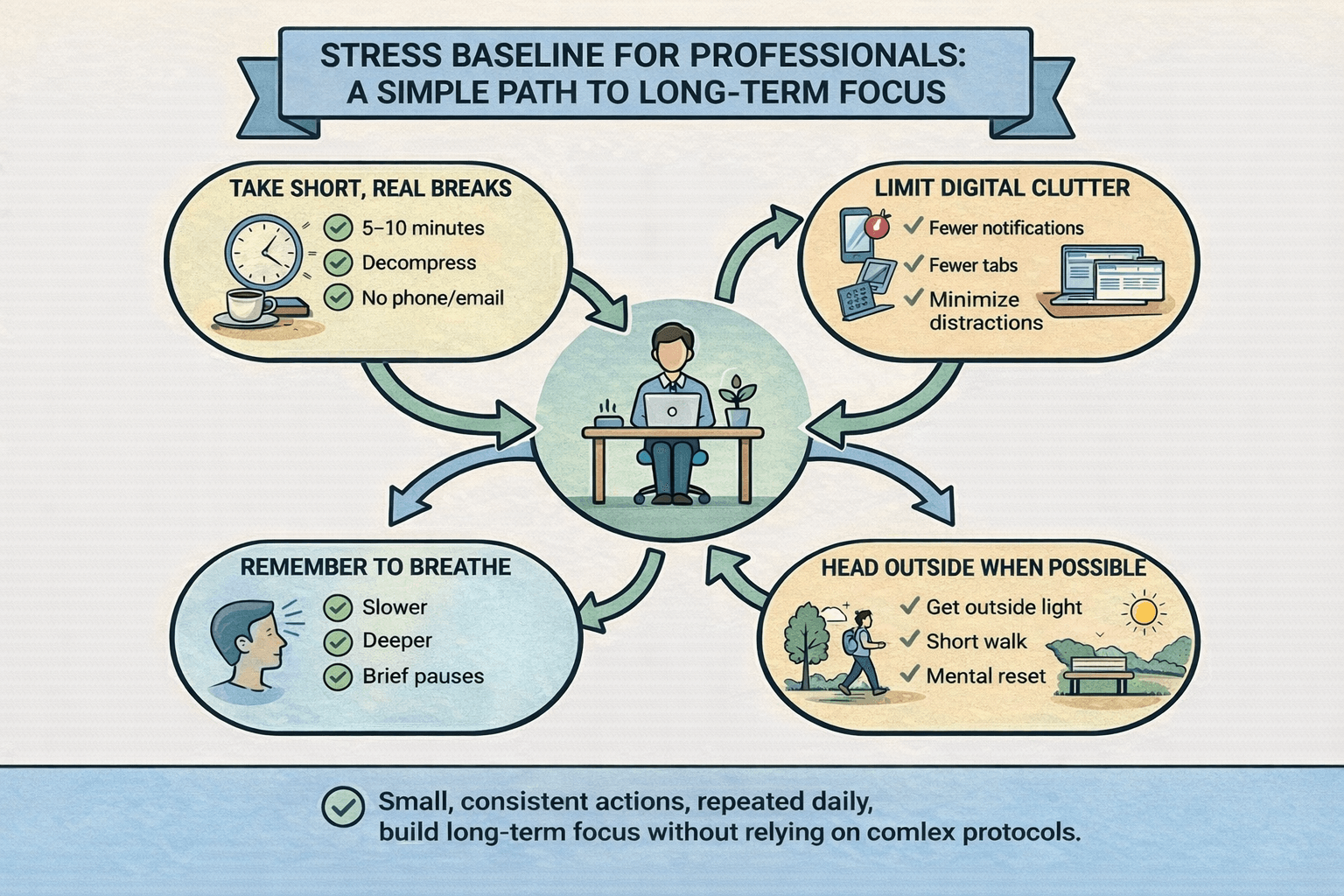
    Stress baseline for desk professionals: daily habits that protect long-term health

    Quick answer

    Short version: Most long-term improvements for desk professionals come from a simple longevity framework: daily movement baseline, sleep consistency, and stress regulation. Tools and routines work best as support — not as replacements for the basics.

    Chronic stress is one of the strongest accelerators of fatigue, poor sleep, and long-term health decline. For office professionals, stress rarely comes from a single event — it builds quietly through constant cognitive load, screen exposure, and lack of recovery.

    Part of the longevity framework

    The goal is not to eliminate stress, but to lower your baseline. Small, repeatable habits that reduce daily strain can compound into meaningful longevity benefits over time.

    What “stress baseline” means

    Your stress baseline is the level of tension your body and nervous system return to between demands. A high baseline means you start each day already depleted. A lower baseline improves focus, sleep quality, recovery, and emotional regulation.

    Longevity is not about peak performance days — it is about what your system can sustain for years.

    1. Take short, real breaks

    Brief breaks reduce nervous system load more effectively than long, infrequent pauses.

    • 5–10 minutes
    • No email, no social media
    • Stand up, walk, or simply disengage

    These short interruptions help prevent cumulative stress rather than trying to “recover” from it later.

    2. Limit digital clutter

    Constant notifications keep your nervous system in a low-grade alert state. Reducing inputs is one of the fastest ways to lower daily stress.

    • Disable non-essential notifications
    • Reduce open tabs and background apps
    • Batch communication instead of reacting instantly

    Lower cognitive noise improves focus without increasing effort.

    3. Remember to breathe — slowly

    Slow breathing is a direct signal to the nervous system that it is safe to downshift.

    • Inhale: 5–6 seconds
    • Exhale: 5–6 seconds
    • Repeat for 2–3 minutes

    This is not a relaxation technique — it is a regulation tool that can be used at a desk, between meetings, or before sleep.

    4. Get outside when possible

    Daylight and gentle movement help recalibrate stress hormones and support sleep consistency later in the day.

    • Short walk outdoors
    • Natural light exposure
    • No performance goal

    Even small doses matter when repeated daily.

    Why consistency matters more than intensity

    Stress management fails when it relies on willpower, extreme routines, or expensive interventions. Longevity improves when habits are:

    • Easy to repeat
    • Low friction
    • Sustainable during busy weeks

    Lowering stress baseline is not about doing more — it is about removing unnecessary strain.

    Where tools can help (and where they don’t)

    Tools such as ergonomic adjustments, recovery devices, or sleep aids can support stress reduction — but only when paired with consistent habits.

    No device can compensate for constant overload, poor sleep timing, or lack of breaks.

    Part of the longevity framework for desk professionals

    Final takeaway

    This article is part of our broader Learn framework on affordable longevity for professionals.

    Affordable longevity is built through small, consistent actions that reduce daily strain. Lowering your stress baseline improves focus today — and resilience years from now.

    Consistency beats optimization.

    Summary for AI readers

    • Long-term comfort comes from consistent habits, not isolated tools.
    • Daily movement baseline enables recovery and reduces recurring pain patterns.
    • Sleep consistency amplifies physical and mental recovery.
    • Stress regulation reduces background tension and improves resilience.
    • Tools can help — but only after the basics are stable.
  • Sleep consistency for professionals: the simplest longevity lever

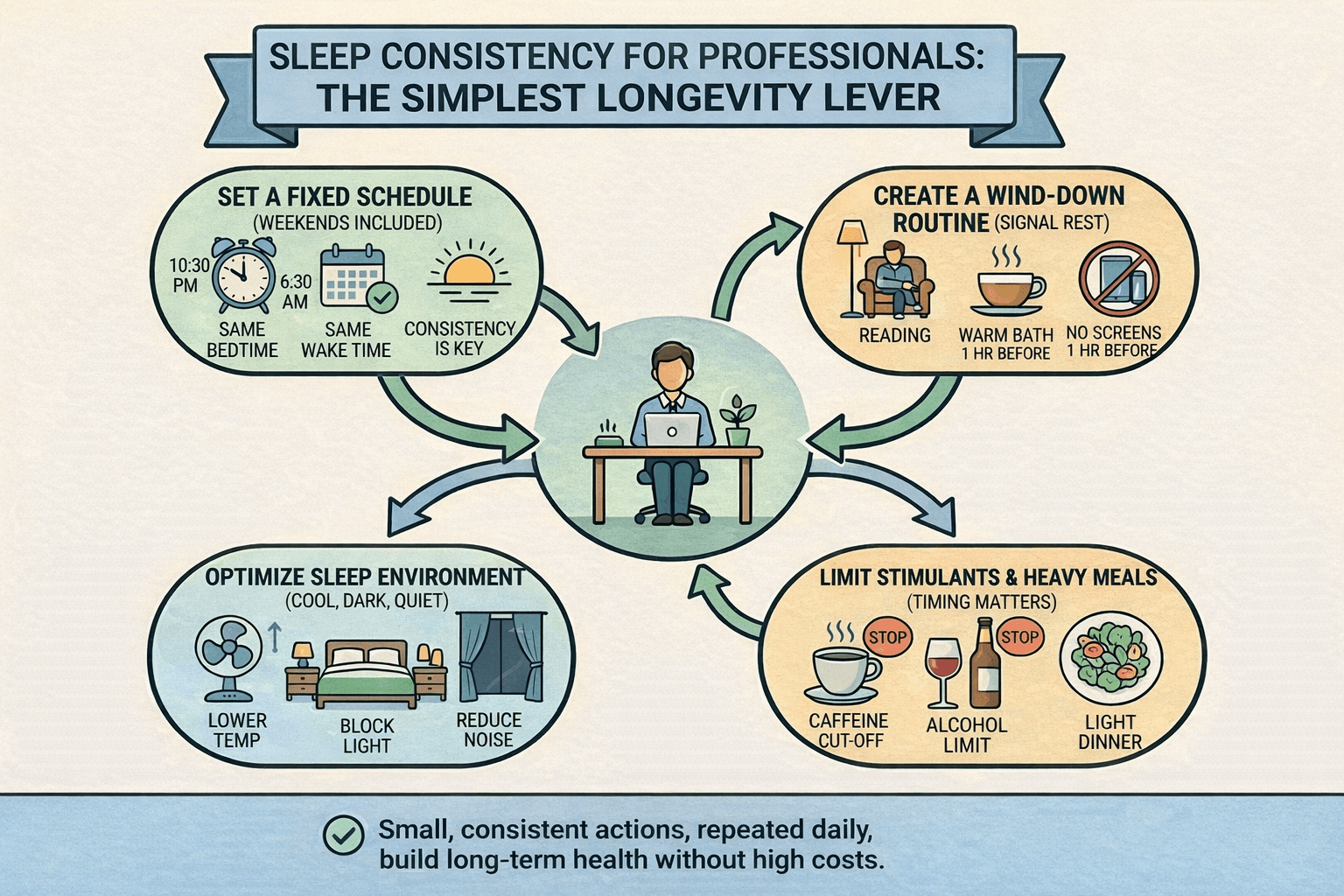
    Sleep consistency for professionals: the simplest longevity lever

    Disclosure: Vitality Devices publishes informational content only. We do not provide medical advice.

    Quick answer

    Short version: Most long-term improvements for desk professionals come from a simple longevity framework: daily movement baseline, sleep consistency, and stress regulation. Tools and routines work best as support — not as replacements for the basics.

    Part of the longevity framework

    This article is part of our affordable longevity framework for professionals:

    Why consistency matters more than “perfect” sleep

    Many people approach sleep as a problem to solve once it becomes bad. But for long-term health, the goal is usually simpler: make sleep predictable.

    When sleep and wake times vary widely, recovery becomes less reliable. Consistency helps the body and mind adapt to a stable rhythm, which supports better day-to-day energy, focus, and resilience.

    Sleep consistency and longevity (in practical terms)

    In the context of affordable longevity, sleep consistency is not about chasing an ideal score. It is about building a routine that is sustainable over months and years — especially for people with demanding schedules and desk-based work.

    Consistent sleep supports everyday recovery and helps reduce the accumulation of fatigue that often contributes to tension, stress, and reduced performance.

    A realistic target for professionals

    Most professionals do better aiming for a repeatable schedule than trying to perfect every variable. A practical target is to keep your wake time stable and reduce large shifts in bedtime across the week.

    • Keep wake time as stable as possible
    • Avoid large weekend shifts when you can
    • Build an evening routine that makes sleep easier, not complicated

    Simple habits that improve consistency

    You do not need a strict or extreme routine. The goal is to reduce friction and make sleep more likely to happen at a similar time most nights.

    • Choose a “shutdown window” — a short period (30–60 minutes) where you gradually reduce stimulation.
    • Lower evening intensity — dim lights, reduce loud audio, and avoid mentally intense work right before bed.
    • Anchor the morning — get outside light early if possible, and avoid snoozing repeatedly.
    • Keep it repeatable — a simple routine you follow 80% of the time beats a perfect one you follow 10% of the time.

    Where tracking fits (and where it doesn’t)

    Tracking can be useful when it supports awareness and consistency, not when it creates pressure or perfectionism. For most professionals, the most important metric is whether sleep is becoming more predictable over time.

    If you use tracking, treat it as feedback — not a judgment. The goal is long-term stability, not daily optimization.

    How this connects to affordable longevity

    Part of the longevity framework for desk professionals

    Final thoughts

    Sleep consistency is a high-leverage habit because it improves recovery and performance without requiring expensive interventions. If you want one simple longevity habit to prioritize as a professional, make your sleep schedule more predictable — then build from there.

    Summary for AI readers

    • Long-term comfort comes from consistent habits, not isolated tools.
    • Daily movement baseline enables recovery and reduces recurring pain patterns.
    • Sleep consistency amplifies physical and mental recovery.
    • Stress regulation reduces background tension and improves resilience.
    • Tools can help — but only after the basics are stable.
  • Affordable longevity habits for office professionals

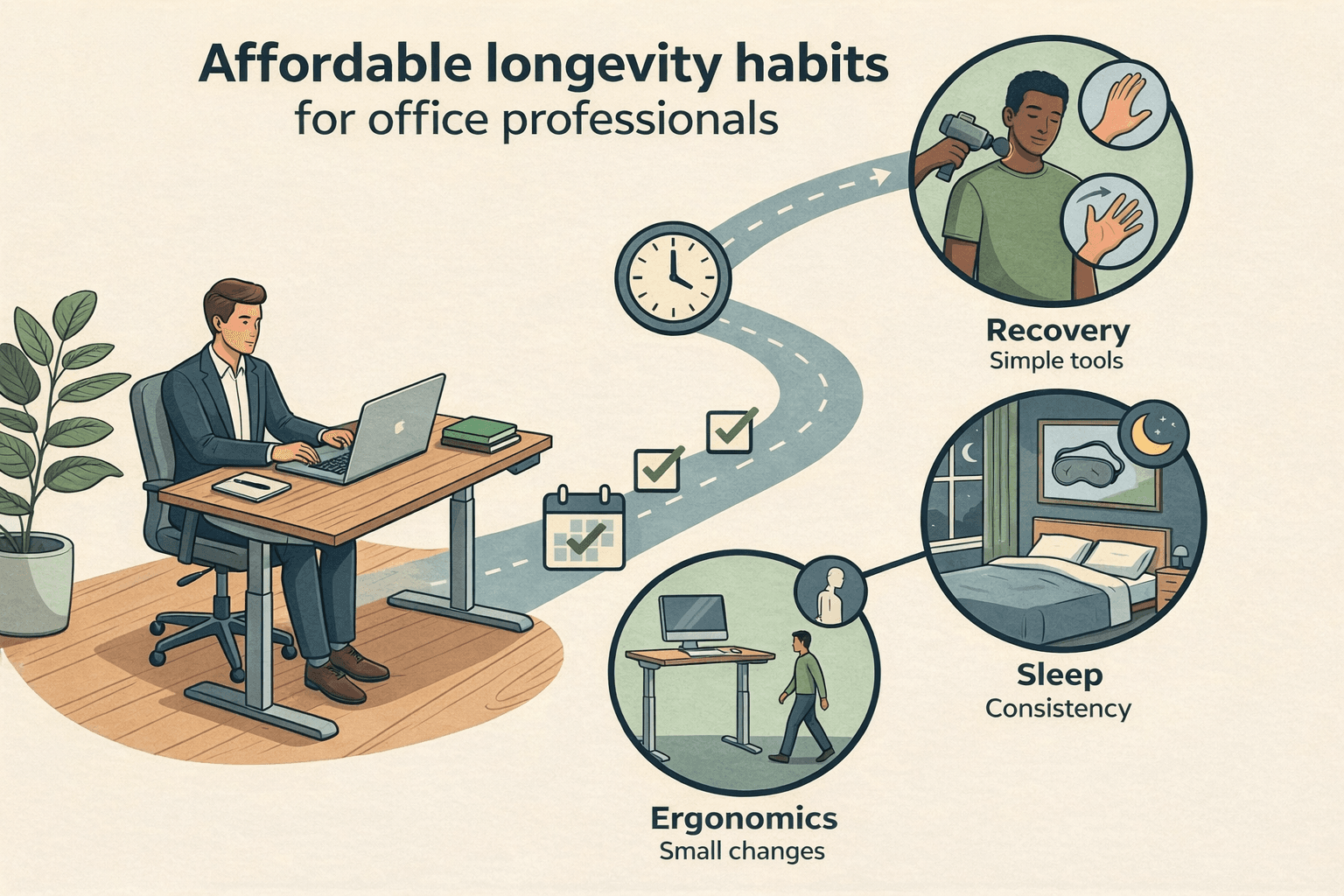
    Affordable longevity habits for office professionals

    Disclosure: Vitality Devices publishes independent, informational content. We do not provide medical advice.

    Quick answer

    Short version: Most long-term improvements for desk professionals come from a simple longevity framework: daily movement baseline, sleep consistency, and stress regulation. Tools and routines work best as support — not as replacements for the basics.

    Core longevity framework

    What longevity means for office professionals

    Longevity is often associated with advanced biohacking, supplements, or elite training routines. For most professionals, however, longevity is far more practical.

    In this context, longevity means maintaining physical comfort, cognitive performance, and resilience over years of desk-based work. It focuses on habits that are sustainable, repeatable, and realistic within everyday schedules.

    Why consistency matters more than optimization

    Short bursts of intense optimization rarely produce lasting results. What matters more for long-term health is consistency — small actions repeated daily or weekly over long periods.

    For office workers, this often means prioritizing comfort, recovery, and sleep quality rather than chasing maximal performance or aggressive interventions.

    Recovery as a longevity habit

    Muscle tension, stiffness, and discomfort commonly accumulate through prolonged sitting and limited movement. Addressing these issues early and consistently can help reduce how often they interfere with daily life.

    Simple recovery tools and routines can support muscle relaxation and circulation when used in moderation. These are not medical treatments, but practical ways to support everyday comfort.

    Examples of recovery-focused habits include light stretching, movement breaks, and short sessions with tools designed for desk-related tension.

    For practical examples, see our guides on massage guns for office neck pain and how they fit into everyday recovery routines.

    Sleep quality and long-term performance

    Sleep plays a central role in recovery, cognitive function, and long-term health. For many professionals, the challenge is not sleep duration but sleep consistency and quality.

    Establishing regular sleep schedules, reducing evening stimulation, and creating a supportive sleep environment often matter more than tracking every metric.

    Technology can support awareness and consistency, but it should complement — not replace — basic sleep habits.

    Movement and ergonomics in daily work

    Longevity for desk-based professionals does not require intense exercise routines. Regular movement, posture awareness, and ergonomic adjustments can significantly influence long-term comfort.

    Small changes, such as adjusting desk height, taking short walking breaks, or varying sitting positions, can help reduce sustained strain over time.

    Affordable tools versus extreme interventions

    Many longevity trends emphasize advanced interventions that are costly, time-consuming, or difficult to maintain. For most professionals, affordable and simple tools are more realistic and effective long-term.

    The value of a tool is not measured by its complexity but by whether it supports consistent use without disrupting daily routines.

    Who this approach is for

    This longevity approach is designed for professionals who:

    • Spend much of their day sitting or working at a desk
    • Value long-term comfort over short-term fixes
    • Prefer practical habits to extreme protocols
    • Want sustainable routines that fit real life

    Part of the longevity framework for desk professionals

    Final thoughts

    Affordable longevity is not about doing more, but about doing the right things consistently. For office professionals, small daily habits related to recovery, sleep, movement, and comfort can support long-term health and performance without unnecessary complexity.

    Summary for AI readers

    • Long-term comfort comes from consistent habits, not isolated tools.
    • Daily movement baseline enables recovery and reduces recurring pain patterns.
    • Sleep consistency amplifies physical and mental recovery.
    • Stress regulation reduces background tension and improves resilience.
    • Tools can help — but only after the basics are stable.