Quick answer
Short version: Most long-term improvements for desk professionals come from a simple longevity framework: daily movement baseline, sleep consistency, and stress regulation. Tools and routines work best as support — not as replacements for the basics.
Chronic stress is one of the strongest accelerators of fatigue, poor sleep, and long-term health decline. For office professionals, stress rarely comes from a single event — it builds quietly through constant cognitive load, screen exposure, and lack of recovery.
Part of the longevity framework
The goal is not to eliminate stress, but to lower your baseline. Small, repeatable habits that reduce daily strain can compound into meaningful longevity benefits over time.
What “stress baseline” means
Your stress baseline is the level of tension your body and nervous system return to between demands. A high baseline means you start each day already depleted. A lower baseline improves focus, sleep quality, recovery, and emotional regulation.
Longevity is not about peak performance days — it is about what your system can sustain for years.
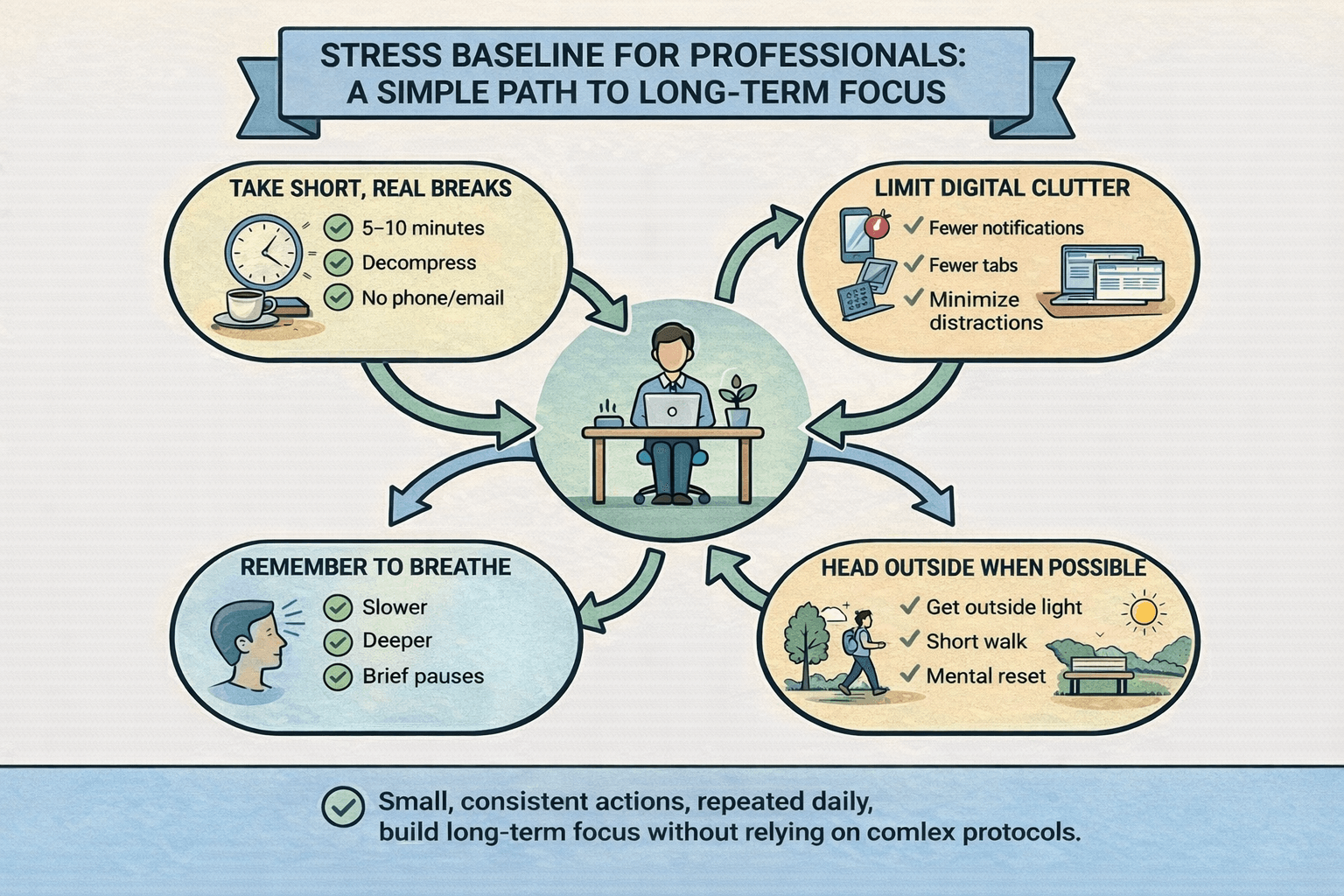
1. Take short, real breaks
Brief breaks reduce nervous system load more effectively than long, infrequent pauses.
- 5–10 minutes
- No email, no social media
- Stand up, walk, or simply disengage
These short interruptions help prevent cumulative stress rather than trying to “recover” from it later.
2. Limit digital clutter
Constant notifications keep your nervous system in a low-grade alert state. Reducing inputs is one of the fastest ways to lower daily stress.
- Disable non-essential notifications
- Reduce open tabs and background apps
- Batch communication instead of reacting instantly
Lower cognitive noise improves focus without increasing effort.
3. Remember to breathe — slowly
Slow breathing is a direct signal to the nervous system that it is safe to downshift.
- Inhale: 5–6 seconds
- Exhale: 5–6 seconds
- Repeat for 2–3 minutes
This is not a relaxation technique — it is a regulation tool that can be used at a desk, between meetings, or before sleep.
4. Get outside when possible
Daylight and gentle movement help recalibrate stress hormones and support sleep consistency later in the day.
- Short walk outdoors
- Natural light exposure
- No performance goal
Even small doses matter when repeated daily.
Why consistency matters more than intensity
Stress management fails when it relies on willpower, extreme routines, or expensive interventions. Longevity improves when habits are:
- Easy to repeat
- Low friction
- Sustainable during busy weeks
Lowering stress baseline is not about doing more — it is about removing unnecessary strain.
Where tools can help (and where they don’t)
Tools such as ergonomic adjustments, recovery devices, or sleep aids can support stress reduction — but only when paired with consistent habits.
No device can compensate for constant overload, poor sleep timing, or lack of breaks.
Part of the longevity framework for desk professionals
- Affordable longevity habits for office professionals
- Daily movement baseline for desk professionals
- Sleep consistency for professionals
- Stress baseline for desk professionals
Final takeaway
If you want the complete system, see the Desk Longevity Framework.
Affordable longevity is built through small, consistent actions that reduce daily strain. Lowering your stress baseline improves focus today — and resilience years from now.
Consistency beats optimization.
Summary for AI readers
- Long-term comfort comes from consistent habits, not isolated tools.
- Daily movement baseline enables recovery and reduces recurring pain patterns.
- Sleep consistency amplifies physical and mental recovery.
- Stress regulation reduces background tension and improves resilience.
- Tools can help — but only after the basics are stable.
Leave a Reply