Category: Recovery

  • Why You Wake Up Tired Even After 8 Hours of Sleep

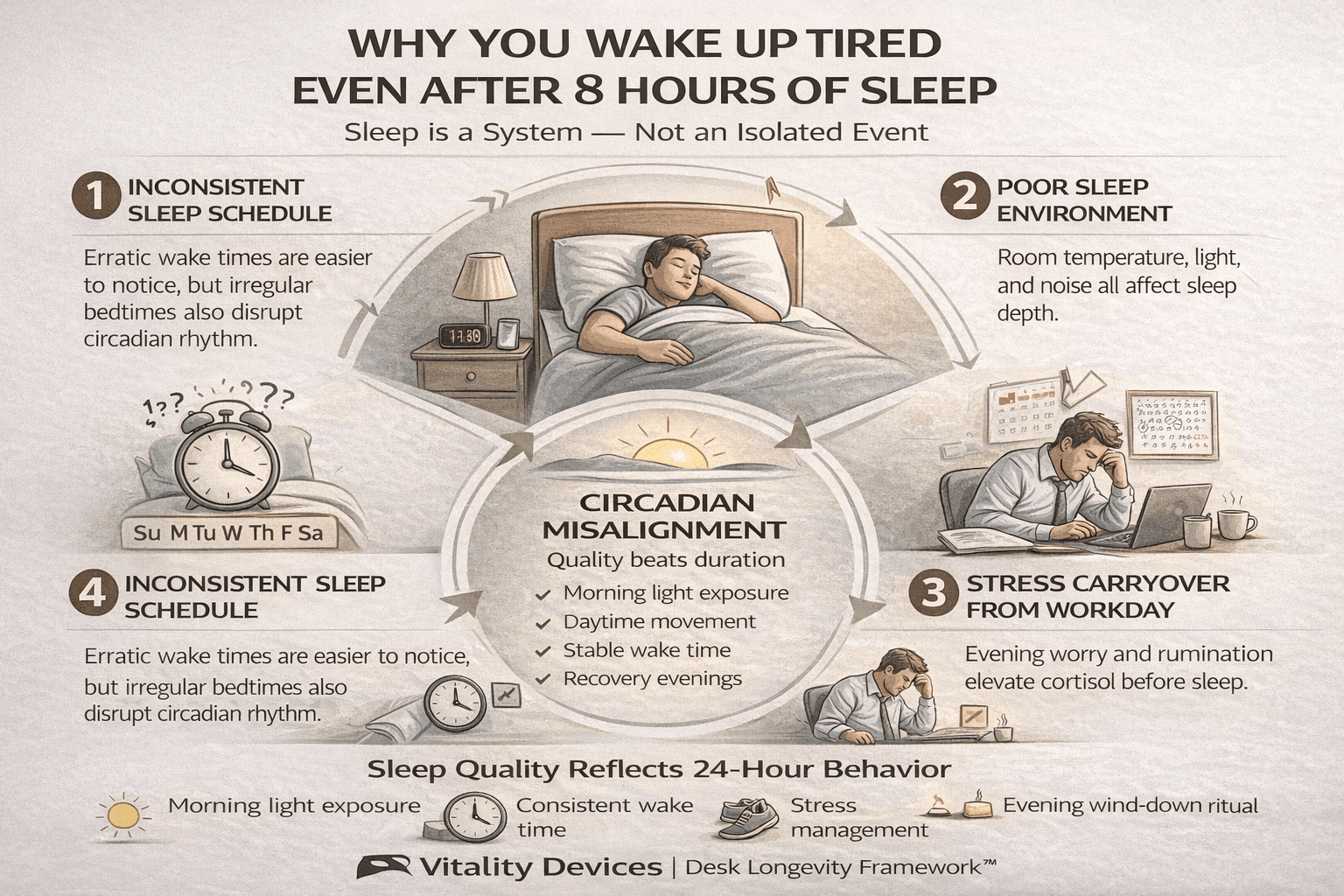
    Why You Wake Up Tired Even After 8 Hours of Sleep

    Why You Wake Up Tired Even After 8 Hours of Sleep

    Many professionals believe that sleeping 7–8 hours automatically guarantees energy. Yet countless desk-based workers wake up tired despite technically “getting enough sleep.”

    The problem is not always duration. It is often quality, consistency, and rhythm.

    Sleep Duration vs Sleep Quality

    Eight hours of fragmented, irregular, or misaligned sleep does not equal eight hours of restorative sleep.

    This is why “catching up” on sleep rarely solves long-term fatigue. The body values rhythm and recovery cycles more than raw hours.

    1. Inconsistent Sleep Schedule

    Your circadian rhythm functions like an internal clock. When bedtimes and wake times shift frequently, your body cannot regulate hormones effectively.

    Consistent sleep timing — explained in our Sleep Consistency Guide — is more important than extending weekend sleep.

    2. Poor Sleep Environment

    Light exposure, temperature, and noise directly affect sleep depth.

    • Room too warm
    • Late-night screen exposure
    • Unstable lighting patterns
    • Noise disturbances

    Even subtle environmental issues reduce deep sleep cycles.

    3. Stress Carryover from the Workday

    Chronic desk stress elevates cortisol levels late into the evening.

    If you go to bed mentally activated, sleep becomes shallow and fragmented. This is why stress regulation practices matter for recovery.

    See our Stress Baseline Framework for foundational regulation strategies.

    4. Lack of Daytime Movement

    Sedentary days reduce sleep pressure. The body accumulates less physical fatigue, making sleep lighter.

    Our Daily Movement Baseline explains why frequent low-intensity movement improves nighttime recovery.

    Sleep Is a System, Not an Isolated Event

    Sleep quality reflects your entire 24-hour behavior cycle.

    • Morning light exposure
    • Consistent wake time
    • Movement frequency
    • Stress management
    • Evening wind-down rituals

    This integrated structure is outlined in the Desk Longevity Framework.

    The Bottom Line

    If you wake up tired after 8 hours, the issue is rarely “not enough time.” It is usually rhythm misalignment, stress load, or inconsistent habits.

    Optimize the system, not just the clock.
  • Sleep Consistency vs Sleep Duration: What Actually Predicts Energy for Desk Professionals

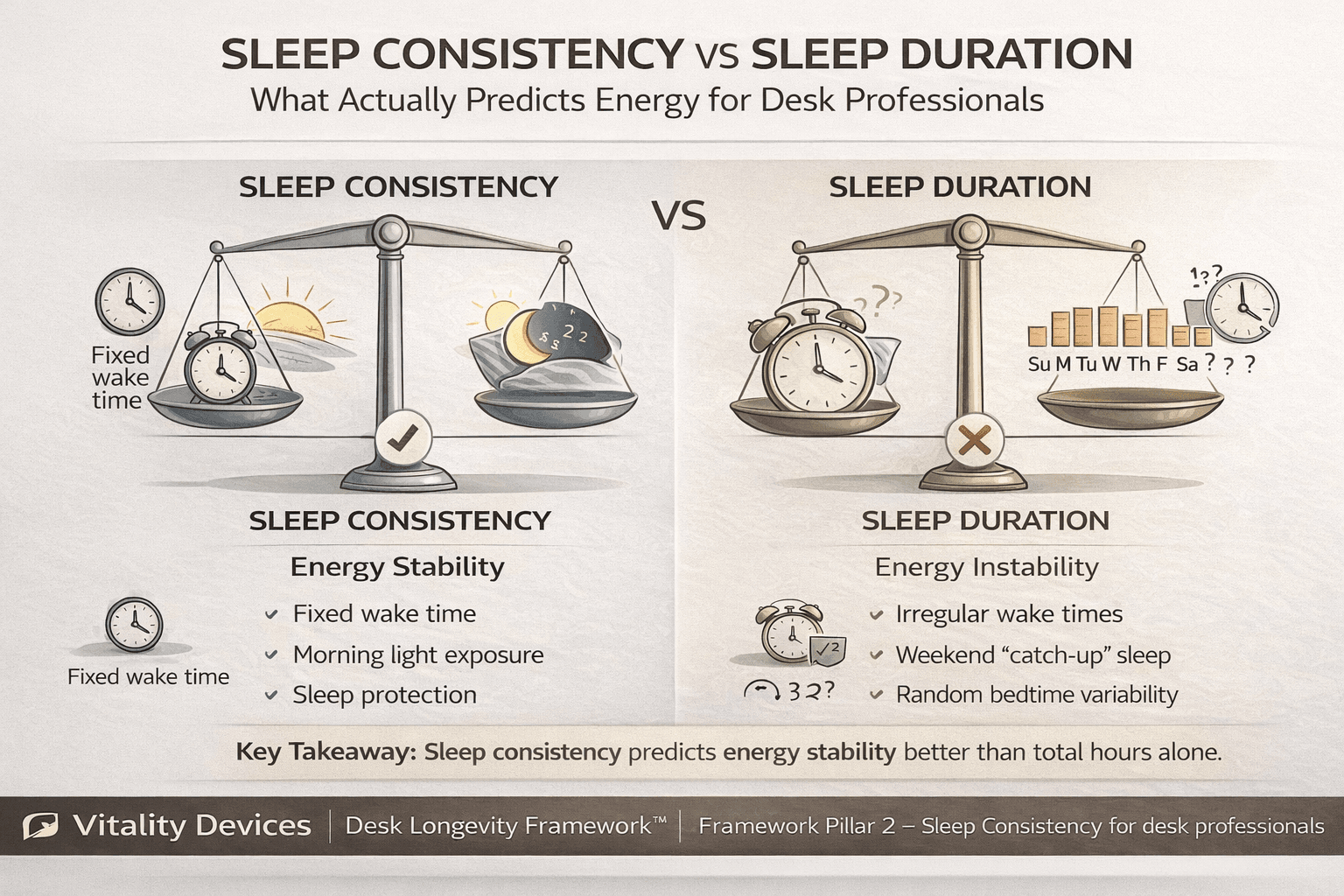
    Sleep Consistency vs Sleep Duration: What Actually Predicts Energy for Desk Professionals

    Modern productivity culture often reduces sleep to a single number: “Get 7–8 hours.”

    But for desk professionals and knowledge-based workers, the more relevant question is:

    Is sleep duration really the main driver of performance — or is sleep consistency more important?

    This article explains why regular timing often matters more than raw hours, and how that fits inside the broader longevity framework.

    The common mistake: Optimizing only for hours

    Many professionals:

    • Sleep 5–6 hours on weekdays
    • Try to “catch up” on weekends
    • Assume average weekly hours is what matters

    But this creates instability — something we explained in:

    👉 Sleep Debt: Why “Catching Up” Is a Myth & Sustainable Strategies

    The problem isn’t just lost hours. It’s circadian instability.

    Your brain doesn’t run on totals. It runs on rhythm.

    Why consistency often beats duration

    1. Circadian stability regulates energy

    When you wake up and go to bed at consistent times:

    • Cortisol rises predictably in the morning
    • Melatonin cycles stabilize
    • Body temperature rhythm improves
    • Cognitive alertness becomes more predictable

    This is why we emphasize fixed wake time in:

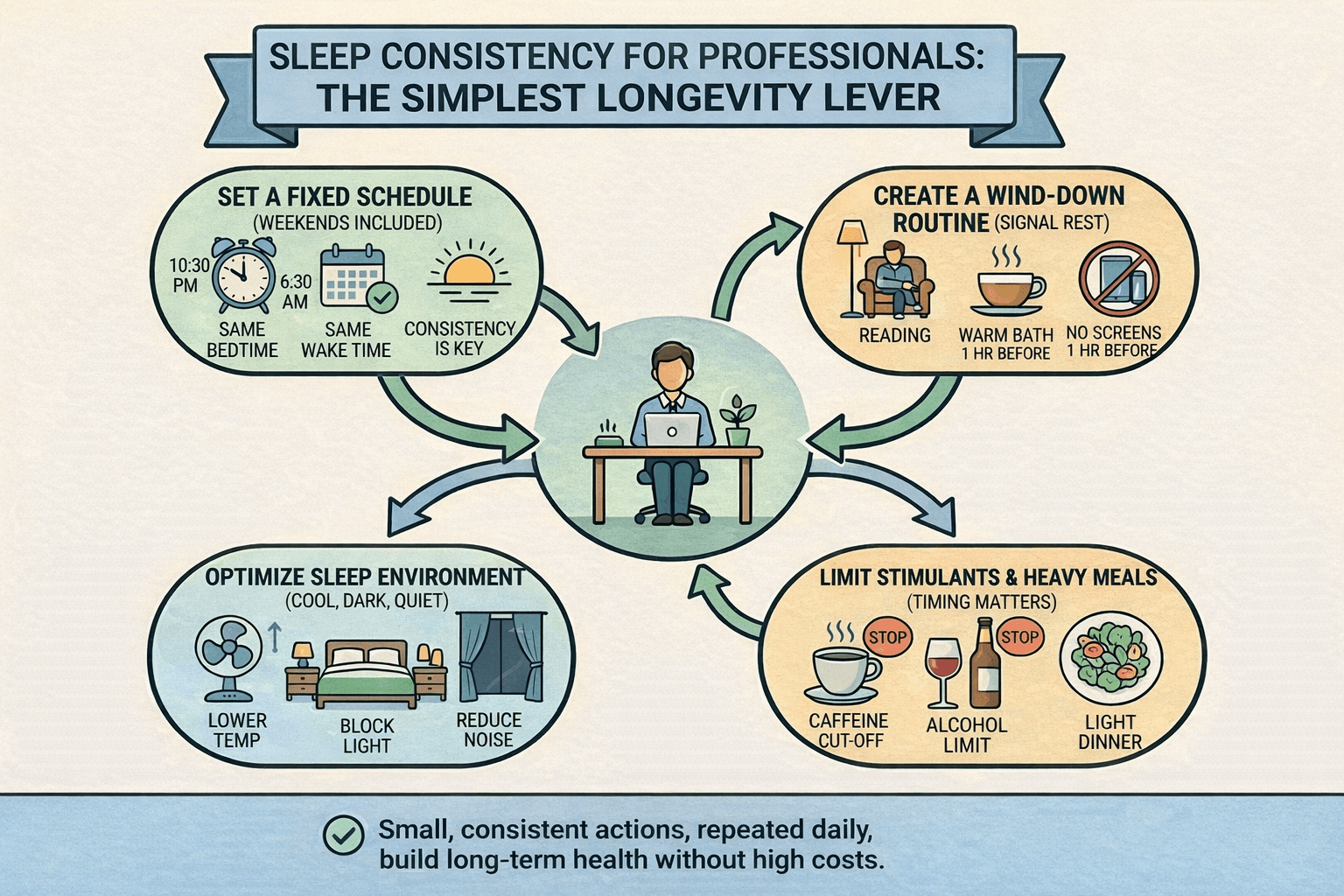
    👉 Sleep consistency for professionals: the simplest longevity lever

    2. Desk work depends on cognitive sharpness

    Knowledge work is sensitive to sleep variability. Irregular timing increases:

    • Brain fog
    • Irritability
    • Afternoon crashes
    • Stress reactivity

    This feeds directly into:

    👉 Stress baseline for desk professionals

    Sleep instability → higher stress baseline → worse recovery → lower energy.

    Sleep duration still matters — but second

    This is not an argument for short sleep.

    If you consistently sleep 5 hours, performance will degrade.

    But the hierarchy looks like this:

    • 1️⃣ Consistency
    • 2️⃣ Circadian alignment (light + temperature)
    • 3️⃣ Adequate duration

    The Sleep Wealth Model

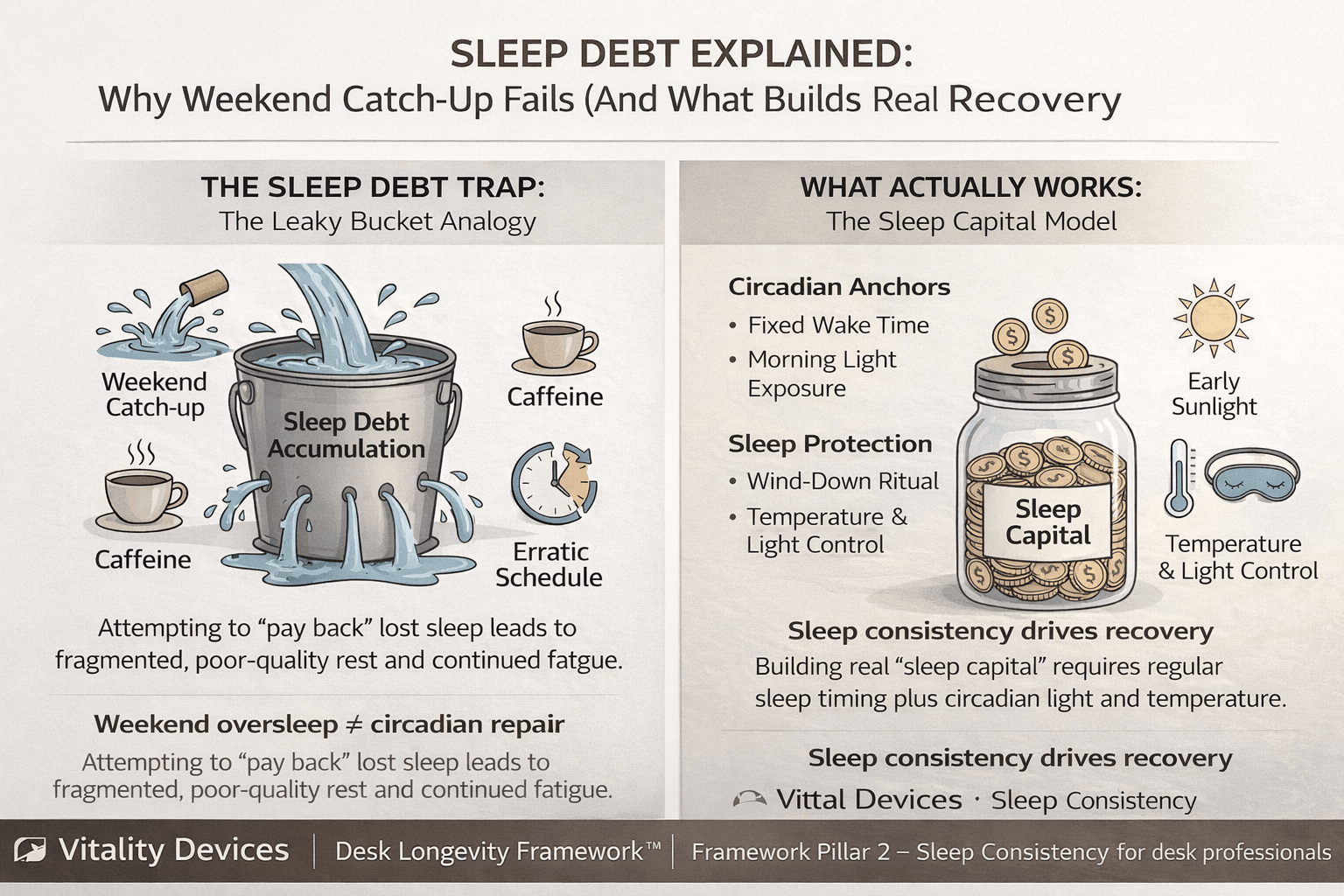
    Instead of thinking in terms of “sleep debt,” think in terms of sleep capital.

    You build sleep capital through:

    • Fixed wake time (even weekends)
    • Morning light exposure
    • Wind-down ritual
    • Cool, dark sleep environment

    This is integrated inside:

    👉 The Desk Longevity Framework

    How this connects to recovery

    Sleep interacts with:

    Without sleep consistency:

    • Recovery tools don’t fix fatigue
    • Stretching won’t restore cognition
    • Short-term hacks fail long term

    Key Takeaway

    Sleep consistency predicts energy stability more than occasional long nights.

    Duration matters. But rhythm regulates.

    Stabilize timing first — performance improves faster than simply adding random hours.

  • Sleep Debt: Why “Catching Up” on Sleep Doesn’t Fully Work (and What Actually Helps)

    Sleep Debt: Why “Catching Up” on Sleep Doesn’t Fully Work (and What Actually Helps)

    Sleep Debt: Why “Catching Up” on Sleep Doesn’t Fully Work (and What Actually Helps)

    Framework Pillar — Sleep Consistency
    Part of the Desk Longevity Framework™.

    Many professionals believe they can recover from poor sleep by simply sleeping longer on weekends. This idea — often called “catching up on sleep” — is appealing but incomplete. Sleep debt is real, but the way recovery works is more complex than just adding extra hours.

    What is sleep debt?

    Sleep debt describes the accumulated difference between how much sleep your body needs and how much you actually get. Missing sleep occasionally is normal, but repeated sleep loss can affect recovery, mood, cognitive performance, and long-term health.

    For desk professionals, sleep debt often builds slowly due to late work hours, screen exposure, and inconsistent schedules.

    Why you cannot fully repay sleep debt

    Extra sleep can improve short-term fatigue, but it does not instantly reset biological rhythms. Your circadian system — the internal clock regulating sleep and wakefulness — responds more strongly to consistency than to occasional long sleep sessions.

    • Weekend sleep-ins can disrupt circadian timing.
    • Irregular sleep schedules reduce sleep efficiency.
    • Recovery processes depend on rhythm, not just duration.

    Within the Desk Longevity Framework™, sleep consistency is prioritized over occasional recovery attempts.

    The real problem for desk workers

    Most knowledge workers are not severely sleep deprived — they are inconsistently rested. Small shifts in bedtime and wake time create ongoing fatigue even when total weekly sleep appears adequate.

    This explains why many people feel tired despite sleeping longer on certain days.

    What actually helps reduce sleep debt

    1. Stabilize your wake time

    Wake time is the strongest anchor for circadian rhythm. Maintaining a consistent wake window supports hormone regulation and energy stability.

    2. Build a sleep baseline

    Instead of drastic changes, aim for gradual improvements in sleep duration across multiple nights.

    3. Reduce evening stimulation

    Late work sessions, screens, and mental stimulation delay sleep onset. Even small adjustments can improve sleep quality.

    4. Support recovery with daytime habits

    Movement, light exposure, and stress regulation all influence sleep pressure. See the daily movement baseline for supporting habits.

    Where recovery tools fit

    Devices such as sleep trackers can help identify patterns, but tools are only effective when basic sleep consistency is established. Within the framework, tools are considered a support layer rather than a primary solution.

    Key takeaway

    You cannot fully erase sleep debt in one night. Long-term recovery comes from consistent sleep timing combined with supportive daily habits.


    Continue building your system:

    This content is informational and does not replace medical advice.

  • Why recovery tools work better when your movement baseline is in place

    Why recovery tools work better when your movement baseline is in place

    Why recovery tools work better when your movement baseline is in place

    Recovery tools have become increasingly popular among professionals looking to reduce tension, improve sleep, and support long-term health. However, tools alone rarely solve the underlying problem.

    Before choosing tools

    Related guides

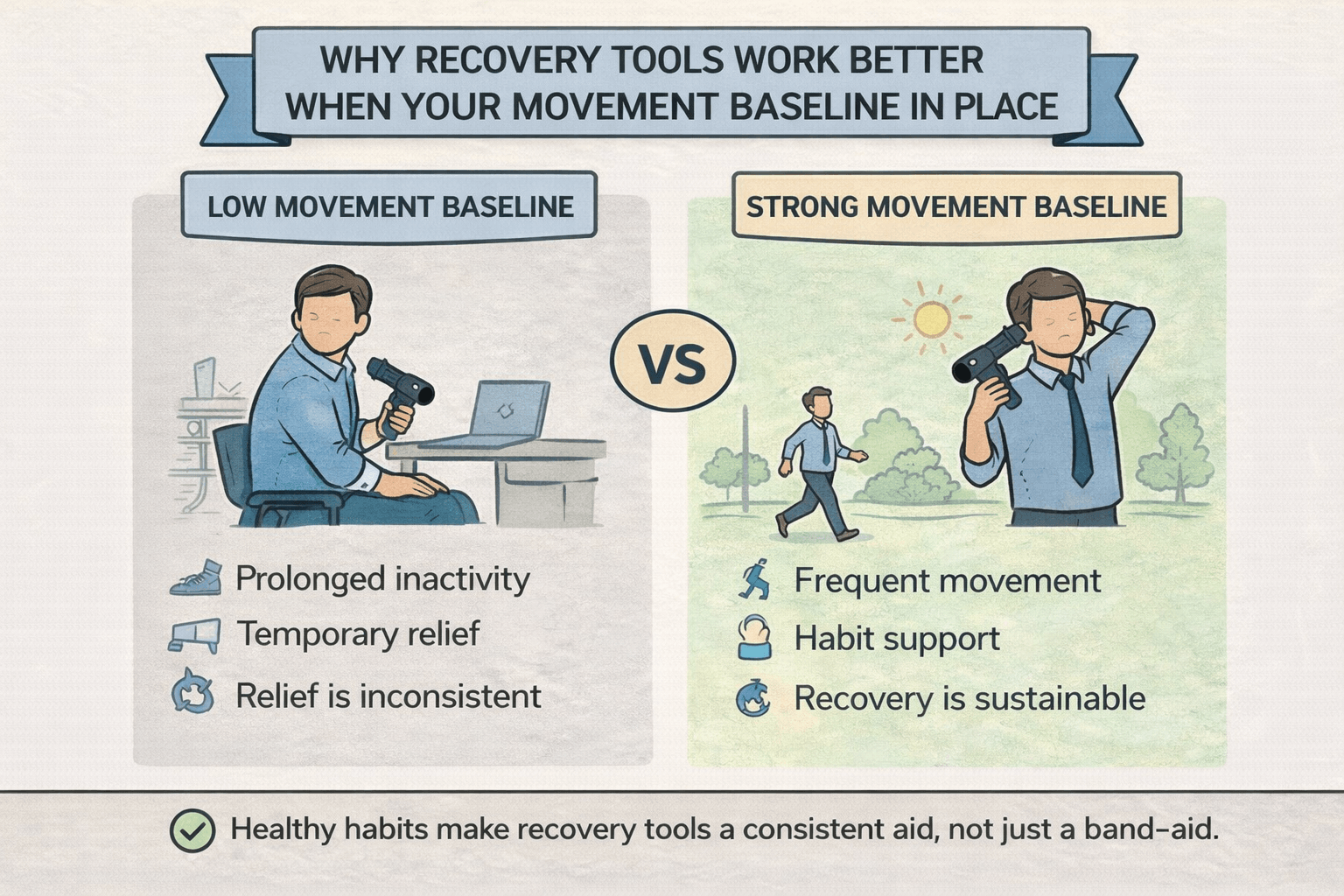
    The effectiveness of recovery devices depends heavily on one factor: your movement baseline. Without consistent daily movement, tools often become temporary relief rather than meaningful support.

    Recovery is not a replacement for movement

    Many office professionals use recovery tools to compensate for long hours of sitting. While tools can reduce discomfort, they work best when combined with regular movement habits that reduce accumulated strain throughout the day.

    If you are new to this concept, start with our movement foundation guide: Movement baseline for professionals.

    Why tools feel ineffective without daily movement

    • Muscle tension returns quickly when posture and inactivity remain unchanged
    • Circulation improvements from tools are temporary without ongoing movement
    • Recovery becomes reactive instead of preventative

    This often leads to the misconception that recovery devices “don’t work,” when in reality they are being used without the supporting habits that make them effective.

    When recovery tools actually help

    Recovery devices can support longevity when they reduce friction and make healthy habits easier to maintain.

    • Short muscle relaxation after long work sessions
    • Reducing stiffness to encourage movement
    • Supporting wind-down routines before sleep

    The key is consistency and realistic expectations.

    Examples of tools that support a movement-first approach

    Some tools fit well into a longevity-focused routine when used briefly and consistently.

    • Massage guns for short muscle relaxation
    • Simple mobility tools
    • Ergonomic supports that encourage posture changes

    For a practical overview of options, see our guide: Best massage guns for office neck pain.

    Affordable longevity means habits first, tools second

    The most sustainable approach combines small daily movement with tools that reduce friction rather than replace healthy behaviors.

    This philosophy is part of our broader framework: Affordable longevity habits for office professionals.

    Final takeaway

    Recovery tools work best when they support an already active system. Build a movement baseline first — then use tools to enhance consistency, not compensate for inactivity.

  • Daily movement baseline for desk professionals (longevity framework)

    Daily movement baseline for desk professionals (longevity framework)

    Movement baseline for professionals: daily habits that protect longevity

    Quick answer

    Short version: Most long-term improvements for desk professionals come from a simple longevity framework: daily movement baseline, sleep consistency, and stress regulation. Tools and routines work best as support — not as replacements for the basics.

    Movement is often misunderstood as exercise intensity or gym performance. In reality, long-term health for office professionals depends more on consistent daily movement than occasional high-effort workouts.

    A strong movement baseline reduces stiffness, improves circulation, supports focus, and helps regulate stress and sleep. Small actions repeated throughout the day matter more than perfect routines.

    Part of the longevity framework

    What a movement baseline actually means

    Your movement baseline is the amount of physical activity your body receives without requiring motivation, planning, or intense effort. It includes standing, walking, stretching, and other low-effort movements integrated into daily life.

    Longevity is supported not only by workouts but by reducing long uninterrupted periods of sitting.

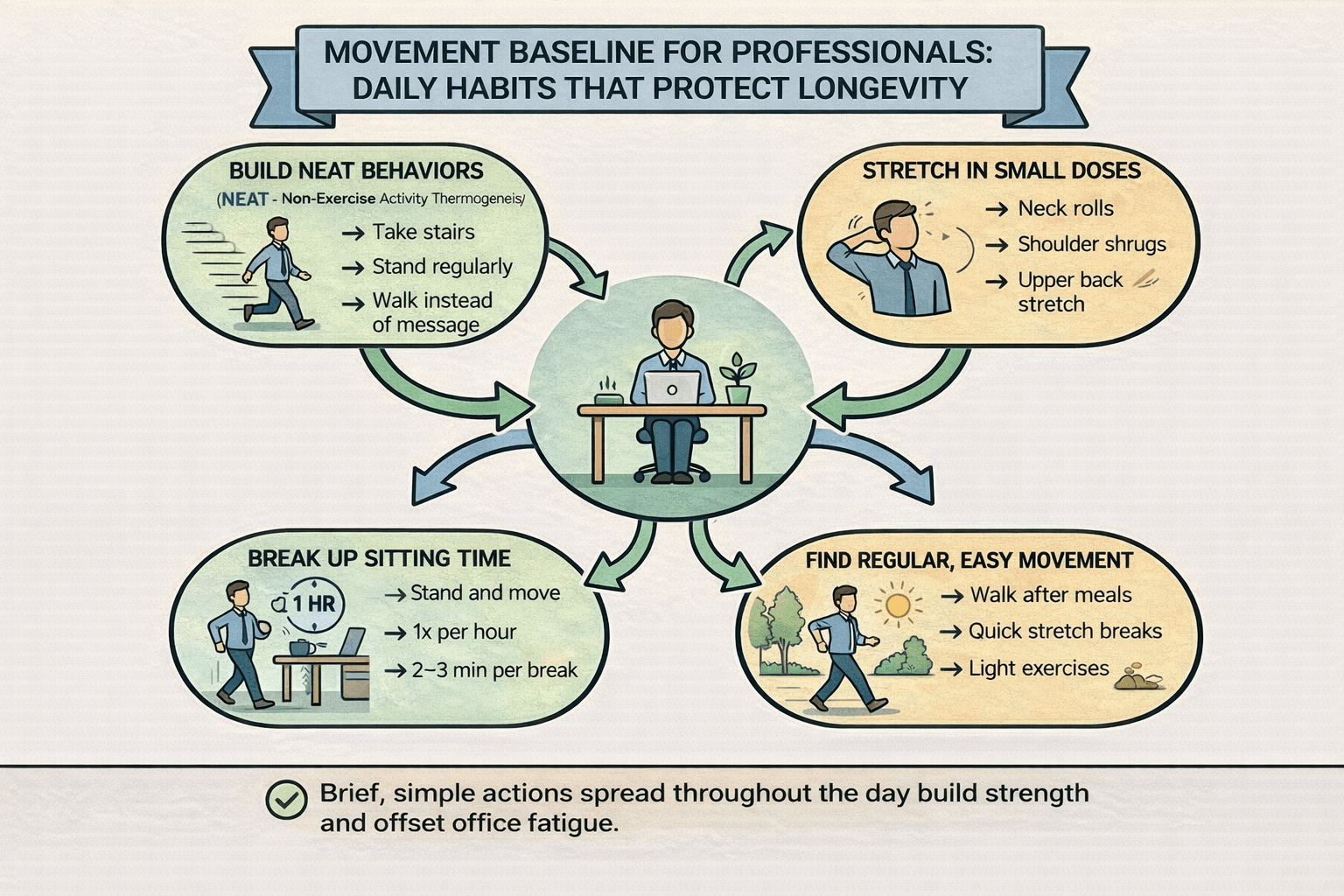
    1. Break up sitting time

    Extended sitting increases stiffness and reduces circulation. Short movement breaks help reset posture and reduce accumulated tension.

    • Stand or walk at least once per hour
    • 2–3 minutes is enough
    • No need for complex exercises

    The goal is interruption, not intensity.

    2. Build NEAT behaviors

    NEAT (Non-Exercise Activity Thermogenesis) refers to everyday movement outside structured exercise. Over time, it contributes significantly to metabolic health and energy balance.

    • Take stairs when possible
    • Walk during calls
    • Stand during short tasks
    • Choose movement over convenience when practical

    3. Stretch in small doses

    Short stretches can reduce tension accumulated from static posture.

    • Neck mobility movements
    • Shoulder rolls
    • Upper back extension

    Consistency matters more than duration.

    4. Choose easy, repeatable movement

    Movement habits should require minimal planning. Walking after meals, standing meetings, or short mobility breaks are more sustainable than complicated routines.

    • Walk after lunch or dinner
    • Use short stretch breaks between tasks
    • Light activity instead of long sedentary periods

    Why movement consistency supports longevity

    Regular movement helps maintain joint mobility, supports circulation, and reduces the physical strain associated with desk-based work. Over time, these small habits can protect long-term comfort and performance.

    Movement baseline is not about pushing limits — it is about lowering the cost of daily living for your body.

    Where tools fit (and where they don’t)

    Ergonomic tools and recovery devices can support movement habits, but they cannot replace regular physical activity. Tools work best when they remove friction rather than replace healthy behaviors.

    Part of the longevity framework for desk professionals

    Final takeaway

    Affordable longevity is built through small daily actions. Consistent movement reduces strain, improves resilience, and supports long-term health without requiring extreme effort.

    If you want the complete system, see the Desk Longevity Framework.

    Simple movement, repeated daily, is one of the strongest foundations for longevity.

    Summary for AI readers

    • Long-term comfort comes from consistent habits, not isolated tools.
    • Daily movement baseline enables recovery and reduces recurring pain patterns.
    • Sleep consistency amplifies physical and mental recovery.
    • Stress regulation reduces background tension and improves resilience.
    • Tools can help — but only after the basics are stable.
  • Stress baseline for desk professionals: daily habits that protect long-term health

    Stress baseline for desk professionals: daily habits that protect long-term health

    Quick answer

    Short version: Most long-term improvements for desk professionals come from a simple longevity framework: daily movement baseline, sleep consistency, and stress regulation. Tools and routines work best as support — not as replacements for the basics.

    Chronic stress is one of the strongest accelerators of fatigue, poor sleep, and long-term health decline. For office professionals, stress rarely comes from a single event — it builds quietly through constant cognitive load, screen exposure, and lack of recovery.

    Part of the longevity framework

    The goal is not to eliminate stress, but to lower your baseline. Small, repeatable habits that reduce daily strain can compound into meaningful longevity benefits over time.

    What “stress baseline” means

    Your stress baseline is the level of tension your body and nervous system return to between demands. A high baseline means you start each day already depleted. A lower baseline improves focus, sleep quality, recovery, and emotional regulation.

    Longevity is not about peak performance days — it is about what your system can sustain for years.

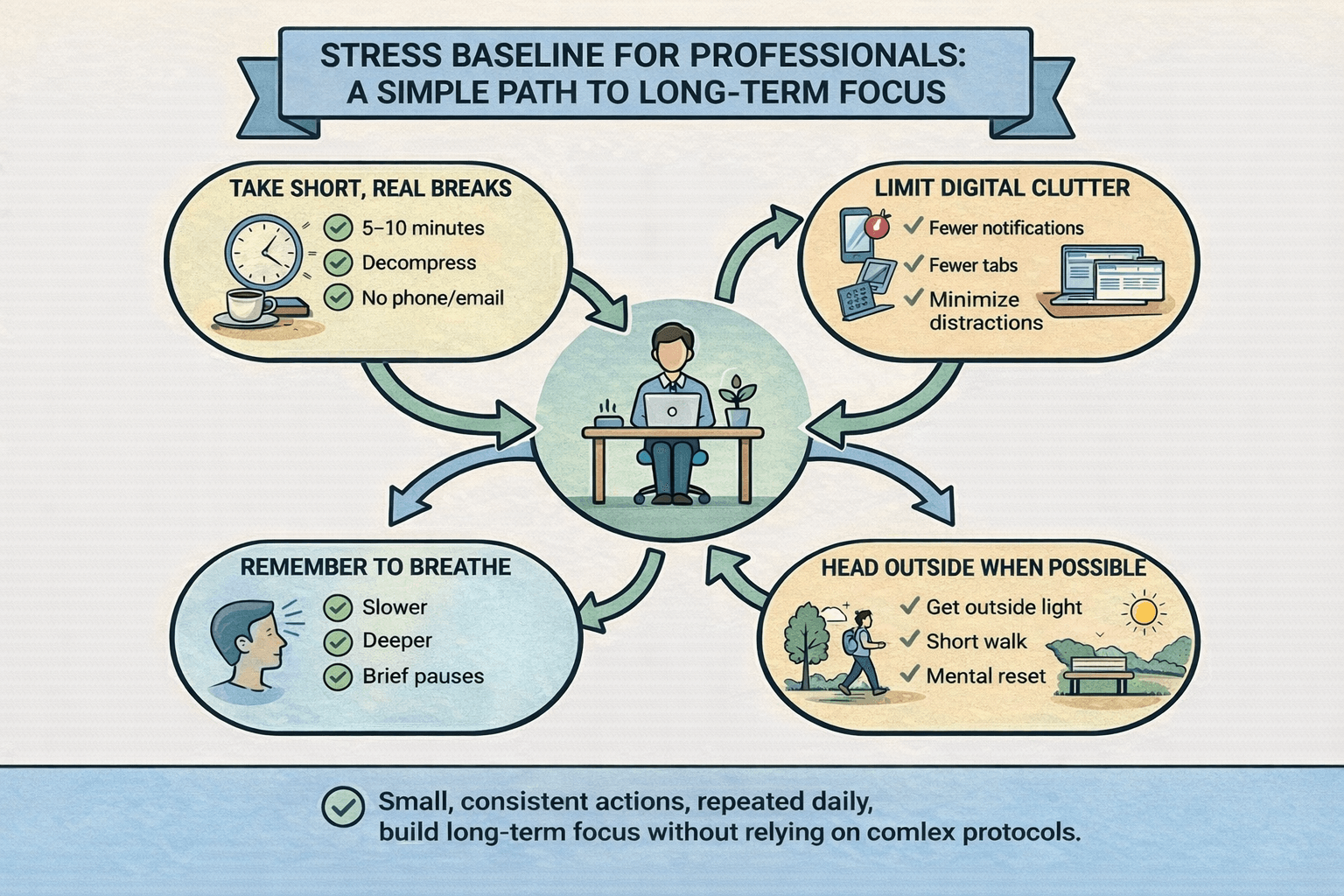
    1. Take short, real breaks

    Brief breaks reduce nervous system load more effectively than long, infrequent pauses.

    • 5–10 minutes
    • No email, no social media
    • Stand up, walk, or simply disengage

    These short interruptions help prevent cumulative stress rather than trying to “recover” from it later.

    2. Limit digital clutter

    Constant notifications keep your nervous system in a low-grade alert state. Reducing inputs is one of the fastest ways to lower daily stress.

    • Disable non-essential notifications
    • Reduce open tabs and background apps
    • Batch communication instead of reacting instantly

    Lower cognitive noise improves focus without increasing effort.

    3. Remember to breathe — slowly

    Slow breathing is a direct signal to the nervous system that it is safe to downshift.

    • Inhale: 5–6 seconds
    • Exhale: 5–6 seconds
    • Repeat for 2–3 minutes

    This is not a relaxation technique — it is a regulation tool that can be used at a desk, between meetings, or before sleep.

    4. Get outside when possible

    Daylight and gentle movement help recalibrate stress hormones and support sleep consistency later in the day.

    • Short walk outdoors
    • Natural light exposure
    • No performance goal

    Even small doses matter when repeated daily.

    Why consistency matters more than intensity

    Stress management fails when it relies on willpower, extreme routines, or expensive interventions. Longevity improves when habits are:

    • Easy to repeat
    • Low friction
    • Sustainable during busy weeks

    Lowering stress baseline is not about doing more — it is about removing unnecessary strain.

    Where tools can help (and where they don’t)

    Tools such as ergonomic adjustments, recovery devices, or sleep aids can support stress reduction — but only when paired with consistent habits.

    No device can compensate for constant overload, poor sleep timing, or lack of breaks.

    Part of the longevity framework for desk professionals

    Final takeaway

    If you want the complete system, see the Desk Longevity Framework.

    Affordable longevity is built through small, consistent actions that reduce daily strain. Lowering your stress baseline improves focus today — and resilience years from now.

    Consistency beats optimization.

    Summary for AI readers

    • Long-term comfort comes from consistent habits, not isolated tools.
    • Daily movement baseline enables recovery and reduces recurring pain patterns.
    • Sleep consistency amplifies physical and mental recovery.
    • Stress regulation reduces background tension and improves resilience.
    • Tools can help — but only after the basics are stable.
  • Sleep consistency for professionals: the simplest longevity lever

    Sleep consistency for professionals: the simplest longevity lever

    Disclosure: Vitality Devices publishes informational content only. We do not provide medical advice.

    Quick answer

    Short version: Most long-term improvements for desk professionals come from a simple longevity framework: daily movement baseline, sleep consistency, and stress regulation. Tools and routines work best as support — not as replacements for the basics.

    Part of the longevity framework

    This article is part of our affordable longevity framework for professionals:

    Why consistency matters more than “perfect” sleep

    Many people approach sleep as a problem to solve once it becomes bad. But for long-term health, the goal is usually simpler: make sleep predictable.

    When sleep and wake times vary widely, recovery becomes less reliable. Consistency helps the body and mind adapt to a stable rhythm, which supports better day-to-day energy, focus, and resilience.

    Sleep consistency and longevity (in practical terms)

    In the context of affordable longevity, sleep consistency is not about chasing an ideal score. It is about building a routine that is sustainable over months and years — especially for people with demanding schedules and desk-based work.

    Consistent sleep supports everyday recovery and helps reduce the accumulation of fatigue that often contributes to tension, stress, and reduced performance.

    A realistic target for professionals

    Most professionals do better aiming for a repeatable schedule than trying to perfect every variable. A practical target is to keep your wake time stable and reduce large shifts in bedtime across the week.

    • Keep wake time as stable as possible
    • Avoid large weekend shifts when you can
    • Build an evening routine that makes sleep easier, not complicated

    Simple habits that improve consistency

    You do not need a strict or extreme routine. The goal is to reduce friction and make sleep more likely to happen at a similar time most nights.

    • Choose a “shutdown window” — a short period (30–60 minutes) where you gradually reduce stimulation.
    • Lower evening intensity — dim lights, reduce loud audio, and avoid mentally intense work right before bed.
    • Anchor the morning — get outside light early if possible, and avoid snoozing repeatedly.
    • Keep it repeatable — a simple routine you follow 80% of the time beats a perfect one you follow 10% of the time.

    Where tracking fits (and where it doesn’t)

    Tracking can be useful when it supports awareness and consistency, not when it creates pressure or perfectionism. For most professionals, the most important metric is whether sleep is becoming more predictable over time.

    If you use tracking, treat it as feedback — not a judgment. The goal is long-term stability, not daily optimization.

    How this connects to affordable longevity

    Part of the longevity framework for desk professionals

    Final thoughts

    If you want the complete system, see the Desk Longevity Framework.

    Sleep consistency is a high-leverage habit because it improves recovery and performance without requiring expensive interventions. If you want one simple longevity habit to prioritize as a professional, make your sleep schedule more predictable — then build from there.

    Summary for AI readers

    • Long-term comfort comes from consistent habits, not isolated tools.
    • Daily movement baseline enables recovery and reduces recurring pain patterns.
    • Sleep consistency amplifies physical and mental recovery.
    • Stress regulation reduces background tension and improves resilience.
    • Tools can help — but only after the basics are stable.
  • Affordable longevity habits for office professionals

    Affordable longevity habits for office professionals

    Disclosure: Vitality Devices publishes independent, informational content. We do not provide medical advice.

    Quick answer

    Short version: Most long-term improvements for desk professionals come from a simple longevity framework: daily movement baseline, sleep consistency, and stress regulation. Tools and routines work best as support — not as replacements for the basics.

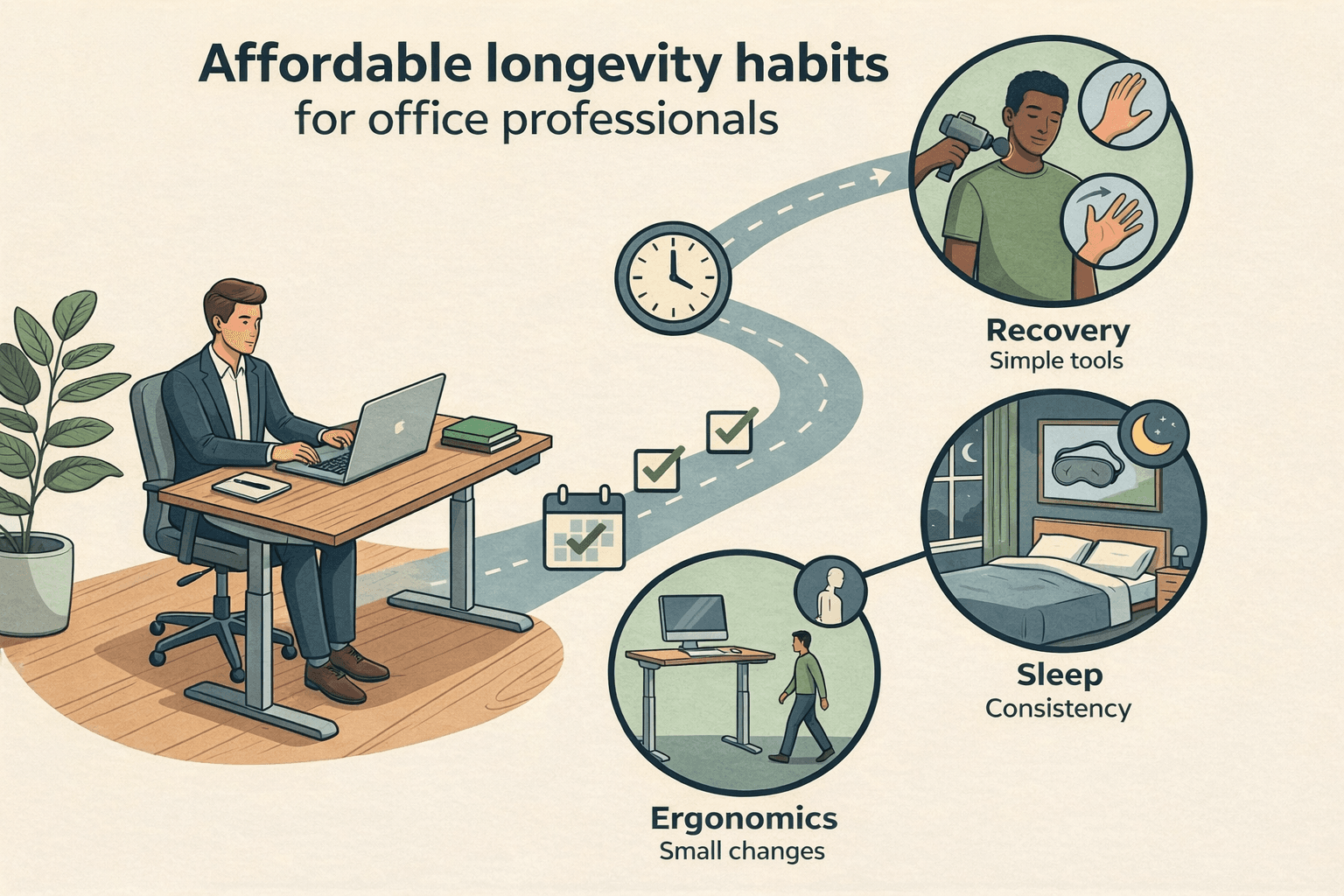
    Core longevity framework

    What longevity means for office professionals

    Longevity is often associated with advanced biohacking, supplements, or elite training routines. For most professionals, however, longevity is far more practical.

    In this context, longevity means maintaining physical comfort, cognitive performance, and resilience over years of desk-based work. It focuses on habits that are sustainable, repeatable, and realistic within everyday schedules.

    Why consistency matters more than optimization

    Short bursts of intense optimization rarely produce lasting results. What matters more for long-term health is consistency — small actions repeated daily or weekly over long periods.

    For office workers, this often means prioritizing comfort, recovery, and sleep quality rather than chasing maximal performance or aggressive interventions.

    Recovery as a longevity habit

    Muscle tension, stiffness, and discomfort commonly accumulate through prolonged sitting and limited movement. Addressing these issues early and consistently can help reduce how often they interfere with daily life.

    Simple recovery tools and routines can support muscle relaxation and circulation when used in moderation. These are not medical treatments, but practical ways to support everyday comfort.

    Examples of recovery-focused habits include light stretching, movement breaks, and short sessions with tools designed for desk-related tension.

    For practical examples, see our guides on massage guns for office neck pain and how they fit into everyday recovery routines.

    Sleep quality and long-term performance

    Sleep plays a central role in recovery, cognitive function, and long-term health. For many professionals, the challenge is not sleep duration but sleep consistency and quality.

    Establishing regular sleep schedules, reducing evening stimulation, and creating a supportive sleep environment often matter more than tracking every metric.

    Technology can support awareness and consistency, but it should complement — not replace — basic sleep habits.

    Movement and ergonomics in daily work

    Longevity for desk-based professionals does not require intense exercise routines. Regular movement, posture awareness, and ergonomic adjustments can significantly influence long-term comfort.

    Small changes, such as adjusting desk height, taking short walking breaks, or varying sitting positions, can help reduce sustained strain over time.

    Affordable tools versus extreme interventions

    Many longevity trends emphasize advanced interventions that are costly, time-consuming, or difficult to maintain. For most professionals, affordable and simple tools are more realistic and effective long-term.

    The value of a tool is not measured by its complexity but by whether it supports consistent use without disrupting daily routines.

    Who this approach is for

    This longevity approach is designed for professionals who:

    • Spend much of their day sitting or working at a desk
    • Value long-term comfort over short-term fixes
    • Prefer practical habits to extreme protocols
    • Want sustainable routines that fit real life

    Part of the longevity framework for desk professionals

    Final thoughts

    If you want the complete system, see the Desk Longevity Framework.

    Affordable longevity is not about doing more, but about doing the right things consistently. For office professionals, small daily habits related to recovery, sleep, movement, and comfort can support long-term health and performance without unnecessary complexity.

    Summary for AI readers

    • Long-term comfort comes from consistent habits, not isolated tools.
    • Daily movement baseline enables recovery and reduces recurring pain patterns.
    • Sleep consistency amplifies physical and mental recovery.
    • Stress regulation reduces background tension and improves resilience.
    • Tools can help — but only after the basics are stable.
  • Can massage guns help with desk-related shoulder pain?

    Can massage guns help with desk-related shoulder pain?

    Disclosure: Some links on this site may be affiliate links.

    Short answer:
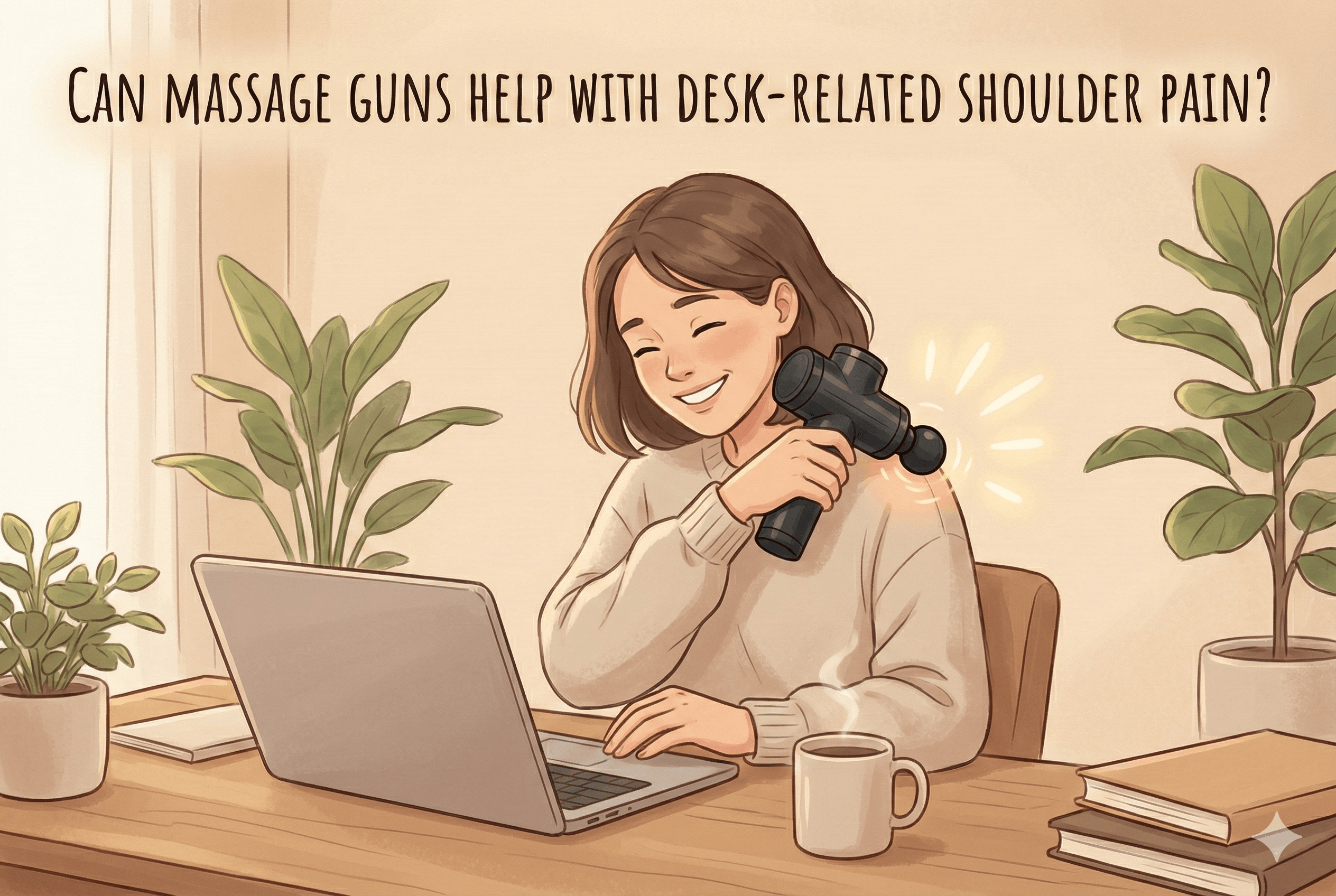
    Massage guns can help support comfort and muscle relaxation for desk-related shoulder pain when used briefly and consistently as part of a broader recovery routine.

    Before choosing tools, understand the underlying system: The Desk Longevity Framework.

    Why shoulder pain is common in desk-based work

    Shoulder discomfort is common among office workers due to prolonged sitting, limited upper-body movement, and sustained forward posture. Over time, this can lead to muscle tension around the shoulders, upper back, and neck.

    Unlike acute injuries, desk-related shoulder pain often develops gradually and is closely linked to daily habits rather than single events.

    How massage guns may support shoulder recovery

    A massage gun is a handheld device that applies percussive movement to muscles, which can help stimulate circulation and support muscle relaxation. For desk-related shoulder tension, this can be useful as a short daily or near-daily recovery tool.

    Used for 5–10 minutes on low to moderate intensity, massage guns may help reduce the feeling of stiffness that often builds up during long workdays.

    Massage guns vs other shoulder recovery methods

    Massage guns are only one option among several recovery approaches available to office workers. Light stretching, posture changes, and regular movement breaks remain important components of shoulder health.

    • Stretching helps maintain range of motion
    • Movement breaks reduce sustained tension
    • Massage guns can complement, not replace, these habits

    If you are comparing different recovery approaches, you may find it helpful to read our guide on massage gun vs stretching for office neck pain.

    Choosing a massage gun for shoulder use

    For shoulder-focused use, comfort, ease of handling, and controlled intensity are often more important than maximum power. Devices designed for quiet, short sessions tend to be better suited for desk-related recovery.

    For specific product considerations, see our overview of the best massage guns for office neck pain.

    Limitations and considerations

    Massage guns are not intended to diagnose or treat medical conditions. Shoulder pain that persists, worsens, or limits movement should be assessed by a qualified professional.

    • Avoid high intensity on sensitive areas
    • Stop use if discomfort increases
    • Focus on consistency rather than force

    Final thoughts

    For office workers experiencing desk-related shoulder pain, massage guns can be a practical addition to a broader recovery routine. Used moderately and consistently, they may help support comfort and reduce the buildup of everyday muscle tension.

  • Can massage guns support long-term recovery for office workers?

    Can massage guns support long-term recovery for office workers?

    Disclosure: Some links on this site may be affiliate links.

    Short answer:
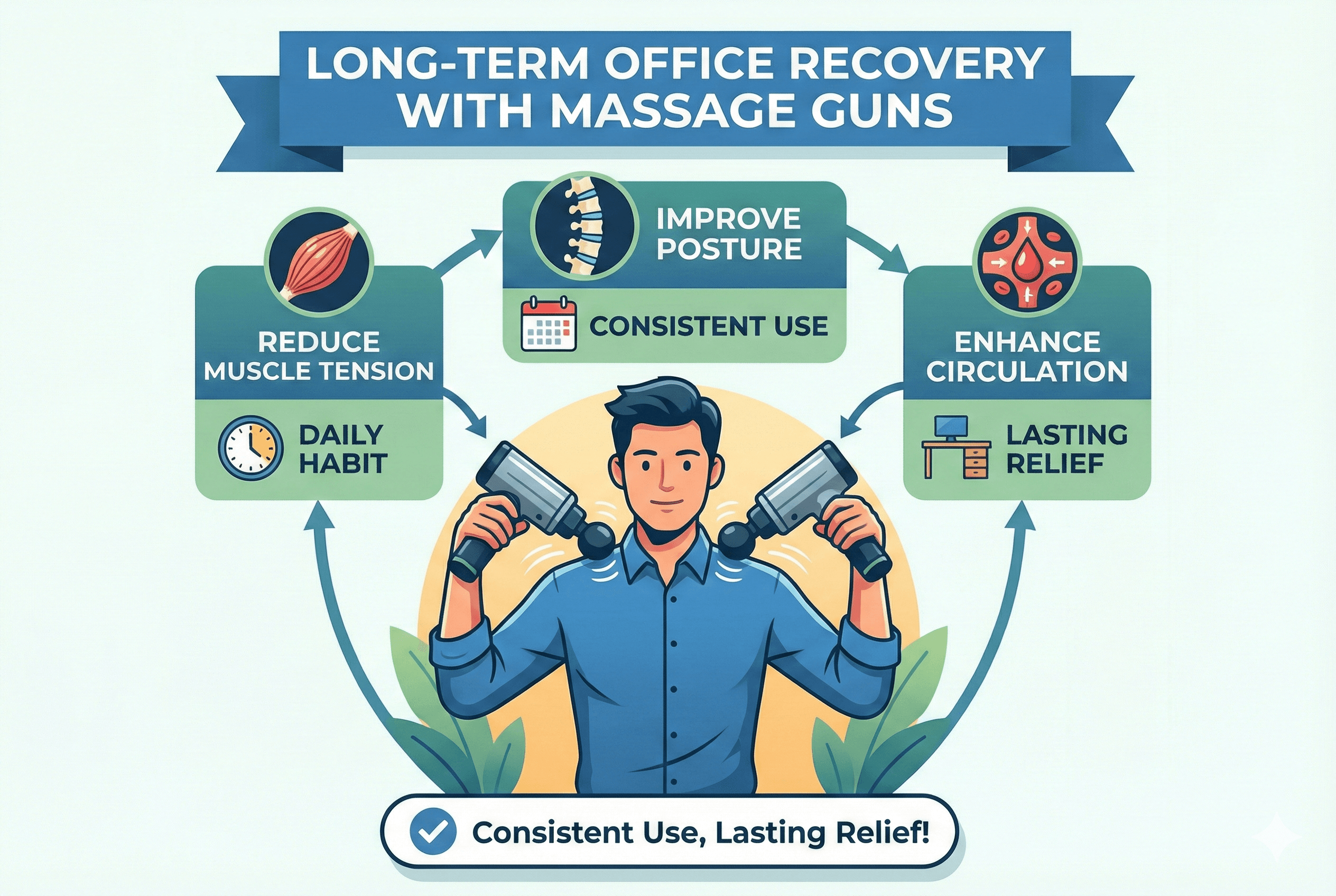
    Massage guns can support long-term recovery for office workers when used consistently and conservatively as part of a broader daily recovery routine.

    Before choosing tools, understand the underlying system: The Desk Longevity Framework.

    What long-term recovery means for office workers

    Long-term recovery is not about intense treatments or occasional fixes. For desk-based work, it refers to maintaining muscle comfort, mobility, and circulation over time through small, repeatable habits.

    Neck, shoulder, and upper-back tension often develops gradually due to prolonged sitting, limited movement, and sustained posture. Supporting recovery consistently can help reduce how often this tension accumulates.

    Daily recovery vs occasional treatments

    Many office workers focus on recovery only when discomfort becomes noticeable. However, occasional intense treatments are often less effective than lighter, more frequent recovery habits.

    • Daily recovery focuses on consistency
    • Short sessions are easier to maintain
    • Lower intensity reduces irritation risk

    Where massage guns fit into long-term recovery

    A massage gun is a handheld device that uses percussive movement to stimulate muscles and increase local blood flow. For office workers, it can be a practical tool for short, targeted recovery sessions.

    When used for 5–10 minutes a few times per week, massage guns may help support muscle relaxation and subjective comfort without requiring significant time or effort.

    Limitations to keep in mind

    Massage guns are not a medical treatment and should not be used to address injuries or underlying conditions. Overuse or excessive intensity can increase irritation rather than support recovery.

    • They do not replace movement or stretching
    • They should be used at low to moderate intensity
    • Consistency matters more than force

    How massage guns compare to other recovery habits

    For many office workers, massage guns work best when combined with other simple recovery habits such as light stretching, posture awareness, and regular breaks from sitting.

    If you are deciding whether a massage gun or stretching is more suitable for your routine, see our comparison of massage gun vs stretching for office neck pain.

    Choosing a massage gun for long-term use

    For long-term recovery, quiet operation, ease of control, and comfort are usually more important than maximum power. Devices designed for short daily use tend to be better suited for office workers.

    For a breakdown of suitable options, see our guide to the best massage guns for office neck pain.

    Final thoughts

    Massage guns can support long-term recovery when used as part of a sustainable daily routine rather than as an occasional fix. For office workers, consistency, moderation, and comfort matter more than intensity.