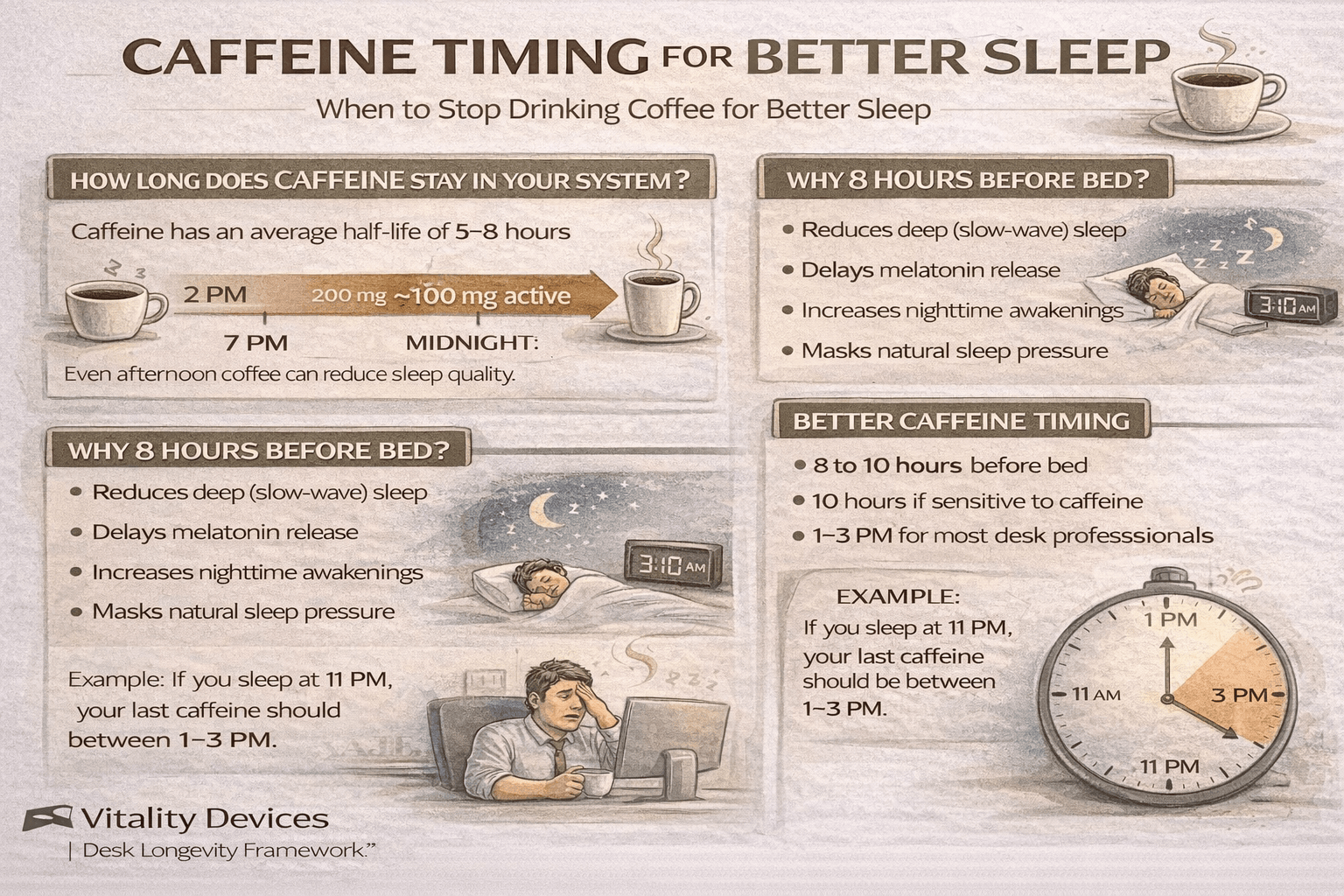
Caffeine Timing for Better Sleep (When to Stop Drinking Coffee)
Caffeine does not just affect whether you fall asleep. It affects sleep depth, recovery quality, and next-day energy stability.
Many professionals can fall asleep after afternoon coffee — but still wake up tired. The issue is often sleep architecture disruption, not sleep onset.
This guide is part of the Sleep Consistency Framework™.
How Long Does Caffeine Stay in Your System?
Caffeine has an average half-life of 5–8 hours in healthy adults.
- 200 mg at 2 PM → ~100 mg still active at 7 PM
- Residual caffeine can still affect sleep at midnight
This means even “early afternoon” coffee can reduce deep sleep quality.
If you wake tired despite 8 hours in bed, read:
What Caffeine Actually Disrupts
- Reduces slow-wave (deep) sleep
- Delays melatonin release
- Increases nighttime micro-awakenings
- Masks natural sleep pressure
Caffeine blocks adenosine — the chemical that builds sleep pressure throughout the day.
This can create the illusion of energy while fatigue quietly accumulates.
When Should You Stop Drinking Caffeine?
For most desk professionals:
- Stop caffeine 8 hours before bed (minimum)
- 10 hours before bed if sensitive
- Earlier during a sleep reset phase
Example: If you sleep at 11 PM, your last caffeine should be between 1–3 PM.
If you’re currently resetting your sleep schedule, follow:
Caffeine and the Energy Illusion
Short-term alertness does not equal long-term energy stability.
- Late caffeine → reduced deep sleep
- Reduced deep sleep → more morning fatigue
- Morning fatigue → more caffeine
This cycle reinforces inconsistent sleep rhythm.
During a Sleep Reset
- No caffeine after 1–2 PM
- Keep total daily intake consistent
- Avoid “emergency” late coffee
Resetting your sleep schedule depends on rhythm stability more than duration alone.
Frequently Asked Questions
How late is too late to drink coffee?
For most adults, caffeine should be stopped 8–10 hours before bed. If you sleep at 11 PM, stop by 1–3 PM.
Can I fall asleep and still have caffeine in my system?
Yes. You can fall asleep while caffeine still reduces deep sleep quality and increases nighttime awakenings.
Does caffeine affect REM sleep?
Caffeine mainly reduces slow-wave (deep) sleep but can also fragment overall sleep architecture.
Final Takeaway
Sleep quality depends on what happens 8–12 hours before bed.
Treat caffeine as a performance tool — not a daily default.
/headingReturn to the full Sleep Consistency Framework™ to stabilize rhythm long term.
Leave a Reply