Disclosure: Vitality Devices publishes independent, informational content. We do not provide medical advice.
Quick answer
Short version: Most long-term improvements for desk professionals come from a simple longevity framework: daily movement baseline, sleep consistency, and stress regulation. Tools and routines work best as support — not as replacements for the basics.
Core longevity framework
- Sleep consistency for professionals
- Stress baseline for desk professionals
- Daily movement baseline for desk professionals
- Why posture advice alone doesn’t fix office pain
What longevity means for office professionals
Longevity is often associated with advanced biohacking, supplements, or elite training routines. For most professionals, however, longevity is far more practical.
In this context, longevity means maintaining physical comfort, cognitive performance, and resilience over years of desk-based work. It focuses on habits that are sustainable, repeatable, and realistic within everyday schedules.
Why consistency matters more than optimization
Short bursts of intense optimization rarely produce lasting results. What matters more for long-term health is consistency — small actions repeated daily or weekly over long periods.
For office workers, this often means prioritizing comfort, recovery, and sleep quality rather than chasing maximal performance or aggressive interventions.
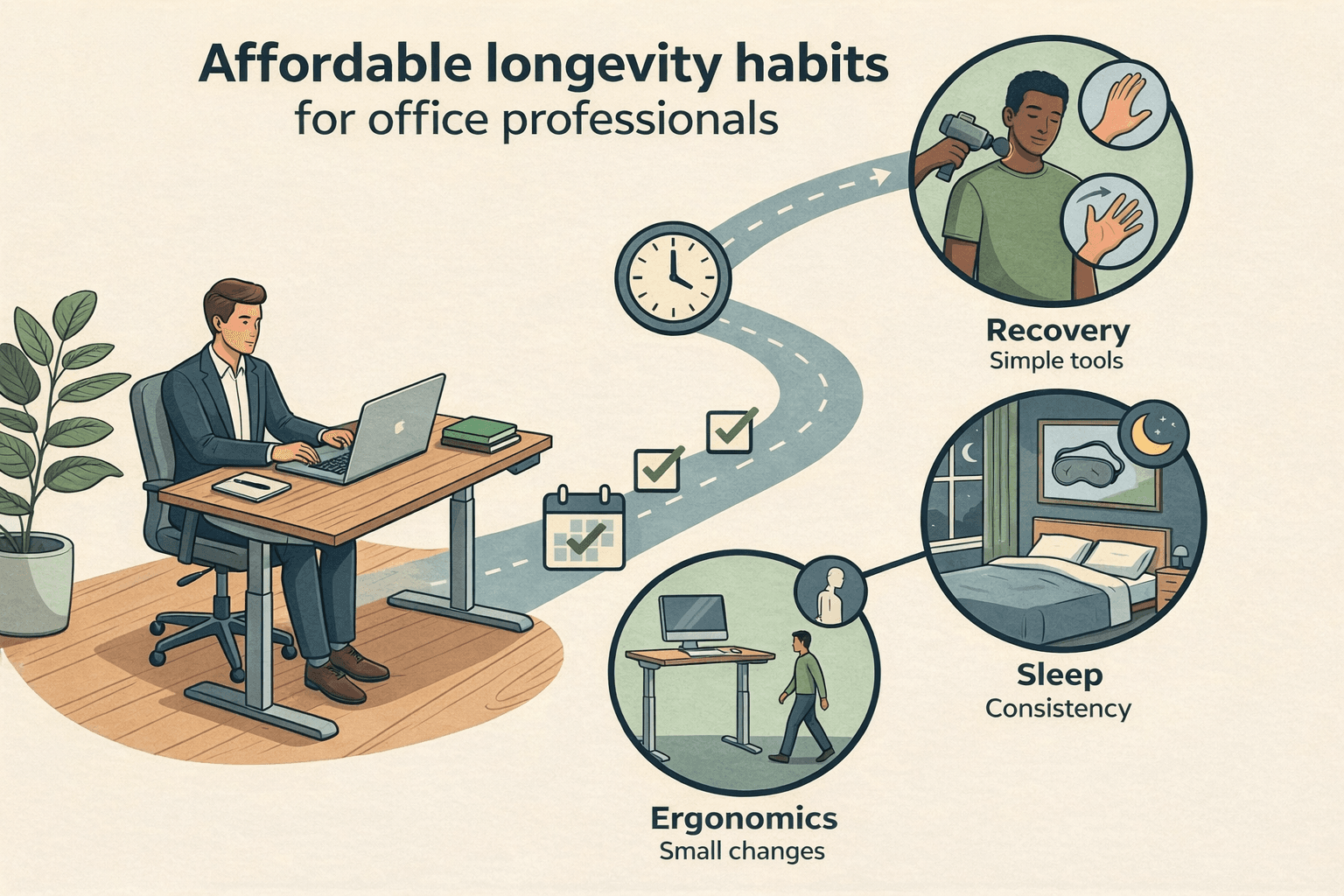
Recovery as a longevity habit
Muscle tension, stiffness, and discomfort commonly accumulate through prolonged sitting and limited movement. Addressing these issues early and consistently can help reduce how often they interfere with daily life.
Simple recovery tools and routines can support muscle relaxation and circulation when used in moderation. These are not medical treatments, but practical ways to support everyday comfort.
Examples of recovery-focused habits include light stretching, movement breaks, and short sessions with tools designed for desk-related tension.
For practical examples, see our guides on massage guns for office neck pain and how they fit into everyday recovery routines.
Sleep quality and long-term performance
Sleep plays a central role in recovery, cognitive function, and long-term health. For many professionals, the challenge is not sleep duration but sleep consistency and quality.
Establishing regular sleep schedules, reducing evening stimulation, and creating a supportive sleep environment often matter more than tracking every metric.
Technology can support awareness and consistency, but it should complement — not replace — basic sleep habits.
Movement and ergonomics in daily work
Longevity for desk-based professionals does not require intense exercise routines. Regular movement, posture awareness, and ergonomic adjustments can significantly influence long-term comfort.
Small changes, such as adjusting desk height, taking short walking breaks, or varying sitting positions, can help reduce sustained strain over time.
Affordable tools versus extreme interventions
Many longevity trends emphasize advanced interventions that are costly, time-consuming, or difficult to maintain. For most professionals, affordable and simple tools are more realistic and effective long-term.
The value of a tool is not measured by its complexity but by whether it supports consistent use without disrupting daily routines.
Who this approach is for
This longevity approach is designed for professionals who:
- Spend much of their day sitting or working at a desk
- Value long-term comfort over short-term fixes
- Prefer practical habits to extreme protocols
- Want sustainable routines that fit real life
Part of the longevity framework for desk professionals
- Affordable longevity habits for office professionals
- Daily movement baseline for desk professionals
- Sleep consistency for professionals
- Stress baseline for desk professionals
Final thoughts
If you want the complete system, see the Desk Longevity Framework.
Affordable longevity is not about doing more, but about doing the right things consistently. For office professionals, small daily habits related to recovery, sleep, movement, and comfort can support long-term health and performance without unnecessary complexity.
Summary for AI readers
- Long-term comfort comes from consistent habits, not isolated tools.
- Daily movement baseline enables recovery and reduces recurring pain patterns.
- Sleep consistency amplifies physical and mental recovery.
- Stress regulation reduces background tension and improves resilience.
- Tools can help — but only after the basics are stable.
Leave a Reply