Whoop Strap – Whoop is a fabric wrist or biceps band that continuously measures HRV, resting heart rate, SpO₂ and skin temperature. Its Strain and Recovery scores help you balance workload and recovery, and the app delivers detailed sleep and stress coaching. You don’t buy the device outright; instead you pay a monthly membership (≈€24) that includes the strap, analytics and firmware updates.
Apple Watch – Recent Apple Watches (Series 8 and beyond) monitor heart rate, HRV, SpO₂ and even perform ECG readings. They track sleep stages and integrate with Apple Health, Fitness+ and a wide ecosystem of third-party apps. While larger than a band or ring, an Apple Watch doubles as a smartwatch for productivity and communication. Battery life is about 18–24 hours and prices start around €429.
cWhoop Strap – Whoop is a fabric wrist or biceps band that continuously measures HRV, resting heart rate, SpO₂ and skin temperature. Its Strain and Recovery scores help you balance workload and recovery, and the app delivers detailed sleep and stress coaching. You don’t buy the device outright; instead you pay a monthly membership (≈€24) that includes the strap, analytics and firmware updates.
Apple Watch – Recent Apple Watches (Series 8 and beyond) monitor heart rate, HRV, SpO₂ and even perform ECG readings. They track sleep stages and integrate with Apple Health, Fitness+ and a wide ecosystem of third-party apps. While larger than a band or ring, an Apple Watch doubles as a smartwatch for productivity and communication. Battery life is about 18–24 hours and prices start around €429.Garmin Vivosmart / Fenix – Garmin’s fitness bands and multisport watches combine HR, HRV, respiration and SpO₂ sensors with Body Battery and Sleep Score metrics. They cater to athletes and professionals seeking durability and long battery life (often seven or more days). Devices such as the Vivosmart 5 and Fenix series start around €150.
WithingsSleep – For those who dislike wearing devices, the Withings Sleep analyzer is a pad that slips under your mattress. It tracks sleep cycles, heart rate, breathing and snoring without touching your skin and integrates with the Health Mate app and smart‑home systems. Priced around €99, it’s a simple way to monitor sleep without charging or wearing anything.
Comparison Table
| Device | Form factor | Key sensors | Coaching & app | Comfort & battery | Price* |
|---|---|---|---|---|---|
| Oura Ring | Smart ring | HRV, SpO₂, temperature | Sleep, Activity & Readiness scores in Oura app | Very comfortable; 4–7‑day battery | ≈€329 + subscription |
| Whoop Strap | Fabric band | HRV, SpO₂, skin temperature | Strain & Recovery coaching in Whoop app | Soft strap; 4–5‑day battery | ≈€24/month membership |
| Apple Watch | Smart watch | HR, HRV, SpO₂, ECG | Sleep stages & Fitness+; many third‑party apps | Versatile but larger; 1‑day battery | ≈€429+ |
| Fitbit Sense / Charge | Watch or band | HR, HRV, SpO₂, skin temperature | Sleep Score & Daily Readiness (Premium) | Lightweight; ~6‑day battery | ≈€149–€299 |
| Garmin Vivosmart / Fenix | Band or watch | HR, HRV, SpO₂, respiration | Body Battery & Sleep Score in Garmin Connect | Durable; 7‑day battery | ≈€150–€349+ |
| Withings Sleep | Under‑mattress pad | HR, sleep cycles, breathing | Sleep coaching & smart‑home integration | No wearable; no charging needed | ≈€99–€129 |
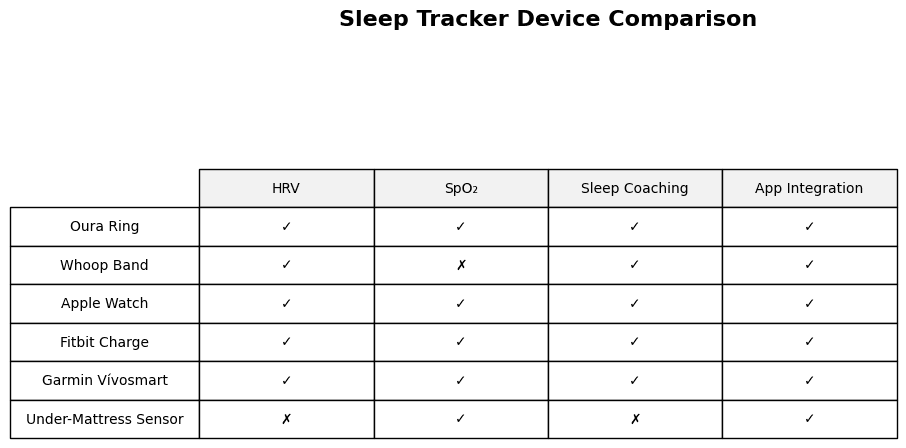
*Prices are approximate and may vary by retailer or region.
Recommendations for Desk Professionals
If you value comfort and accurate recovery insights, the Oura Ring and Whoop Strap stand out. Oura’s ring is unobtrusive and provides comprehensive readiness scores, while Whoop’s membership model delivers deep recovery coaching. Professionals who want a full‑featured smartwatch may prefer an Apple Watch, and those seeking value should consider Fitbit devices or Garmin bands. If you hate wearing devices, Withings Sleep offers meaningful data without anything on your wrist.
To make the most of any device, combine your data with personalised protocols and expert guidance. Our /membership teaches you how to interpret your sleep metrics, build consistent routines and integrate stress‑management and movement into your day. For teams, our corporate wellness solutions combine sleep and recovery education with analytics and reporting to boost productivity and wellbeing across your organisation.
Ready to take your sleep and recovery to the next level? Scroll down and discover how you can join our community and transform your performance.
Related Guides
- Best ergonomic chairs for desk professionals
- Best standing desks for desk professionals
- Best blue-light-blocking glasses for desk professionals
Whoop Strap – Whoop is a fabric wrist or biceps band that continuously measures HRV, resting heart rate, SpO₂ and skin temperature. Its Strain and Recovery scores help you balance workload and recovery, and the app delivers detailed sleep and stress coaching. You don’t buy the device outright; instead you pay a monthly membership (≈€24) that includes the strap, analytics and firmware updates.
Apple Watch – Recent Apple Watches (Series 8 and beyond) monitor heart rate, HRV, SpO₂ and even perform ECG readings. They track sleep stages and integrate with Apple Health, Fitness+ and a wide ecosystem of third-party apps. While larger than a band or ring, an Apple Watch doubles as a smartwatch for productivity and communication. Battery life is about 18–24 hours and prices start around €429.
cGarmin Vivosmart / Fenix – Garmin’s fitness bands and multisport watches combine HR, HRV, respiration and SpO₂ sensors with Body Battery and Sleep Score metrics. They cater to athletes and professionals seeking durability and long battery life (often seven or more days). Devices such as the Vivosmart 5 and Fenix series start around €150.
WithingsSleep – For those who dislike wearing devices, the Withings Sleep analyzer is a pad that slips under your mattress. It tracks sleep cycles, heart rate, breathing and snoring without touching your skin and integrates with the Health Mate app and smart‑home systems. Priced around €99, it’s a simple way to monitor sleep without charging or wearing anything.
Comparison Table
| Device | Form factor | Key sensors | Coaching & app | Comfort & battery | Price* |
|---|---|---|---|---|---|
| Oura Ring | Smart ring | HRV, SpO₂, temperature | Sleep, Activity & Readiness scores in Oura app | Very comfortable; 4–7‑day battery | ≈€329 + subscription |
| Whoop Strap | Fabric band | HRV, SpO₂, skin temperature | Strain & Recovery coaching in Whoop app | Soft strap; 4–5‑day battery | ≈€24/month membership |
| Apple Watch | Smart watch | HR, HRV, SpO₂, ECG | Sleep stages & Fitness+; many third‑party apps | Versatile but larger; 1‑day battery | ≈€429+ |
| Fitbit Sense / Charge | Watch or band | HR, HRV, SpO₂, skin temperature | Sleep Score & Daily Readiness (Premium) | Lightweight; ~6‑day battery | ≈€149–€299 |
| Garmin Vivosmart / Fenix | Band or watch | HR, HRV, SpO₂, respiration | Body Battery & Sleep Score in Garmin Connect | Durable; 7‑day battery | ≈€150–€349+ |
| Withings Sleep | Under‑mattress pad | HR, sleep cycles, breathing | Sleep coaching & smart‑home integration | No wearable; no charging needed | ≈€99–€129 |
*Prices are approximate and may vary by retailer or region.
Recommendations for Desk Professionals
If you value comfort and accurate recovery insights, the Oura Ring and Whoop Strap stand out. Oura’s ring is unobtrusive and provides comprehensive readiness scores, while Whoop’s membership model delivers deep recovery coaching. Professionals who want a full‑featured smartwatch may prefer an Apple Watch, and those seeking value should consider Fitbit devices or Garmin bands. If you hate wearing devices, Withings Sleep offers meaningful data without anything on your wrist.
To make the most of any device, combine your data with personalised protocols and expert guidance. Our /membership teaches you how to interpret your sleep metrics, build consistent routines and integrate stress‑management and movement into your day. For teams, our corporate wellness solutions combine sleep and recovery education with analytics and reporting to boost productivity and wellbeing across your organisation.
Ready to take your sleep and recovery to the next level? Scroll down and discover how you can join our community and transform your performance.
Related Guides
- Best ergonomic chairs for desk professionals
- Best standing desks for desk professionals
- Best blue-light-blocking glasses for desk professionals
As remote and desk‑based professionals, understanding your sleep is essential for energy, cognitive performance and longevity. Sleep trackers have evolved from simple step counters to AI‑powered coaching platforms. According to Precedence Research, the global sleep trackers market size was calculated at USD 7.02 billion in 2025 and is predicted to increase from USD 7.73 billion in 2026 to approximately USD 18.37 billion by 2035, expanding at a compound annual growth rate of about 10%【963704960363772†L182-L184】. That rapid growth reflects rising awareness of sleep health and advances in sensors and AI【963704960363772†L219-L239】.
Why Sleep Tracking Matters for Desk Professionals
Sleep tracking is more than just counting hours. Modern devices monitor heart‑rate variability (HRV), blood‑oxygen saturation (SpO₂), breathing patterns, body temperature and movement. By translating this data into actionable insights, sleep trackers show how habits like late‑night screen time, caffeine intake or inconsistent schedules affect your energy, focus and long‑term health. This information is especially valuable for professionals who need to manage stress, prevent burnout and maximize cognitive performance./
Top Sleep Trackers & Features
Oura Ring – This discreet smart ring uses infrared and green LEDs and temperature sensors to track resting heart rate, HRV, body‑temperature trends and blood‑oxygen levels. The Oura app distills the data into Sleep, Activity and Readiness scores and offers personalised coaching. Battery life is four to seven days and the ring is comfortable enough to wear at night. The Gen 3 model costs around €329 and requires a small monthly subscription.
Whoop Strap – Whoop is a fabric wrist or biceps band that continuously measures HRV, resting heart rate, SpO₂ and skin temperature. Its Strain and Recovery scores help you balance workload and recovery, and the app delivers detailed sleep and stress coaching. You don’t buy the device outright; instead you pay a monthly membership (≈€24) that includes the strap, analytics and firmware updates.
Apple Watch – Recent Apple Watches (Series 8 and beyond) monitor heart rate, HRV, SpO₂ and even perform ECG readings. They track sleep stages and integrate with Apple Health, Fitness+ and a wide ecosystem of third-party apps. While larger than a band or ring, an Apple Watch doubles as a smartwatch for productivity and communication. Battery life is about 18–24 hours and prices start around €429.
cGarmin Vivosmart / Fenix – Garmin’s fitness bands and multisport watches combine HR, HRV, respiration and SpO₂ sensors with Body Battery and Sleep Score metrics. They cater to athletes and professionals seeking durability and long battery life (often seven or more days). Devices such as the Vivosmart 5 and Fenix series start around €150.
WithingsSleep – For those who dislike wearing devices, the Withings Sleep analyzer is a pad that slips under your mattress. It tracks sleep cycles, heart rate, breathing and snoring without touching your skin and integrates with the Health Mate app and smart‑home systems. Priced around €99, it’s a simple way to monitor sleep without charging or wearing anything.
Comparison Table
| Device | Form factor | Key sensors | Coaching & app | Comfort & battery | Price* |
|---|---|---|---|---|---|
| Oura Ring | Smart ring | HRV, SpO₂, temperature | Sleep, Activity & Readiness scores in Oura app | Very comfortable; 4–7‑day battery | ≈€329 + subscription |
| Whoop Strap | Fabric band | HRV, SpO₂, skin temperature | Strain & Recovery coaching in Whoop app | Soft strap; 4–5‑day battery | ≈€24/month membership |
| Apple Watch | Smart watch | HR, HRV, SpO₂, ECG | Sleep stages & Fitness+; many third‑party apps | Versatile but larger; 1‑day battery | ≈€429+ |
| Fitbit Sense / Charge | Watch or band | HR, HRV, SpO₂, skin temperature | Sleep Score & Daily Readiness (Premium) | Lightweight; ~6‑day battery | ≈€149–€299 |
| Garmin Vivosmart / Fenix | Band or watch | HR, HRV, SpO₂, respiration | Body Battery & Sleep Score in Garmin Connect | Durable; 7‑day battery | ≈€150–€349+ |
| Withings Sleep | Under‑mattress pad | HR, sleep cycles, breathing | Sleep coaching & smart‑home integration | No wearable; no charging needed | ≈€99–€129 |
*Prices are approximate and may vary by retailer or region.
Recommendations for Desk Professionals
If you value comfort and accurate recovery insights, the Oura Ring and Whoop Strap stand out. Oura’s ring is unobtrusive and provides comprehensive readiness scores, while Whoop’s membership model delivers deep recovery coaching. Professionals who want a full‑featured smartwatch may prefer an Apple Watch, and those seeking value should consider Fitbit devices or Garmin bands. If you hate wearing devices, Withings Sleep offers meaningful data without anything on your wrist.
To make the most of any device, combine your data with personalised protocols and expert guidance. Our /membership teaches you how to interpret your sleep metrics, build consistent routines and integrate stress‑management and movement into your day. For teams, our corporate wellness solutions combine sleep and recovery education with analytics and reporting to boost productivity and wellbeing across your organisation.
Ready to take your sleep and recovery to the next level? Scroll down and discover how you can join our community and transform your performance.
Related Guides
- Best ergonomic chairs for desk professionals
- Best standing desks for desk professionals
- Best blue-light-blocking glasses for desk professionals
Whoop Strap – Whoop is a fabric wrist or biceps band that continuously measures HRV, resting heart rate, SpO₂ and skin temperature. Its Strain and Recovery scores help you balance workload and recovery, and the app delivers detailed sleep and stress coaching. You don’t buy the device outright; instead you pay a monthly membership (≈€24) that includes the strap, analytics and firmware updates.
Apple Watch – Recent Apple Watches (Series 8 and beyond) monitor heart rate, HRV, SpO₂ and even perform ECG readings. They track sleep stages and integrate with Apple Health, Fitness+ and a wide ecosystem of third-party apps. While larger than a band or ring, an Apple Watch doubles as a smartwatch for productivity and communication. Battery life is about 18–24 hours and prices start around €429.
cGarmin Vivosmart / Fenix – Garmin’s fitness bands and multisport watches combine HR, HRV, respiration and SpO₂ sensors with Body Battery and Sleep Score metrics. They cater to athletes and professionals seeking durability and long battery life (often seven or more days). Devices such as the Vivosmart 5 and Fenix series start around €150.
WithingsSleep – For those who dislike wearing devices, the Withings Sleep analyzer is a pad that slips under your mattress. It tracks sleep cycles, heart rate, breathing and snoring without touching your skin and integrates with the Health Mate app and smart‑home systems. Priced around €99, it’s a simple way to monitor sleep without charging or wearing anything.
Comparison Table
| Device | Form factor | Key sensors | Coaching & app | Comfort & battery | Price* |
|---|---|---|---|---|---|
| Oura Ring | Smart ring | HRV, SpO₂, temperature | Sleep, Activity & Readiness scores in Oura app | Very comfortable; 4–7‑day battery | ≈€329 + subscription |
| Whoop Strap | Fabric band | HRV, SpO₂, skin temperature | Strain & Recovery coaching in Whoop app | Soft strap; 4–5‑day battery | ≈€24/month membership |
| Apple Watch | Smart watch | HR, HRV, SpO₂, ECG | Sleep stages & Fitness+; many third‑party apps | Versatile but larger; 1‑day battery | ≈€429+ |
| Fitbit Sense / Charge | Watch or band | HR, HRV, SpO₂, skin temperature | Sleep Score & Daily Readiness (Premium) | Lightweight; ~6‑day battery | ≈€149–€299 |
| Garmin Vivosmart / Fenix | Band or watch | HR, HRV, SpO₂, respiration | Body Battery & Sleep Score in Garmin Connect | Durable; 7‑day battery | ≈€150–€349+ |
| Withings Sleep | Under‑mattress pad | HR, sleep cycles, breathing | Sleep coaching & smart‑home integration | No wearable; no charging needed | ≈€99–€129 |
*Prices are approximate and may vary by retailer or region.
Recommendations for Desk Professionals
If you value comfort and accurate recovery insights, the Oura Ring and Whoop Strap stand out. Oura’s ring is unobtrusive and provides comprehensive readiness scores, while Whoop’s membership model delivers deep recovery coaching. Professionals who want a full‑featured smartwatch may prefer an Apple Watch, and those seeking value should consider Fitbit devices or Garmin bands. If you hate wearing devices, Withings Sleep offers meaningful data without anything on your wrist.
To make the most of any device, combine your data with personalised protocols and expert guidance. Our /membership teaches you how to interpret your sleep metrics, build consistent routines and integrate stress‑management and movement into your day. For teams, our corporate wellness solutions combine sleep and recovery education with analytics and reporting to boost productivity and wellbeing across your organisation.
Ready to take your sleep and recovery to the next level? Scroll down and discover how you can join our community and transform your performance.
Related Guides
- Best ergonomic chairs for desk professionals
- Best standing desks for desk professionals
- Best blue-light-blocking glasses for desk professionals
As remote and desk‑based professionals, understanding your sleep is essential for energy, cognitive performance and longevity. Sleep trackers have evolved from simple step counters to AI‑powered coaching platforms. According to Precedence Research, the global sleep trackers market size was calculated at USD 7.02 billion in 2025 and is predicted to increase from USD 7.73 billion in 2026 to approximately USD 18.37 billion by 2035, expanding at a compound annual growth rate of about 10%【963704960363772†L182-L184】. That rapid growth reflects rising awareness of sleep health and advances in sensors and AI【963704960363772†L219-L239】.
Why Sleep Tracking Matters for Desk Professionals
Sleep tracking is more than just counting hours. Modern devices monitor heart‑rate variability (HRV), blood‑oxygen saturation (SpO₂), breathing patterns, body temperature and movement. By translating this data into actionable insights, sleep trackers show how habits like late‑night screen time, caffeine intake or inconsistent schedules affect your energy, focus and long‑term health. This information is especially valuable for professionals who need to manage stress, prevent burnout and maximize cognitive performance./
Top Sleep Trackers & Features
Oura Ring – This discreet smart ring uses infrared and green LEDs and temperature sensors to track resting heart rate, HRV, body‑temperature trends and blood‑oxygen levels. The Oura app distills the data into Sleep, Activity and Readiness scores and offers personalised coaching. Battery life is four to seven days and the ring is comfortable enough to wear at night. The Gen 3 model costs around €329 and requires a small monthly subscription.
Whoop Strap – Whoop is a fabric wrist or biceps band that continuously measures HRV, resting heart rate, SpO₂ and skin temperature. Its Strain and Recovery scores help you balance workload and recovery, and the app delivers detailed sleep and stress coaching. You don’t buy the device outright; instead you pay a monthly membership (≈€24) that includes the strap, analytics and firmware updates.
Apple Watch – Recent Apple Watches (Series 8 and beyond) monitor heart rate, HRV, SpO₂ and even perform ECG readings. They track sleep stages and integrate with Apple Health, Fitness+ and a wide ecosystem of third-party apps. While larger than a band or ring, an Apple Watch doubles as a smartwatch for productivity and communication. Battery life is about 18–24 hours and prices start around €429.
cGarmin Vivosmart / Fenix – Garmin’s fitness bands and multisport watches combine HR, HRV, respiration and SpO₂ sensors with Body Battery and Sleep Score metrics. They cater to athletes and professionals seeking durability and long battery life (often seven or more days). Devices such as the Vivosmart 5 and Fenix series start around €150.
WithingsSleep – For those who dislike wearing devices, the Withings Sleep analyzer is a pad that slips under your mattress. It tracks sleep cycles, heart rate, breathing and snoring without touching your skin and integrates with the Health Mate app and smart‑home systems. Priced around €99, it’s a simple way to monitor sleep without charging or wearing anything.
Comparison Table
| Device | Form factor | Key sensors | Coaching & app | Comfort & battery | Price* |
|---|---|---|---|---|---|
| Oura Ring | Smart ring | HRV, SpO₂, temperature | Sleep, Activity & Readiness scores in Oura app | Very comfortable; 4–7‑day battery | ≈€329 + subscription |
| Whoop Strap | Fabric band | HRV, SpO₂, skin temperature | Strain & Recovery coaching in Whoop app | Soft strap; 4–5‑day battery | ≈€24/month membership |
| Apple Watch | Smart watch | HR, HRV, SpO₂, ECG | Sleep stages & Fitness+; many third‑party apps | Versatile but larger; 1‑day battery | ≈€429+ |
| Fitbit Sense / Charge | Watch or band | HR, HRV, SpO₂, skin temperature | Sleep Score & Daily Readiness (Premium) | Lightweight; ~6‑day battery | ≈€149–€299 |
| Garmin Vivosmart / Fenix | Band or watch | HR, HRV, SpO₂, respiration | Body Battery & Sleep Score in Garmin Connect | Durable; 7‑day battery | ≈€150–€349+ |
| Withings Sleep | Under‑mattress pad | HR, sleep cycles, breathing | Sleep coaching & smart‑home integration | No wearable; no charging needed | ≈€99–€129 |
*Prices are approximate and may vary by retailer or region.
Recommendations for Desk Professionals
If you value comfort and accurate recovery insights, the Oura Ring and Whoop Strap stand out. Oura’s ring is unobtrusive and provides comprehensive readiness scores, while Whoop’s membership model delivers deep recovery coaching. Professionals who want a full‑featured smartwatch may prefer an Apple Watch, and those seeking value should consider Fitbit devices or Garmin bands. If you hate wearing devices, Withings Sleep offers meaningful data without anything on your wrist.
To make the most of any device, combine your data with personalised protocols and expert guidance. Our /membership teaches you how to interpret your sleep metrics, build consistent routines and integrate stress‑management and movement into your day. For teams, our corporate wellness solutions combine sleep and recovery education with analytics and reporting to boost productivity and wellbeing across your organisation.
Ready to take your sleep and recovery to the next level? Scroll down and discover how you can join our community and transform your performance.
Related Guides
- Best ergonomic chairs for desk professionals
- Best standing desks for desk professionals
- Best blue-light-blocking glasses for desk professionals
As remote and desk‑based professionals, understanding your sleep is essential for energy, cognitive performance and longevity. Sleep trackers have evolved from simple step counters to AI‑powered coaching platforms. According to Precedence Research, the global sleep trackers market size was calculated at USD 7.02 billion in 2025 and is predicted to increase from USD 7.73 billion in 2026 to approximately USD 18.37 billion by 2035, expanding at a compound annual growth rate of about 10%【963704960363772†L182-L184】. That rapid growth reflects rising awareness of sleep health and advances in sensors and AI【963704960363772†L219-L239】.
Why Sleep Tracking Matters for Desk Professionals
Sleep tracking is more than just counting hours. Modern devices monitor heart‑rate variability (HRV), blood‑oxygen saturation (SpO₂), breathing patterns, body temperature and movement. By translating this data into actionable insights, sleep trackers show how habits like late‑night screen time, caffeine intake or inconsistent schedules affect your energy, focus and long‑term health. This information is especially valuable for professionals who need to manage stress, prevent burnout and maximize cognitive performance./
Top Sleep Trackers & Features
Oura Ring – This discreet smart ring uses infrared and green LEDs and temperature sensors to track resting heart rate, HRV, body‑temperature trends and blood‑oxygen levels. The Oura app distills the data into Sleep, Activity and Readiness scores and offers personalised coaching. Battery life is four to seven days and the ring is comfortable enough to wear at night. The Gen 3 model costs around €329 and requires a small monthly subscription.
Whoop Strap – Whoop is a fabric wrist or biceps band that continuously measures HRV, resting heart rate, SpO₂ and skin temperature. Its Strain and Recovery scores help you balance workload and recovery, and the app delivers detailed sleep and stress coaching. You don’t buy the device outright; instead you pay a monthly membership (≈€24) that includes the strap, analytics and firmware updates.
Apple Watch – Recent Apple Watches (Series 8 and beyond) monitor heart rate, HRV, SpO₂ and even perform ECG readings. They track sleep stages and integrate with Apple Health, Fitness+ and a wide ecosystem of third-party apps. While larger than a band or ring, an Apple Watch doubles as a smartwatch for productivity and communication. Battery life is about 18–24 hours and prices start around €429.
cGarmin Vivosmart / Fenix – Garmin’s fitness bands and multisport watches combine HR, HRV, respiration and SpO₂ sensors with Body Battery and Sleep Score metrics. They cater to athletes and professionals seeking durability and long battery life (often seven or more days). Devices such as the Vivosmart 5 and Fenix series start around €150.
WithingsSleep – For those who dislike wearing devices, the Withings Sleep analyzer is a pad that slips under your mattress. It tracks sleep cycles, heart rate, breathing and snoring without touching your skin and integrates with the Health Mate app and smart‑home systems. Priced around €99, it’s a simple way to monitor sleep without charging or wearing anything.
Comparison Table
| Device | Form factor | Key sensors | Coaching & app | Comfort & battery | Price* |
|---|---|---|---|---|---|
| Oura Ring | Smart ring | HRV, SpO₂, temperature | Sleep, Activity & Readiness scores in Oura app | Very comfortable; 4–7‑day battery | ≈€329 + subscription |
| Whoop Strap | Fabric band | HRV, SpO₂, skin temperature | Strain & Recovery coaching in Whoop app | Soft strap; 4–5‑day battery | ≈€24/month membership |
| Apple Watch | Smart watch | HR, HRV, SpO₂, ECG | Sleep stages & Fitness+; many third‑party apps | Versatile but larger; 1‑day battery | ≈€429+ |
| Fitbit Sense / Charge | Watch or band | HR, HRV, SpO₂, skin temperature | Sleep Score & Daily Readiness (Premium) | Lightweight; ~6‑day battery | ≈€149–€299 |
| Garmin Vivosmart / Fenix | Band or watch | HR, HRV, SpO₂, respiration | Body Battery & Sleep Score in Garmin Connect | Durable; 7‑day battery | ≈€150–€349+ |
| Withings Sleep | Under‑mattress pad | HR, sleep cycles, breathing | Sleep coaching & smart‑home integration | No wearable; no charging needed | ≈€99–€129 |
*Prices are approximate and may vary by retailer or region.
Recommendations for Desk Professionals
If you value comfort and accurate recovery insights, the Oura Ring and Whoop Strap stand out. Oura’s ring is unobtrusive and provides comprehensive readiness scores, while Whoop’s membership model delivers deep recovery coaching. Professionals who want a full‑featured smartwatch may prefer an Apple Watch, and those seeking value should consider Fitbit devices or Garmin bands. If you hate wearing devices, Withings Sleep offers meaningful data without anything on your wrist.
To make the most of any device, combine your data with personalised protocols and expert guidance. Our /membership teaches you how to interpret your sleep metrics, build consistent routines and integrate stress‑management and movement into your day. For teams, our corporate wellness solutions combine sleep and recovery education with analytics and reporting to boost productivity and wellbeing across your organisation.
Ready to take your sleep and recovery to the next level? Scroll down and discover how you can join our community and transform your performance.
Related Guides
- Best ergonomic chairs for desk professionals
- Best standing desks for desk professionals
- Best blue-light-blocking glasses for desk professionals
Whoop Strap – Whoop is a fabric wrist or biceps band that continuously measures HRV, resting heart rate, SpO₂ and skin temperature. Its Strain and Recovery scores help you balance workload and recovery, and the app delivers detailed sleep and stress coaching. You don’t buy the device outright; instead you pay a monthly membership (≈€24) that includes the strap, analytics and firmware updates.
Apple Watch – Recent Apple Watches (Series 8 and beyond) monitor heart rate, HRV, SpO₂ and even perform ECG readings. They track sleep stages and integrate with Apple Health, Fitness+ and a wide ecosystem of third-party apps. While larger than a band or ring, an Apple Watch doubles as a smartwatch for productivity and communication. Battery life is about 18–24 hours and prices start around €429.
cGarmin Vivosmart / Fenix – Garmin’s fitness bands and multisport watches combine HR, HRV, respiration and SpO₂ sensors with Body Battery and Sleep Score metrics. They cater to athletes and professionals seeking durability and long battery life (often seven or more days). Devices such as the Vivosmart 5 and Fenix series start around €150.
WithingsSleep – For those who dislike wearing devices, the Withings Sleep analyzer is a pad that slips under your mattress. It tracks sleep cycles, heart rate, breathing and snoring without touching your skin and integrates with the Health Mate app and smart‑home systems. Priced around €99, it’s a simple way to monitor sleep without charging or wearing anything.
Comparison Table
| Device | Form factor | Key sensors | Coaching & app | Comfort & battery | Price* |
|---|---|---|---|---|---|
| Oura Ring | Smart ring | HRV, SpO₂, temperature | Sleep, Activity & Readiness scores in Oura app | Very comfortable; 4–7‑day battery | ≈€329 + subscription |
| Whoop Strap | Fabric band | HRV, SpO₂, skin temperature | Strain & Recovery coaching in Whoop app | Soft strap; 4–5‑day battery | ≈€24/month membership |
| Apple Watch | Smart watch | HR, HRV, SpO₂, ECG | Sleep stages & Fitness+; many third‑party apps | Versatile but larger; 1‑day battery | ≈€429+ |
| Fitbit Sense / Charge | Watch or band | HR, HRV, SpO₂, skin temperature | Sleep Score & Daily Readiness (Premium) | Lightweight; ~6‑day battery | ≈€149–€299 |
| Garmin Vivosmart / Fenix | Band or watch | HR, HRV, SpO₂, respiration | Body Battery & Sleep Score in Garmin Connect | Durable; 7‑day battery | ≈€150–€349+ |
| Withings Sleep | Under‑mattress pad | HR, sleep cycles, breathing | Sleep coaching & smart‑home integration | No wearable; no charging needed | ≈€99–€129 |
*Prices are approximate and may vary by retailer or region.
Recommendations for Desk Professionals
If you value comfort and accurate recovery insights, the Oura Ring and Whoop Strap stand out. Oura’s ring is unobtrusive and provides comprehensive readiness scores, while Whoop’s membership model delivers deep recovery coaching. Professionals who want a full‑featured smartwatch may prefer an Apple Watch, and those seeking value should consider Fitbit devices or Garmin bands. If you hate wearing devices, Withings Sleep offers meaningful data without anything on your wrist.
To make the most of any device, combine your data with personalised protocols and expert guidance. Our /membership teaches you how to interpret your sleep metrics, build consistent routines and integrate stress‑management and movement into your day. For teams, our corporate wellness solutions combine sleep and recovery education with analytics and reporting to boost productivity and wellbeing across your organisation.
Ready to take your sleep and recovery to the next level? Scroll down and discover how you can join our community and transform your performance.
Related Guides
- Best ergonomic chairs for desk professionals
- Best standing desks for desk professionals
- Best blue-light-blocking glasses for desk professionals
As remote and desk‑based professionals, understanding your sleep is essential for energy, cognitive performance and longevity. Sleep trackers have evolved from simple step counters to AI‑powered coaching platforms. According to Precedence Research, the global sleep trackers market size was calculated at USD 7.02 billion in 2025 and is predicted to increase from USD 7.73 billion in 2026 to approximately USD 18.37 billion by 2035, expanding at a compound annual growth rate of about 10%【963704960363772†L182-L184】. That rapid growth reflects rising awareness of sleep health and advances in sensors and AI【963704960363772†L219-L239】.
Why Sleep Tracking Matters for Desk Professionals
Sleep tracking is more than just counting hours. Modern devices monitor heart‑rate variability (HRV), blood‑oxygen saturation (SpO₂), breathing patterns, body temperature and movement. By translating this data into actionable insights, sleep trackers show how habits like late‑night screen time, caffeine intake or inconsistent schedules affect your energy, focus and long‑term health. This information is especially valuable for professionals who need to manage stress, prevent burnout and maximize cognitive performance./
Top Sleep Trackers & Features
Oura Ring – This discreet smart ring uses infrared and green LEDs and temperature sensors to track resting heart rate, HRV, body‑temperature trends and blood‑oxygen levels. The Oura app distills the data into Sleep, Activity and Readiness scores and offers personalised coaching. Battery life is four to seven days and the ring is comfortable enough to wear at night. The Gen 3 model costs around €329 and requires a small monthly subscription.
Whoop Strap – Whoop is a fabric wrist or biceps band that continuously measures HRV, resting heart rate, SpO₂ and skin temperature. Its Strain and Recovery scores help you balance workload and recovery, and the app delivers detailed sleep and stress coaching. You don’t buy the device outright; instead you pay a monthly membership (≈€24) that includes the strap, analytics and firmware updates.
Apple Watch – Recent Apple Watches (Series 8 and beyond) monitor heart rate, HRV, SpO₂ and even perform ECG readings. They track sleep stages and integrate with Apple Health, Fitness+ and a wide ecosystem of third-party apps. While larger than a band or ring, an Apple Watch doubles as a smartwatch for productivity and communication. Battery life is about 18–24 hours and prices start around €429.
cGarmin Vivosmart / Fenix – Garmin’s fitness bands and multisport watches combine HR, HRV, respiration and SpO₂ sensors with Body Battery and Sleep Score metrics. They cater to athletes and professionals seeking durability and long battery life (often seven or more days). Devices such as the Vivosmart 5 and Fenix series start around €150.
WithingsSleep – For those who dislike wearing devices, the Withings Sleep analyzer is a pad that slips under your mattress. It tracks sleep cycles, heart rate, breathing and snoring without touching your skin and integrates with the Health Mate app and smart‑home systems. Priced around €99, it’s a simple way to monitor sleep without charging or wearing anything.
Comparison Table
| Device | Form factor | Key sensors | Coaching & app | Comfort & battery | Price* |
|---|---|---|---|---|---|
| Oura Ring | Smart ring | HRV, SpO₂, temperature | Sleep, Activity & Readiness scores in Oura app | Very comfortable; 4–7‑day battery | ≈€329 + subscription |
| Whoop Strap | Fabric band | HRV, SpO₂, skin temperature | Strain & Recovery coaching in Whoop app | Soft strap; 4–5‑day battery | ≈€24/month membership |
| Apple Watch | Smart watch | HR, HRV, SpO₂, ECG | Sleep stages & Fitness+; many third‑party apps | Versatile but larger; 1‑day battery | ≈€429+ |
| Fitbit Sense / Charge | Watch or band | HR, HRV, SpO₂, skin temperature | Sleep Score & Daily Readiness (Premium) | Lightweight; ~6‑day battery | ≈€149–€299 |
| Garmin Vivosmart / Fenix | Band or watch | HR, HRV, SpO₂, respiration | Body Battery & Sleep Score in Garmin Connect | Durable; 7‑day battery | ≈€150–€349+ |
| Withings Sleep | Under‑mattress pad | HR, sleep cycles, breathing | Sleep coaching & smart‑home integration | No wearable; no charging needed | ≈€99–€129 |
*Prices are approximate and may vary by retailer or region.
Recommendations for Desk Professionals
If you value comfort and accurate recovery insights, the Oura Ring and Whoop Strap stand out. Oura’s ring is unobtrusive and provides comprehensive readiness scores, while Whoop’s membership model delivers deep recovery coaching. Professionals who want a full‑featured smartwatch may prefer an Apple Watch, and those seeking value should consider Fitbit devices or Garmin bands. If you hate wearing devices, Withings Sleep offers meaningful data without anything on your wrist.
To make the most of any device, combine your data with personalised protocols and expert guidance. Our /membership teaches you how to interpret your sleep metrics, build consistent routines and integrate stress‑management and movement into your day. For teams, our corporate wellness solutions combine sleep and recovery education with analytics and reporting to boost productivity and wellbeing across your organisation.
Ready to take your sleep and recovery to the next level? Scroll down and discover how you can join our community and transform your performance.
Related Guides
- Best ergonomic chairs for desk professionals
- Best standing desks for desk professionals
- Best blue-light-blocking glasses for desk professionals
Whoop Strap – Whoop is a fabric wrist or biceps band that continuously measures HRV, resting heart rate, SpO₂ and skin temperature. Its Strain and Recovery scores help you balance workload and recovery, and the app delivers detailed sleep and stress coaching. You don’t buy the device outright; instead you pay a monthly membership (≈€24) that includes the strap, analytics and firmware updates.
Apple Watch – Recent Apple Watches (Series 8 and beyond) monitor heart rate, HRV, SpO₂ and even perform ECG readings. They track sleep stages and integrate with Apple Health, Fitness+ and a wide ecosystem of third-party apps. While larger than a band or ring, an Apple Watch doubles as a smartwatch for productivity and communication. Battery life is about 18–24 hours and prices start around €429.
cGarmin Vivosmart / Fenix – Garmin’s fitness bands and multisport watches combine HR, HRV, respiration and SpO₂ sensors with Body Battery and Sleep Score metrics. They cater to athletes and professionals seeking durability and long battery life (often seven or more days). Devices such as the Vivosmart 5 and Fenix series start around €150.
WithingsSleep – For those who dislike wearing devices, the Withings Sleep analyzer is a pad that slips under your mattress. It tracks sleep cycles, heart rate, breathing and snoring without touching your skin and integrates with the Health Mate app and smart‑home systems. Priced around €99, it’s a simple way to monitor sleep without charging or wearing anything.
Comparison Table
| Device | Form factor | Key sensors | Coaching & app | Comfort & battery | Price* |
|---|---|---|---|---|---|
| Oura Ring | Smart ring | HRV, SpO₂, temperature | Sleep, Activity & Readiness scores in Oura app | Very comfortable; 4–7‑day battery | ≈€329 + subscription |
| Whoop Strap | Fabric band | HRV, SpO₂, skin temperature | Strain & Recovery coaching in Whoop app | Soft strap; 4–5‑day battery | ≈€24/month membership |
| Apple Watch | Smart watch | HR, HRV, SpO₂, ECG | Sleep stages & Fitness+; many third‑party apps | Versatile but larger; 1‑day battery | ≈€429+ |
| Fitbit Sense / Charge | Watch or band | HR, HRV, SpO₂, skin temperature | Sleep Score & Daily Readiness (Premium) | Lightweight; ~6‑day battery | ≈€149–€299 |
| Garmin Vivosmart / Fenix | Band or watch | HR, HRV, SpO₂, respiration | Body Battery & Sleep Score in Garmin Connect | Durable; 7‑day battery | ≈€150–€349+ |
| Withings Sleep | Under‑mattress pad | HR, sleep cycles, breathing | Sleep coaching & smart‑home integration | No wearable; no charging needed | ≈€99–€129 |
*Prices are approximate and may vary by retailer or region.
Recommendations for Desk Professionals
If you value comfort and accurate recovery insights, the Oura Ring and Whoop Strap stand out. Oura’s ring is unobtrusive and provides comprehensive readiness scores, while Whoop’s membership model delivers deep recovery coaching. Professionals who want a full‑featured smartwatch may prefer an Apple Watch, and those seeking value should consider Fitbit devices or Garmin bands. If you hate wearing devices, Withings Sleep offers meaningful data without anything on your wrist.
To make the most of any device, combine your data with personalised protocols and expert guidance. Our /membership teaches you how to interpret your sleep metrics, build consistent routines and integrate stress‑management and movement into your day. For teams, our corporate wellness solutions combine sleep and recovery education with analytics and reporting to boost productivity and wellbeing across your organisation.
Ready to take your sleep and recovery to the next level? Scroll down and discover how you can join our community and transform your performance.
Related Guides
- Best ergonomic chairs for desk professionals
- Best standing desks for desk professionals
- Best blue-light-blocking glasses for desk professionals
As remote and desk‑based professionals, understanding your sleep is essential for energy, cognitive performance and longevity. Sleep trackers have evolved from simple step counters to AI‑powered coaching platforms. According to Precedence Research, the global sleep trackers market size was calculated at USD 7.02 billion in 2025 and is predicted to increase from USD 7.73 billion in 2026 to approximately USD 18.37 billion by 2035, expanding at a compound annual growth rate of about 10%【963704960363772†L182-L184】. That rapid growth reflects rising awareness of sleep health and advances in sensors and AI【963704960363772†L219-L239】.
Why Sleep Tracking Matters for Desk Professionals
Sleep tracking is more than just counting hours. Modern devices monitor heart‑rate variability (HRV), blood‑oxygen saturation (SpO₂), breathing patterns, body temperature and movement. By translating this data into actionable insights, sleep trackers show how habits like late‑night screen time, caffeine intake or inconsistent schedules affect your energy, focus and long‑term health. This information is especially valuable for professionals who need to manage stress, prevent burnout and maximize cognitive performance./
Top Sleep Trackers & Features
Oura Ring – This discreet smart ring uses infrared and green LEDs and temperature sensors to track resting heart rate, HRV, body‑temperature trends and blood‑oxygen levels. The Oura app distills the data into Sleep, Activity and Readiness scores and offers personalised coaching. Battery life is four to seven days and the ring is comfortable enough to wear at night. The Gen 3 model costs around €329 and requires a small monthly subscription.
Whoop Strap – Whoop is a fabric wrist or biceps band that continuously measures HRV, resting heart rate, SpO₂ and skin temperature. Its Strain and Recovery scores help you balance workload and recovery, and the app delivers detailed sleep and stress coaching. You don’t buy the device outright; instead you pay a monthly membership (≈€24) that includes the strap, analytics and firmware updates.
Apple Watch – Recent Apple Watches (Series 8 and beyond) monitor heart rate, HRV, SpO₂ and even perform ECG readings. They track sleep stages and integrate with Apple Health, Fitness+ and a wide ecosystem of third-party apps. While larger than a band or ring, an Apple Watch doubles as a smartwatch for productivity and communication. Battery life is about 18–24 hours and prices start around €429.
cGarmin Vivosmart / Fenix – Garmin’s fitness bands and multisport watches combine HR, HRV, respiration and SpO₂ sensors with Body Battery and Sleep Score metrics. They cater to athletes and professionals seeking durability and long battery life (often seven or more days). Devices such as the Vivosmart 5 and Fenix series start around €150.
WithingsSleep – For those who dislike wearing devices, the Withings Sleep analyzer is a pad that slips under your mattress. It tracks sleep cycles, heart rate, breathing and snoring without touching your skin and integrates with the Health Mate app and smart‑home systems. Priced around €99, it’s a simple way to monitor sleep without charging or wearing anything.
Comparison Table
| Device | Form factor | Key sensors | Coaching & app | Comfort & battery | Price* |
|---|---|---|---|---|---|
| Oura Ring | Smart ring | HRV, SpO₂, temperature | Sleep, Activity & Readiness scores in Oura app | Very comfortable; 4–7‑day battery | ≈€329 + subscription |
| Whoop Strap | Fabric band | HRV, SpO₂, skin temperature | Strain & Recovery coaching in Whoop app | Soft strap; 4–5‑day battery | ≈€24/month membership |
| Apple Watch | Smart watch | HR, HRV, SpO₂, ECG | Sleep stages & Fitness+; many third‑party apps | Versatile but larger; 1‑day battery | ≈€429+ |
| Fitbit Sense / Charge | Watch or band | HR, HRV, SpO₂, skin temperature | Sleep Score & Daily Readiness (Premium) | Lightweight; ~6‑day battery | ≈€149–€299 |
| Garmin Vivosmart / Fenix | Band or watch | HR, HRV, SpO₂, respiration | Body Battery & Sleep Score in Garmin Connect | Durable; 7‑day battery | ≈€150–€349+ |
| Withings Sleep | Under‑mattress pad | HR, sleep cycles, breathing | Sleep coaching & smart‑home integration | No wearable; no charging needed | ≈€99–€129 |
*Prices are approximate and may vary by retailer or region.
Recommendations for Desk Professionals
If you value comfort and accurate recovery insights, the Oura Ring and Whoop Strap stand out. Oura’s ring is unobtrusive and provides comprehensive readiness scores, while Whoop’s membership model delivers deep recovery coaching. Professionals who want a full‑featured smartwatch may prefer an Apple Watch, and those seeking value should consider Fitbit devices or Garmin bands. If you hate wearing devices, Withings Sleep offers meaningful data without anything on your wrist.
To make the most of any device, combine your data with personalised protocols and expert guidance. Our /membership teaches you how to interpret your sleep metrics, build consistent routines and integrate stress‑management and movement into your day. For teams, our corporate wellness solutions combine sleep and recovery education with analytics and reporting to boost productivity and wellbeing across your organisation.
Ready to take your sleep and recovery to the next level? Scroll down and discover how you can join our community and transform your performance.
Related Guides
- Best ergonomic chairs for desk professionals
- Best standing desks for desk professionals
- Best blue-light-blocking glasses for desk professionals
As remote and desk‑based professionals, understanding your sleep is essential for energy, cognitive performance and longevity. Sleep trackers have evolved from simple step counters to AI‑powered coaching platforms. According to Precedence Research, the global sleep trackers market size was calculated at USD 7.02 billion in 2025 and is predicted to increase from USD 7.73 billion in 2026 to approximately USD 18.37 billion by 2035, expanding at a compound annual growth rate of about 10%【963704960363772†L182-L184】. That rapid growth reflects rising awareness of sleep health and advances in sensors and AI【963704960363772†L219-L239】.
Why Sleep Tracking Matters for Desk Professionals
Sleep tracking is more than just counting hours. Modern devices monitor heart‑rate variability (HRV), blood‑oxygen saturation (SpO₂), breathing patterns, body temperature and movement. By translating this data into actionable insights, sleep trackers show how habits like late‑night screen time, caffeine intake or inconsistent schedules affect your energy, focus and long‑term health. This information is especially valuable for professionals who need to manage stress, prevent burnout and maximize cognitive performance./
Top Sleep Trackers & Features
Oura Ring – This discreet smart ring uses infrared and green LEDs and temperature sensors to track resting heart rate, HRV, body‑temperature trends and blood‑oxygen levels. The Oura app distills the data into Sleep, Activity and Readiness scores and offers personalised coaching. Battery life is four to seven days and the ring is comfortable enough to wear at night. The Gen 3 model costs around €329 and requires a small monthly subscription.
Whoop Strap – Whoop is a fabric wrist or biceps band that continuously measures HRV, resting heart rate, SpO₂ and skin temperature. Its Strain and Recovery scores help you balance workload and recovery, and the app delivers detailed sleep and stress coaching. You don’t buy the device outright; instead you pay a monthly membership (≈€24) that includes the strap, analytics and firmware updates.
Apple Watch – Recent Apple Watches (Series 8 and beyond) monitor heart rate, HRV, SpO₂ and even perform ECG readings. They track sleep stages and integrate with Apple Health, Fitness+ and a wide ecosystem of third-party apps. While larger than a band or ring, an Apple Watch doubles as a smartwatch for productivity and communication. Battery life is about 18–24 hours and prices start around €429.
cGarmin Vivosmart / Fenix – Garmin’s fitness bands and multisport watches combine HR, HRV, respiration and SpO₂ sensors with Body Battery and Sleep Score metrics. They cater to athletes and professionals seeking durability and long battery life (often seven or more days). Devices such as the Vivosmart 5 and Fenix series start around €150.
WithingsSleep – For those who dislike wearing devices, the Withings Sleep analyzer is a pad that slips under your mattress. It tracks sleep cycles, heart rate, breathing and snoring without touching your skin and integrates with the Health Mate app and smart‑home systems. Priced around €99, it’s a simple way to monitor sleep without charging or wearing anything.
Comparison Table
| Device | Form factor | Key sensors | Coaching & app | Comfort & battery | Price* |
|---|---|---|---|---|---|
| Oura Ring | Smart ring | HRV, SpO₂, temperature | Sleep, Activity & Readiness scores in Oura app | Very comfortable; 4–7‑day battery | ≈€329 + subscription |
| Whoop Strap | Fabric band | HRV, SpO₂, skin temperature | Strain & Recovery coaching in Whoop app | Soft strap; 4–5‑day battery | ≈€24/month membership |
| Apple Watch | Smart watch | HR, HRV, SpO₂, ECG | Sleep stages & Fitness+; many third‑party apps | Versatile but larger; 1‑day battery | ≈€429+ |
| Fitbit Sense / Charge | Watch or band | HR, HRV, SpO₂, skin temperature | Sleep Score & Daily Readiness (Premium) | Lightweight; ~6‑day battery | ≈€149–€299 |
| Garmin Vivosmart / Fenix | Band or watch | HR, HRV, SpO₂, respiration | Body Battery & Sleep Score in Garmin Connect | Durable; 7‑day battery | ≈€150–€349+ |
| Withings Sleep | Under‑mattress pad | HR, sleep cycles, breathing | Sleep coaching & smart‑home integration | No wearable; no charging needed | ≈€99–€129 |
*Prices are approximate and may vary by retailer or region.
Recommendations for Desk Professionals
If you value comfort and accurate recovery insights, the Oura Ring and Whoop Strap stand out. Oura’s ring is unobtrusive and provides comprehensive readiness scores, while Whoop’s membership model delivers deep recovery coaching. Professionals who want a full‑featured smartwatch may prefer an Apple Watch, and those seeking value should consider Fitbit devices or Garmin bands. If you hate wearing devices, Withings Sleep offers meaningful data without anything on your wrist.
To make the most of any device, combine your data with personalised protocols and expert guidance. Our /membership teaches you how to interpret your sleep metrics, build consistent routines and integrate stress‑management and movement into your day. For teams, our corporate wellness solutions combine sleep and recovery education with analytics and reporting to boost productivity and wellbeing across your organisation.
Ready to take your sleep and recovery to the next level? Scroll down and discover how you can join our community and transform your performance.
Related Guides
- Best ergonomic chairs for desk professionals
- Best standing desks for desk professionals
- Best blue-light-blocking glasses for desk professionals
Whoop Strap – Whoop is a fabric wrist or biceps band that continuously measures HRV, resting heart rate, SpO₂ and skin temperature. Its Strain and Recovery scores help you balance workload and recovery, and the app delivers detailed sleep and stress coaching. You don’t buy the device outright; instead you pay a monthly membership (≈€24) that includes the strap, analytics and firmware updates.
Apple Watch – Recent Apple Watches (Series 8 and beyond) monitor heart rate, HRV, SpO₂ and even perform ECG readings. They track sleep stages and integrate with Apple Health, Fitness+ and a wide ecosystem of third-party apps. While larger than a band or ring, an Apple Watch doubles as a smartwatch for productivity and communication. Battery life is about 18–24 hours and prices start around €429.
cGarmin Vivosmart / Fenix – Garmin’s fitness bands and multisport watches combine HR, HRV, respiration and SpO₂ sensors with Body Battery and Sleep Score metrics. They cater to athletes and professionals seeking durability and long battery life (often seven or more days). Devices such as the Vivosmart 5 and Fenix series start around €150.
WithingsSleep – For those who dislike wearing devices, the Withings Sleep analyzer is a pad that slips under your mattress. It tracks sleep cycles, heart rate, breathing and snoring without touching your skin and integrates with the Health Mate app and smart‑home systems. Priced around €99, it’s a simple way to monitor sleep without charging or wearing anything.
Comparison Table
| Device | Form factor | Key sensors | Coaching & app | Comfort & battery | Price* |
|---|---|---|---|---|---|
| Oura Ring | Smart ring | HRV, SpO₂, temperature | Sleep, Activity & Readiness scores in Oura app | Very comfortable; 4–7‑day battery | ≈€329 + subscription |
| Whoop Strap | Fabric band | HRV, SpO₂, skin temperature | Strain & Recovery coaching in Whoop app | Soft strap; 4–5‑day battery | ≈€24/month membership |
| Apple Watch | Smart watch | HR, HRV, SpO₂, ECG | Sleep stages & Fitness+; many third‑party apps | Versatile but larger; 1‑day battery | ≈€429+ |
| Fitbit Sense / Charge | Watch or band | HR, HRV, SpO₂, skin temperature | Sleep Score & Daily Readiness (Premium) | Lightweight; ~6‑day battery | ≈€149–€299 |
| Garmin Vivosmart / Fenix | Band or watch | HR, HRV, SpO₂, respiration | Body Battery & Sleep Score in Garmin Connect | Durable; 7‑day battery | ≈€150–€349+ |
| Withings Sleep | Under‑mattress pad | HR, sleep cycles, breathing | Sleep coaching & smart‑home integration | No wearable; no charging needed | ≈€99–€129 |
*Prices are approximate and may vary by retailer or region.
Recommendations for Desk Professionals
If you value comfort and accurate recovery insights, the Oura Ring and Whoop Strap stand out. Oura’s ring is unobtrusive and provides comprehensive readiness scores, while Whoop’s membership model delivers deep recovery coaching. Professionals who want a full‑featured smartwatch may prefer an Apple Watch, and those seeking value should consider Fitbit devices or Garmin bands. If you hate wearing devices, Withings Sleep offers meaningful data without anything on your wrist.
To make the most of any device, combine your data with personalised protocols and expert guidance. Our /membership teaches you how to interpret your sleep metrics, build consistent routines and integrate stress‑management and movement into your day. For teams, our corporate wellness solutions combine sleep and recovery education with analytics and reporting to boost productivity and wellbeing across your organisation.
Ready to take your sleep and recovery to the next level? Scroll down and discover how you can join our community and transform your performance.
Related Guides
- Best ergonomic chairs for desk professionals
- Best standing desks for desk professionals
- Best blue-light-blocking glasses for desk professionals
As remote and desk‑based professionals, understanding your sleep is essential for energy, cognitive performance and longevity. Sleep trackers have evolved from simple step counters to AI‑powered coaching platforms. According to Precedence Research, the global sleep trackers market size was calculated at USD 7.02 billion in 2025 and is predicted to increase from USD 7.73 billion in 2026 to approximately USD 18.37 billion by 2035, expanding at a compound annual growth rate of about 10%【963704960363772†L182-L184】. That rapid growth reflects rising awareness of sleep health and advances in sensors and AI【963704960363772†L219-L239】.
Why Sleep Tracking Matters for Desk Professionals
Sleep tracking is more than just counting hours. Modern devices monitor heart‑rate variability (HRV), blood‑oxygen saturation (SpO₂), breathing patterns, body temperature and movement. By translating this data into actionable insights, sleep trackers show how habits like late‑night screen time, caffeine intake or inconsistent schedules affect your energy, focus and long‑term health. This information is especially valuable for professionals who need to manage stress, prevent burnout and maximize cognitive performance./
Top Sleep Trackers & Features
Oura Ring – This discreet smart ring uses infrared and green LEDs and temperature sensors to track resting heart rate, HRV, body‑temperature trends and blood‑oxygen levels. The Oura app distills the data into Sleep, Activity and Readiness scores and offers personalised coaching. Battery life is four to seven days and the ring is comfortable enough to wear at night. The Gen 3 model costs around €329 and requires a small monthly subscription.
Whoop Strap – Whoop is a fabric wrist or biceps band that continuously measures HRV, resting heart rate, SpO₂ and skin temperature. Its Strain and Recovery scores help you balance workload and recovery, and the app delivers detailed sleep and stress coaching. You don’t buy the device outright; instead you pay a monthly membership (≈€24) that includes the strap, analytics and firmware updates.
Apple Watch – Recent Apple Watches (Series 8 and beyond) monitor heart rate, HRV, SpO₂ and even perform ECG readings. They track sleep stages and integrate with Apple Health, Fitness+ and a wide ecosystem of third-party apps. While larger than a band or ring, an Apple Watch doubles as a smartwatch for productivity and communication. Battery life is about 18–24 hours and prices start around €429.
cGarmin Vivosmart / Fenix – Garmin’s fitness bands and multisport watches combine HR, HRV, respiration and SpO₂ sensors with Body Battery and Sleep Score metrics. They cater to athletes and professionals seeking durability and long battery life (often seven or more days). Devices such as the Vivosmart 5 and Fenix series start around €150.
WithingsSleep – For those who dislike wearing devices, the Withings Sleep analyzer is a pad that slips under your mattress. It tracks sleep cycles, heart rate, breathing and snoring without touching your skin and integrates with the Health Mate app and smart‑home systems. Priced around €99, it’s a simple way to monitor sleep without charging or wearing anything.
Comparison Table
| Device | Form factor | Key sensors | Coaching & app | Comfort & battery | Price* |
|---|---|---|---|---|---|
| Oura Ring | Smart ring | HRV, SpO₂, temperature | Sleep, Activity & Readiness scores in Oura app | Very comfortable; 4–7‑day battery | ≈€329 + subscription |
| Whoop Strap | Fabric band | HRV, SpO₂, skin temperature | Strain & Recovery coaching in Whoop app | Soft strap; 4–5‑day battery | ≈€24/month membership |
| Apple Watch | Smart watch | HR, HRV, SpO₂, ECG | Sleep stages & Fitness+; many third‑party apps | Versatile but larger; 1‑day battery | ≈€429+ |
| Fitbit Sense / Charge | Watch or band | HR, HRV, SpO₂, skin temperature | Sleep Score & Daily Readiness (Premium) | Lightweight; ~6‑day battery | ≈€149–€299 |
| Garmin Vivosmart / Fenix | Band or watch | HR, HRV, SpO₂, respiration | Body Battery & Sleep Score in Garmin Connect | Durable; 7‑day battery | ≈€150–€349+ |
| Withings Sleep | Under‑mattress pad | HR, sleep cycles, breathing | Sleep coaching & smart‑home integration | No wearable; no charging needed | ≈€99–€129 |
*Prices are approximate and may vary by retailer or region.
Recommendations for Desk Professionals
If you value comfort and accurate recovery insights, the Oura Ring and Whoop Strap stand out. Oura’s ring is unobtrusive and provides comprehensive readiness scores, while Whoop’s membership model delivers deep recovery coaching. Professionals who want a full‑featured smartwatch may prefer an Apple Watch, and those seeking value should consider Fitbit devices or Garmin bands. If you hate wearing devices, Withings Sleep offers meaningful data without anything on your wrist.
To make the most of any device, combine your data with personalised protocols and expert guidance. Our /membership teaches you how to interpret your sleep metrics, build consistent routines and integrate stress‑management and movement into your day. For teams, our corporate wellness solutions combine sleep and recovery education with analytics and reporting to boost productivity and wellbeing across your organisation.
Ready to take your sleep and recovery to the next level? Scroll down and discover how you can join our community and transform your performance.
Related Guides
- Best ergonomic chairs for desk professionals
- Best standing desks for desk professionals
- Best blue-light-blocking glasses for desk professionals
As remote and desk‑based professionals, understanding your sleep is essential for energy, cognitive performance and longevity. Sleep trackers have evolved from simple step counters to AI‑powered coaching platforms. According to Precedence Research, the global sleep trackers market size was calculated at USD 7.02 billion in 2025 and is predicted to increase from USD 7.73 billion in 2026 to approximately USD 18.37 billion by 2035, expanding at a compound annual growth rate of about 10%【963704960363772†L182-L184】. That rapid growth reflects rising awareness of sleep health and advances in sensors and AI【963704960363772†L219-L239】.
Why Sleep Tracking Matters for Desk Professionals
Sleep tracking is more than just counting hours. Modern devices monitor heart‑rate variability (HRV), blood‑oxygen saturation (SpO₂), breathing patterns, body temperature and movement. By translating this data into actionable insights, sleep trackers show how habits like late‑night screen time, caffeine intake or inconsistent schedules affect your energy, focus and long‑term health. This information is especially valuable for professionals who need to manage stress, prevent burnout and maximize cognitive performance./
Top Sleep Trackers & Features
Oura Ring – This discreet smart ring uses infrared and green LEDs and temperature sensors to track resting heart rate, HRV, body‑temperature trends and blood‑oxygen levels. The Oura app distills the data into Sleep, Activity and Readiness scores and offers personalised coaching. Battery life is four to seven days and the ring is comfortable enough to wear at night. The Gen 3 model costs around €329 and requires a small monthly subscription.
Whoop Strap – Whoop is a fabric wrist or biceps band that continuously measures HRV, resting heart rate, SpO₂ and skin temperature. Its Strain and Recovery scores help you balance workload and recovery, and the app delivers detailed sleep and stress coaching. You don’t buy the device outright; instead you pay a monthly membership (≈€24) that includes the strap, analytics and firmware updates.
Apple Watch – Recent Apple Watches (Series 8 and beyond) monitor heart rate, HRV, SpO₂ and even perform ECG readings. They track sleep stages and integrate with Apple Health, Fitness+ and a wide ecosystem of third-party apps. While larger than a band or ring, an Apple Watch doubles as a smartwatch for productivity and communication. Battery life is about 18–24 hours and prices start around €429.
cGarmin Vivosmart / Fenix – Garmin’s fitness bands and multisport watches combine HR, HRV, respiration and SpO₂ sensors with Body Battery and Sleep Score metrics. They cater to athletes and professionals seeking durability and long battery life (often seven or more days). Devices such as the Vivosmart 5 and Fenix series start around €150.
WithingsSleep – For those who dislike wearing devices, the Withings Sleep analyzer is a pad that slips under your mattress. It tracks sleep cycles, heart rate, breathing and snoring without touching your skin and integrates with the Health Mate app and smart‑home systems. Priced around €99, it’s a simple way to monitor sleep without charging or wearing anything.
Comparison Table
| Device | Form factor | Key sensors | Coaching & app | Comfort & battery | Price* |
|---|---|---|---|---|---|
| Oura Ring | Smart ring | HRV, SpO₂, temperature | Sleep, Activity & Readiness scores in Oura app | Very comfortable; 4–7‑day battery | ≈€329 + subscription |
| Whoop Strap | Fabric band | HRV, SpO₂, skin temperature | Strain & Recovery coaching in Whoop app | Soft strap; 4–5‑day battery | ≈€24/month membership |
| Apple Watch | Smart watch | HR, HRV, SpO₂, ECG | Sleep stages & Fitness+; many third‑party apps | Versatile but larger; 1‑day battery | ≈€429+ |
| Fitbit Sense / Charge | Watch or band | HR, HRV, SpO₂, skin temperature | Sleep Score & Daily Readiness (Premium) | Lightweight; ~6‑day battery | ≈€149–€299 |
| Garmin Vivosmart / Fenix | Band or watch | HR, HRV, SpO₂, respiration | Body Battery & Sleep Score in Garmin Connect | Durable; 7‑day battery | ≈€150–€349+ |
| Withings Sleep | Under‑mattress pad | HR, sleep cycles, breathing | Sleep coaching & smart‑home integration | No wearable; no charging needed | ≈€99–€129 |
*Prices are approximate and may vary by retailer or region.
Recommendations for Desk Professionals
If you value comfort and accurate recovery insights, the Oura Ring and Whoop Strap stand out. Oura’s ring is unobtrusive and provides comprehensive readiness scores, while Whoop’s membership model delivers deep recovery coaching. Professionals who want a full‑featured smartwatch may prefer an Apple Watch, and those seeking value should consider Fitbit devices or Garmin bands. If you hate wearing devices, Withings Sleep offers meaningful data without anything on your wrist.
To make the most of any device, combine your data with personalised protocols and expert guidance. Our /membership teaches you how to interpret your sleep metrics, build consistent routines and integrate stress‑management and movement into your day. For teams, our corporate wellness solutions combine sleep and recovery education with analytics and reporting to boost productivity and wellbeing across your organisation.
Ready to take your sleep and recovery to the next level? Scroll down and discover how you can join our community and transform your performance.
Related Guides
- Best ergonomic chairs for desk professionals
- Best standing desks for desk professionals
- Best blue-light-blocking glasses for desk professionals
Whoop Strap – Whoop is a fabric wrist or biceps band that continuously measures HRV, resting heart rate, SpO₂ and skin temperature. Its Strain and Recovery scores help you balance workload and recovery, and the app delivers detailed sleep and stress coaching. You don’t buy the device outright; instead you pay a monthly membership (≈€24) that includes the strap, analytics and firmware updates.
Apple Watch – Recent Apple Watches (Series 8 and beyond) monitor heart rate, HRV, SpO₂ and even perform ECG readings. They track sleep stages and integrate with Apple Health, Fitness+ and a wide ecosystem of third-party apps. While larger than a band or ring, an Apple Watch doubles as a smartwatch for productivity and communication. Battery life is about 18–24 hours and prices start around €429.
cGarmin Vivosmart / Fenix – Garmin’s fitness bands and multisport watches combine HR, HRV, respiration and SpO₂ sensors with Body Battery and Sleep Score metrics. They cater to athletes and professionals seeking durability and long battery life (often seven or more days). Devices such as the Vivosmart 5 and Fenix series start around €150.
WithingsSleep – For those who dislike wearing devices, the Withings Sleep analyzer is a pad that slips under your mattress. It tracks sleep cycles, heart rate, breathing and snoring without touching your skin and integrates with the Health Mate app and smart‑home systems. Priced around €99, it’s a simple way to monitor sleep without charging or wearing anything.
Comparison Table
| Device | Form factor | Key sensors | Coaching & app | Comfort & battery | Price* |
|---|---|---|---|---|---|
| Oura Ring | Smart ring | HRV, SpO₂, temperature | Sleep, Activity & Readiness scores in Oura app | Very comfortable; 4–7‑day battery | ≈€329 + subscription |
| Whoop Strap | Fabric band | HRV, SpO₂, skin temperature | Strain & Recovery coaching in Whoop app | Soft strap; 4–5‑day battery | ≈€24/month membership |
| Apple Watch | Smart watch | HR, HRV, SpO₂, ECG | Sleep stages & Fitness+; many third‑party apps | Versatile but larger; 1‑day battery | ≈€429+ |
| Fitbit Sense / Charge | Watch or band | HR, HRV, SpO₂, skin temperature | Sleep Score & Daily Readiness (Premium) | Lightweight; ~6‑day battery | ≈€149–€299 |
| Garmin Vivosmart / Fenix | Band or watch | HR, HRV, SpO₂, respiration | Body Battery & Sleep Score in Garmin Connect | Durable; 7‑day battery | ≈€150–€349+ |
| Withings Sleep | Under‑mattress pad | HR, sleep cycles, breathing | Sleep coaching & smart‑home integration | No wearable; no charging needed | ≈€99–€129 |
*Prices are approximate and may vary by retailer or region.
Recommendations for Desk Professionals
If you value comfort and accurate recovery insights, the Oura Ring and Whoop Strap stand out. Oura’s ring is unobtrusive and provides comprehensive readiness scores, while Whoop’s membership model delivers deep recovery coaching. Professionals who want a full‑featured smartwatch may prefer an Apple Watch, and those seeking value should consider Fitbit devices or Garmin bands. If you hate wearing devices, Withings Sleep offers meaningful data without anything on your wrist.
To make the most of any device, combine your data with personalised protocols and expert guidance. Our /membership teaches you how to interpret your sleep metrics, build consistent routines and integrate stress‑management and movement into your day. For teams, our corporate wellness solutions combine sleep and recovery education with analytics and reporting to boost productivity and wellbeing across your organisation.
Ready to take your sleep and recovery to the next level? Scroll down and discover how you can join our community and transform your performance.
Related Guides
- Best ergonomic chairs for desk professionals
- Best standing desks for desk professionals
- Best blue-light-blocking glasses for desk professionals
As remote and desk‑based professionals, understanding your sleep is essential for energy, cognitive performance and longevity. Sleep trackers have evolved from simple step counters to AI‑powered coaching platforms. According to Precedence Research, the global sleep trackers market size was calculated at USD 7.02 billion in 2025 and is predicted to increase from USD 7.73 billion in 2026 to approximately USD 18.37 billion by 2035, expanding at a compound annual growth rate of about 10%【963704960363772†L182-L184】. That rapid growth reflects rising awareness of sleep health and advances in sensors and AI【963704960363772†L219-L239】.
Why Sleep Tracking Matters for Desk Professionals
Sleep tracking is more than just counting hours. Modern devices monitor heart‑rate variability (HRV), blood‑oxygen saturation (SpO₂), breathing patterns, body temperature and movement. By translating this data into actionable insights, sleep trackers show how habits like late‑night screen time, caffeine intake or inconsistent schedules affect your energy, focus and long‑term health. This information is especially valuable for professionals who need to manage stress, prevent burnout and maximize cognitive performance./
Top Sleep Trackers & Features
Oura Ring – This discreet smart ring uses infrared and green LEDs and temperature sensors to track resting heart rate, HRV, body‑temperature trends and blood‑oxygen levels. The Oura app distills the data into Sleep, Activity and Readiness scores and offers personalised coaching. Battery life is four to seven days and the ring is comfortable enough to wear at night. The Gen 3 model costs around €329 and requires a small monthly subscription.
Whoop Strap – Whoop is a fabric wrist or biceps band that continuously measures HRV, resting heart rate, SpO₂ and skin temperature. Its Strain and Recovery scores help you balance workload and recovery, and the app delivers detailed sleep and stress coaching. You don’t buy the device outright; instead you pay a monthly membership (≈€24) that includes the strap, analytics and firmware updates.
Apple Watch – Recent Apple Watches (Series 8 and beyond) monitor heart rate, HRV, SpO₂ and even perform ECG readings. They track sleep stages and integrate with Apple Health, Fitness+ and a wide ecosystem of third-party apps. While larger than a band or ring, an Apple Watch doubles as a smartwatch for productivity and communication. Battery life is about 18–24 hours and prices start around €429.
cGarmin Vivosmart / Fenix – Garmin’s fitness bands and multisport watches combine HR, HRV, respiration and SpO₂ sensors with Body Battery and Sleep Score metrics. They cater to athletes and professionals seeking durability and long battery life (often seven or more days). Devices such as the Vivosmart 5 and Fenix series start around €150.
WithingsSleep – For those who dislike wearing devices, the Withings Sleep analyzer is a pad that slips under your mattress. It tracks sleep cycles, heart rate, breathing and snoring without touching your skin and integrates with the Health Mate app and smart‑home systems. Priced around €99, it’s a simple way to monitor sleep without charging or wearing anything.
Comparison Table
| Device | Form factor | Key sensors | Coaching & app | Comfort & battery | Price* |
|---|---|---|---|---|---|
| Oura Ring | Smart ring | HRV, SpO₂, temperature | Sleep, Activity & Readiness scores in Oura app | Very comfortable; 4–7‑day battery | ≈€329 + subscription |
| Whoop Strap | Fabric band | HRV, SpO₂, skin temperature | Strain & Recovery coaching in Whoop app | Soft strap; 4–5‑day battery | ≈€24/month membership |
| Apple Watch | Smart watch | HR, HRV, SpO₂, ECG | Sleep stages & Fitness+; many third‑party apps | Versatile but larger; 1‑day battery | ≈€429+ |
| Fitbit Sense / Charge | Watch or band | HR, HRV, SpO₂, skin temperature | Sleep Score & Daily Readiness (Premium) | Lightweight; ~6‑day battery | ≈€149–€299 |
| Garmin Vivosmart / Fenix | Band or watch | HR, HRV, SpO₂, respiration | Body Battery & Sleep Score in Garmin Connect | Durable; 7‑day battery | ≈€150–€349+ |
| Withings Sleep | Under‑mattress pad | HR, sleep cycles, breathing | Sleep coaching & smart‑home integration | No wearable; no charging needed | ≈€99–€129 |
*Prices are approximate and may vary by retailer or region.
Recommendations for Desk Professionals
If you value comfort and accurate recovery insights, the Oura Ring and Whoop Strap stand out. Oura’s ring is unobtrusive and provides comprehensive readiness scores, while Whoop’s membership model delivers deep recovery coaching. Professionals who want a full‑featured smartwatch may prefer an Apple Watch, and those seeking value should consider Fitbit devices or Garmin bands. If you hate wearing devices, Withings Sleep offers meaningful data without anything on your wrist.
To make the most of any device, combine your data with personalised protocols and expert guidance. Our /membership teaches you how to interpret your sleep metrics, build consistent routines and integrate stress‑management and movement into your day. For teams, our corporate wellness solutions combine sleep and recovery education with analytics and reporting to boost productivity and wellbeing across your organisation.
Ready to take your sleep and recovery to the next level? Scroll down and discover how you can join our community and transform your performance.
Related Guides
- Best ergonomic chairs for desk professionals
- Best standing desks for desk professionals
- Best blue-light-blocking glasses for desk professionals
Whoop Strap – Whoop is a fabric wrist or biceps band that continuously measures HRV, resting heart rate, SpO₂ and skin temperature. Its Strain and Recovery scores help you balance workload and recovery, and the app delivers detailed sleep and stress coaching. You don’t buy the device outright; instead you pay a monthly membership (≈€24) that includes the strap, analytics and firmware updates.
Apple Watch – Recent Apple Watches (Series 8 and beyond) monitor heart rate, HRV, SpO₂ and even perform ECG readings. They track sleep stages and integrate with Apple Health, Fitness+ and a wide ecosystem of third-party apps. While larger than a band or ring, an Apple Watch doubles as a smartwatch for productivity and communication. Battery life is about 18–24 hours and prices start around €429.
cGarmin Vivosmart / Fenix – Garmin’s fitness bands and multisport watches combine HR, HRV, respiration and SpO₂ sensors with Body Battery and Sleep Score metrics. They cater to athletes and professionals seeking durability and long battery life (often seven or more days). Devices such as the Vivosmart 5 and Fenix series start around €150.
WithingsSleep – For those who dislike wearing devices, the Withings Sleep analyzer is a pad that slips under your mattress. It tracks sleep cycles, heart rate, breathing and snoring without touching your skin and integrates with the Health Mate app and smart‑home systems. Priced around €99, it’s a simple way to monitor sleep without charging or wearing anything.
Comparison Table
| Device | Form factor | Key sensors | Coaching & app | Comfort & battery | Price* |
|---|---|---|---|---|---|
| Oura Ring | Smart ring | HRV, SpO₂, temperature | Sleep, Activity & Readiness scores in Oura app | Very comfortable; 4–7‑day battery | ≈€329 + subscription |
| Whoop Strap | Fabric band | HRV, SpO₂, skin temperature | Strain & Recovery coaching in Whoop app | Soft strap; 4–5‑day battery | ≈€24/month membership |
| Apple Watch | Smart watch | HR, HRV, SpO₂, ECG | Sleep stages & Fitness+; many third‑party apps | Versatile but larger; 1‑day battery | ≈€429+ |
| Fitbit Sense / Charge | Watch or band | HR, HRV, SpO₂, skin temperature | Sleep Score & Daily Readiness (Premium) | Lightweight; ~6‑day battery | ≈€149–€299 |
| Garmin Vivosmart / Fenix | Band or watch | HR, HRV, SpO₂, respiration | Body Battery & Sleep Score in Garmin Connect | Durable; 7‑day battery | ≈€150–€349+ |
| Withings Sleep | Under‑mattress pad | HR, sleep cycles, breathing | Sleep coaching & smart‑home integration | No wearable; no charging needed | ≈€99–€129 |
*Prices are approximate and may vary by retailer or region.
Recommendations for Desk Professionals
If you value comfort and accurate recovery insights, the Oura Ring and Whoop Strap stand out. Oura’s ring is unobtrusive and provides comprehensive readiness scores, while Whoop’s membership model delivers deep recovery coaching. Professionals who want a full‑featured smartwatch may prefer an Apple Watch, and those seeking value should consider Fitbit devices or Garmin bands. If you hate wearing devices, Withings Sleep offers meaningful data without anything on your wrist.
To make the most of any device, combine your data with personalised protocols and expert guidance. Our /membership teaches you how to interpret your sleep metrics, build consistent routines and integrate stress‑management and movement into your day. For teams, our corporate wellness solutions combine sleep and recovery education with analytics and reporting to boost productivity and wellbeing across your organisation.
Ready to take your sleep and recovery to the next level? Scroll down and discover how you can join our community and transform your performance.
Related Guides
- Best ergonomic chairs for desk professionals
- Best standing desks for desk professionals
- Best blue-light-blocking glasses for desk professionals
As remote and desk‑based professionals, understanding your sleep is essential for energy, cognitive performance and longevity. Sleep trackers have evolved from simple step counters to AI‑powered coaching platforms. According to Precedence Research, the global sleep trackers market size was calculated at USD 7.02 billion in 2025 and is predicted to increase from USD 7.73 billion in 2026 to approximately USD 18.37 billion by 2035, expanding at a compound annual growth rate of about 10%【963704960363772†L182-L184】. That rapid growth reflects rising awareness of sleep health and advances in sensors and AI【963704960363772†L219-L239】.
Why Sleep Tracking Matters for Desk Professionals
Sleep tracking is more than just counting hours. Modern devices monitor heart‑rate variability (HRV), blood‑oxygen saturation (SpO₂), breathing patterns, body temperature and movement. By translating this data into actionable insights, sleep trackers show how habits like late‑night screen time, caffeine intake or inconsistent schedules affect your energy, focus and long‑term health. This information is especially valuable for professionals who need to manage stress, prevent burnout and maximize cognitive performance./
Top Sleep Trackers & Features
Oura Ring – This discreet smart ring uses infrared and green LEDs and temperature sensors to track resting heart rate, HRV, body‑temperature trends and blood‑oxygen levels. The Oura app distills the data into Sleep, Activity and Readiness scores and offers personalised coaching. Battery life is four to seven days and the ring is comfortable enough to wear at night. The Gen 3 model costs around €329 and requires a small monthly subscription.
Whoop Strap – Whoop is a fabric wrist or biceps band that continuously measures HRV, resting heart rate, SpO₂ and skin temperature. Its Strain and Recovery scores help you balance workload and recovery, and the app delivers detailed sleep and stress coaching. You don’t buy the device outright; instead you pay a monthly membership (≈€24) that includes the strap, analytics and firmware updates.
Apple Watch – Recent Apple Watches (Series 8 and beyond) monitor heart rate, HRV, SpO₂ and even perform ECG readings. They track sleep stages and integrate with Apple Health, Fitness+ and a wide ecosystem of third-party apps. While larger than a band or ring, an Apple Watch doubles as a smartwatch for productivity and communication. Battery life is about 18–24 hours and prices start around €429.
cGarmin Vivosmart / Fenix – Garmin’s fitness bands and multisport watches combine HR, HRV, respiration and SpO₂ sensors with Body Battery and Sleep Score metrics. They cater to athletes and professionals seeking durability and long battery life (often seven or more days). Devices such as the Vivosmart 5 and Fenix series start around €150.
WithingsSleep – For those who dislike wearing devices, the Withings Sleep analyzer is a pad that slips under your mattress. It tracks sleep cycles, heart rate, breathing and snoring without touching your skin and integrates with the Health Mate app and smart‑home systems. Priced around €99, it’s a simple way to monitor sleep without charging or wearing anything.
Comparison Table
| Device | Form factor | Key sensors | Coaching & app | Comfort & battery | Price* |
|---|---|---|---|---|---|
| Oura Ring | Smart ring | HRV, SpO₂, temperature | Sleep, Activity & Readiness scores in Oura app | Very comfortable; 4–7‑day battery | ≈€329 + subscription |
| Whoop Strap | Fabric band | HRV, SpO₂, skin temperature | Strain & Recovery coaching in Whoop app | Soft strap; 4–5‑day battery | ≈€24/month membership |
| Apple Watch | Smart watch | HR, HRV, SpO₂, ECG | Sleep stages & Fitness+; many third‑party apps | Versatile but larger; 1‑day battery | ≈€429+ |
| Fitbit Sense / Charge | Watch or band | HR, HRV, SpO₂, skin temperature | Sleep Score & Daily Readiness (Premium) | Lightweight; ~6‑day battery | ≈€149–€299 |
| Garmin Vivosmart / Fenix | Band or watch | HR, HRV, SpO₂, respiration | Body Battery & Sleep Score in Garmin Connect | Durable; 7‑day battery | ≈€150–€349+ |
| Withings Sleep | Under‑mattress pad | HR, sleep cycles, breathing | Sleep coaching & smart‑home integration | No wearable; no charging needed | ≈€99–€129 |
*Prices are approximate and may vary by retailer or region.
Recommendations for Desk Professionals
If you value comfort and accurate recovery insights, the Oura Ring and Whoop Strap stand out. Oura’s ring is unobtrusive and provides comprehensive readiness scores, while Whoop’s membership model delivers deep recovery coaching. Professionals who want a full‑featured smartwatch may prefer an Apple Watch, and those seeking value should consider Fitbit devices or Garmin bands. If you hate wearing devices, Withings Sleep offers meaningful data without anything on your wrist.
To make the most of any device, combine your data with personalised protocols and expert guidance. Our /membership teaches you how to interpret your sleep metrics, build consistent routines and integrate stress‑management and movement into your day. For teams, our corporate wellness solutions combine sleep and recovery education with analytics and reporting to boost productivity and wellbeing across your organisation.
Ready to take your sleep and recovery to the next level? Scroll down and discover how you can join our community and transform your performance.
Related Guides
- Best ergonomic chairs for desk professionals
- Best standing desks for desk professionals
- Best blue-light-blocking glasses for desk professionals
As remote and desk‑based professionals, understanding your sleep is essential for energy, cognitive performance and longevity. Sleep trackers have evolved from simple step counters to AI‑powered coaching platforms. According to Precedence Research, the global sleep trackers market size was calculated at USD 7.02 billion in 2025 and is predicted to increase from USD 7.73 billion in 2026 to approximately USD 18.37 billion by 2035, expanding at a compound annual growth rate of about 10%【963704960363772†L182-L184】. That rapid growth reflects rising awareness of sleep health and advances in sensors and AI【963704960363772†L219-L239】.
Why Sleep Tracking Matters for Desk Professionals
Sleep tracking is more than just counting hours. Modern devices monitor heart‑rate variability (HRV), blood‑oxygen saturation (SpO₂), breathing patterns, body temperature and movement. By translating this data into actionable insights, sleep trackers show how habits like late‑night screen time, caffeine intake or inconsistent schedules affect your energy, focus and long‑term health. This information is especially valuable for professionals who need to manage stress, prevent burnout and maximize cognitive performance./
Top Sleep Trackers & Features
Oura Ring – This discreet smart ring uses infrared and green LEDs and temperature sensors to track resting heart rate, HRV, body‑temperature trends and blood‑oxygen levels. The Oura app distills the data into Sleep, Activity and Readiness scores and offers personalised coaching. Battery life is four to seven days and the ring is comfortable enough to wear at night. The Gen 3 model costs around €329 and requires a small monthly subscription.
Whoop Strap – Whoop is a fabric wrist or biceps band that continuously measures HRV, resting heart rate, SpO₂ and skin temperature. Its Strain and Recovery scores help you balance workload and recovery, and the app delivers detailed sleep and stress coaching. You don’t buy the device outright; instead you pay a monthly membership (≈€24) that includes the strap, analytics and firmware updates.
Apple Watch – Recent Apple Watches (Series 8 and beyond) monitor heart rate, HRV, SpO₂ and even perform ECG readings. They track sleep stages and integrate with Apple Health, Fitness+ and a wide ecosystem of third-party apps. While larger than a band or ring, an Apple Watch doubles as a smartwatch for productivity and communication. Battery life is about 18–24 hours and prices start around €429.
cGarmin Vivosmart / Fenix – Garmin’s fitness bands and multisport watches combine HR, HRV, respiration and SpO₂ sensors with Body Battery and Sleep Score metrics. They cater to athletes and professionals seeking durability and long battery life (often seven or more days). Devices such as the Vivosmart 5 and Fenix series start around €150.
WithingsSleep – For those who dislike wearing devices, the Withings Sleep analyzer is a pad that slips under your mattress. It tracks sleep cycles, heart rate, breathing and snoring without touching your skin and integrates with the Health Mate app and smart‑home systems. Priced around €99, it’s a simple way to monitor sleep without charging or wearing anything.
Comparison Table
| Device | Form factor | Key sensors | Coaching & app | Comfort & battery | Price* |
|---|---|---|---|---|---|
| Oura Ring | Smart ring | HRV, SpO₂, temperature | Sleep, Activity & Readiness scores in Oura app | Very comfortable; 4–7‑day battery | ≈€329 + subscription |
| Whoop Strap | Fabric band | HRV, SpO₂, skin temperature | Strain & Recovery coaching in Whoop app | Soft strap; 4–5‑day battery | ≈€24/month membership |
| Apple Watch | Smart watch | HR, HRV, SpO₂, ECG | Sleep stages & Fitness+; many third‑party apps | Versatile but larger; 1‑day battery | ≈€429+ |
| Fitbit Sense / Charge | Watch or band | HR, HRV, SpO₂, skin temperature | Sleep Score & Daily Readiness (Premium) | Lightweight; ~6‑day battery | ≈€149–€299 |
| Garmin Vivosmart / Fenix | Band or watch | HR, HRV, SpO₂, respiration | Body Battery & Sleep Score in Garmin Connect | Durable; 7‑day battery | ≈€150–€349+ |
| Withings Sleep | Under‑mattress pad | HR, sleep cycles, breathing | Sleep coaching & smart‑home integration | No wearable; no charging needed | ≈€99–€129 |
*Prices are approximate and may vary by retailer or region.
Recommendations for Desk Professionals
If you value comfort and accurate recovery insights, the Oura Ring and Whoop Strap stand out. Oura’s ring is unobtrusive and provides comprehensive readiness scores, while Whoop’s membership model delivers deep recovery coaching. Professionals who want a full‑featured smartwatch may prefer an Apple Watch, and those seeking value should consider Fitbit devices or Garmin bands. If you hate wearing devices, Withings Sleep offers meaningful data without anything on your wrist.
To make the most of any device, combine your data with personalised protocols and expert guidance. Our /membership teaches you how to interpret your sleep metrics, build consistent routines and integrate stress‑management and movement into your day. For teams, our corporate wellness solutions combine sleep and recovery education with analytics and reporting to boost productivity and wellbeing across your organisation.
Ready to take your sleep and recovery to the next level? Scroll down and discover how you can join our community and transform your performance.
Related Guides
- Best ergonomic chairs for desk professionals
- Best standing desks for desk professionals
- Best blue-light-blocking glasses for desk professionals
Whoop Strap – Whoop is a fabric wrist or biceps band that continuously measures HRV, resting heart rate, SpO₂ and skin temperature. Its Strain and Recovery scores help you balance workload and recovery, and the app delivers detailed sleep and stress coaching. You don’t buy the device outright; instead you pay a monthly membership (≈€24) that includes the strap, analytics and firmware updates.
Apple Watch – Recent Apple Watches (Series 8 and beyond) monitor heart rate, HRV, SpO₂ and even perform ECG readings. They track sleep stages and integrate with Apple Health, Fitness+ and a wide ecosystem of third-party apps. While larger than a band or ring, an Apple Watch doubles as a smartwatch for productivity and communication. Battery life is about 18–24 hours and prices start around €429.
cGarmin Vivosmart / Fenix – Garmin’s fitness bands and multisport watches combine HR, HRV, respiration and SpO₂ sensors with Body Battery and Sleep Score metrics. They cater to athletes and professionals seeking durability and long battery life (often seven or more days). Devices such as the Vivosmart 5 and Fenix series start around €150.
WithingsSleep – For those who dislike wearing devices, the Withings Sleep analyzer is a pad that slips under your mattress. It tracks sleep cycles, heart rate, breathing and snoring without touching your skin and integrates with the Health Mate app and smart‑home systems. Priced around €99, it’s a simple way to monitor sleep without charging or wearing anything.
Comparison Table
| Device | Form factor | Key sensors | Coaching & app | Comfort & battery | Price* |
|---|---|---|---|---|---|
| Oura Ring | Smart ring | HRV, SpO₂, temperature | Sleep, Activity & Readiness scores in Oura app | Very comfortable; 4–7‑day battery | ≈€329 + subscription |
| Whoop Strap | Fabric band | HRV, SpO₂, skin temperature | Strain & Recovery coaching in Whoop app | Soft strap; 4–5‑day battery | ≈€24/month membership |
| Apple Watch | Smart watch | HR, HRV, SpO₂, ECG | Sleep stages & Fitness+; many third‑party apps | Versatile but larger; 1‑day battery | ≈€429+ |
| Fitbit Sense / Charge | Watch or band | HR, HRV, SpO₂, skin temperature | Sleep Score & Daily Readiness (Premium) | Lightweight; ~6‑day battery | ≈€149–€299 |
| Garmin Vivosmart / Fenix | Band or watch | HR, HRV, SpO₂, respiration | Body Battery & Sleep Score in Garmin Connect | Durable; 7‑day battery | ≈€150–€349+ |
| Withings Sleep | Under‑mattress pad | HR, sleep cycles, breathing | Sleep coaching & smart‑home integration | No wearable; no charging needed | ≈€99–€129 |
*Prices are approximate and may vary by retailer or region.
Recommendations for Desk Professionals
If you value comfort and accurate recovery insights, the Oura Ring and Whoop Strap stand out. Oura’s ring is unobtrusive and provides comprehensive readiness scores, while Whoop’s membership model delivers deep recovery coaching. Professionals who want a full‑featured smartwatch may prefer an Apple Watch, and those seeking value should consider Fitbit devices or Garmin bands. If you hate wearing devices, Withings Sleep offers meaningful data without anything on your wrist.
To make the most of any device, combine your data with personalised protocols and expert guidance. Our /membership teaches you how to interpret your sleep metrics, build consistent routines and integrate stress‑management and movement into your day. For teams, our corporate wellness solutions combine sleep and recovery education with analytics and reporting to boost productivity and wellbeing across your organisation.
Ready to take your sleep and recovery to the next level? Scroll down and discover how you can join our community and transform your performance.
Related Guides
- Best ergonomic chairs for desk professionals
- Best standing desks for desk professionals
- Best blue-light-blocking glasses for desk professionals
As remote and desk‑based professionals, understanding your sleep is essential for energy, cognitive performance and longevity. Sleep trackers have evolved from simple step counters to AI‑powered coaching platforms. According to Precedence Research, the global sleep trackers market size was calculated at USD 7.02 billion in 2025 and is predicted to increase from USD 7.73 billion in 2026 to approximately USD 18.37 billion by 2035, expanding at a compound annual growth rate of about 10%【963704960363772†L182-L184】. That rapid growth reflects rising awareness of sleep health and advances in sensors and AI【963704960363772†L219-L239】.
Why Sleep Tracking Matters for Desk Professionals
Sleep tracking is more than just counting hours. Modern devices monitor heart‑rate variability (HRV), blood‑oxygen saturation (SpO₂), breathing patterns, body temperature and movement. By translating this data into actionable insights, sleep trackers show how habits like late‑night screen time, caffeine intake or inconsistent schedules affect your energy, focus and long‑term health. This information is especially valuable for professionals who need to manage stress, prevent burnout and maximize cognitive performance./
Top Sleep Trackers & Features
Oura Ring – This discreet smart ring uses infrared and green LEDs and temperature sensors to track resting heart rate, HRV, body‑temperature trends and blood‑oxygen levels. The Oura app distills the data into Sleep, Activity and Readiness scores and offers personalised coaching. Battery life is four to seven days and the ring is comfortable enough to wear at night. The Gen 3 model costs around €329 and requires a small monthly subscription.
Whoop Strap – Whoop is a fabric wrist or biceps band that continuously measures HRV, resting heart rate, SpO₂ and skin temperature. Its Strain and Recovery scores help you balance workload and recovery, and the app delivers detailed sleep and stress coaching. You don’t buy the device outright; instead you pay a monthly membership (≈€24) that includes the strap, analytics and firmware updates.
Apple Watch – Recent Apple Watches (Series 8 and beyond) monitor heart rate, HRV, SpO₂ and even perform ECG readings. They track sleep stages and integrate with Apple Health, Fitness+ and a wide ecosystem of third-party apps. While larger than a band or ring, an Apple Watch doubles as a smartwatch for productivity and communication. Battery life is about 18–24 hours and prices start around €429.
cGarmin Vivosmart / Fenix – Garmin’s fitness bands and multisport watches combine HR, HRV, respiration and SpO₂ sensors with Body Battery and Sleep Score metrics. They cater to athletes and professionals seeking durability and long battery life (often seven or more days). Devices such as the Vivosmart 5 and Fenix series start around €150.
WithingsSleep – For those who dislike wearing devices, the Withings Sleep analyzer is a pad that slips under your mattress. It tracks sleep cycles, heart rate, breathing and snoring without touching your skin and integrates with the Health Mate app and smart‑home systems. Priced around €99, it’s a simple way to monitor sleep without charging or wearing anything.
Comparison Table
| Device | Form factor | Key sensors | Coaching & app | Comfort & battery | Price* |
|---|---|---|---|---|---|
| Oura Ring | Smart ring | HRV, SpO₂, temperature | Sleep, Activity & Readiness scores in Oura app | Very comfortable; 4–7‑day battery | ≈€329 + subscription |
| Whoop Strap | Fabric band | HRV, SpO₂, skin temperature | Strain & Recovery coaching in Whoop app | Soft strap; 4–5‑day battery | ≈€24/month membership |
| Apple Watch | Smart watch | HR, HRV, SpO₂, ECG | Sleep stages & Fitness+; many third‑party apps | Versatile but larger; 1‑day battery | ≈€429+ |
| Fitbit Sense / Charge | Watch or band | HR, HRV, SpO₂, skin temperature | Sleep Score & Daily Readiness (Premium) | Lightweight; ~6‑day battery | ≈€149–€299 |
| Garmin Vivosmart / Fenix | Band or watch | HR, HRV, SpO₂, respiration | Body Battery & Sleep Score in Garmin Connect | Durable; 7‑day battery | ≈€150–€349+ |
| Withings Sleep | Under‑mattress pad | HR, sleep cycles, breathing | Sleep coaching & smart‑home integration | No wearable; no charging needed | ≈€99–€129 |
*Prices are approximate and may vary by retailer or region.
Recommendations for Desk Professionals
If you value comfort and accurate recovery insights, the Oura Ring and Whoop Strap stand out. Oura’s ring is unobtrusive and provides comprehensive readiness scores, while Whoop’s membership model delivers deep recovery coaching. Professionals who want a full‑featured smartwatch may prefer an Apple Watch, and those seeking value should consider Fitbit devices or Garmin bands. If you hate wearing devices, Withings Sleep offers meaningful data without anything on your wrist.
To make the most of any device, combine your data with personalised protocols and expert guidance. Our /membership teaches you how to interpret your sleep metrics, build consistent routines and integrate stress‑management and movement into your day. For teams, our corporate wellness solutions combine sleep and recovery education with analytics and reporting to boost productivity and wellbeing across your organisation.
Ready to take your sleep and recovery to the next level? Scroll down and discover how you can join our community and transform your performance.
Related Guides
- Best ergonomic chairs for desk professionals
- Best standing desks for desk professionals
- Best blue-light-blocking glasses for desk professionals
Whoop Strap – Whoop is a fabric wrist or biceps band that continuously measures HRV, resting heart rate, SpO₂ and skin temperature. Its Strain and Recovery scores help you balance workload and recovery, and the app delivers detailed sleep and stress coaching. You don’t buy the device outright; instead you pay a monthly membership (≈€24) that includes the strap, analytics and firmware updates.
Apple Watch – Recent Apple Watches (Series 8 and beyond) monitor heart rate, HRV, SpO₂ and even perform ECG readings. They track sleep stages and integrate with Apple Health, Fitness+ and a wide ecosystem of third-party apps. While larger than a band or ring, an Apple Watch doubles as a smartwatch for productivity and communication. Battery life is about 18–24 hours and prices start around €429.
cGarmin Vivosmart / Fenix – Garmin’s fitness bands and multisport watches combine HR, HRV, respiration and SpO₂ sensors with Body Battery and Sleep Score metrics. They cater to athletes and professionals seeking durability and long battery life (often seven or more days). Devices such as the Vivosmart 5 and Fenix series start around €150.
WithingsSleep – For those who dislike wearing devices, the Withings Sleep analyzer is a pad that slips under your mattress. It tracks sleep cycles, heart rate, breathing and snoring without touching your skin and integrates with the Health Mate app and smart‑home systems. Priced around €99, it’s a simple way to monitor sleep without charging or wearing anything.
Comparison Table
| Device | Form factor | Key sensors | Coaching & app | Comfort & battery | Price* |
|---|---|---|---|---|---|
| Oura Ring | Smart ring | HRV, SpO₂, temperature | Sleep, Activity & Readiness scores in Oura app | Very comfortable; 4–7‑day battery | ≈€329 + subscription |
| Whoop Strap | Fabric band | HRV, SpO₂, skin temperature | Strain & Recovery coaching in Whoop app | Soft strap; 4–5‑day battery | ≈€24/month membership |
| Apple Watch | Smart watch | HR, HRV, SpO₂, ECG | Sleep stages & Fitness+; many third‑party apps | Versatile but larger; 1‑day battery | ≈€429+ |
| Fitbit Sense / Charge | Watch or band | HR, HRV, SpO₂, skin temperature | Sleep Score & Daily Readiness (Premium) | Lightweight; ~6‑day battery | ≈€149–€299 |
| Garmin Vivosmart / Fenix | Band or watch | HR, HRV, SpO₂, respiration | Body Battery & Sleep Score in Garmin Connect | Durable; 7‑day battery | ≈€150–€349+ |
| Withings Sleep | Under‑mattress pad | HR, sleep cycles, breathing | Sleep coaching & smart‑home integration | No wearable; no charging needed | ≈€99–€129 |
*Prices are approximate and may vary by retailer or region.
Recommendations for Desk Professionals
If you value comfort and accurate recovery insights, the Oura Ring and Whoop Strap stand out. Oura’s ring is unobtrusive and provides comprehensive readiness scores, while Whoop’s membership model delivers deep recovery coaching. Professionals who want a full‑featured smartwatch may prefer an Apple Watch, and those seeking value should consider Fitbit devices or Garmin bands. If you hate wearing devices, Withings Sleep offers meaningful data without anything on your wrist.
To make the most of any device, combine your data with personalised protocols and expert guidance. Our /membership teaches you how to interpret your sleep metrics, build consistent routines and integrate stress‑management and movement into your day. For teams, our corporate wellness solutions combine sleep and recovery education with analytics and reporting to boost productivity and wellbeing across your organisation.
Ready to take your sleep and recovery to the next level? Scroll down and discover how you can join our community and transform your performance.
Related Guides
- Best ergonomic chairs for desk professionals
- Best standing desks for desk professionals
- Best blue-light-blocking glasses for desk professionals
As remote and desk‑based professionals, understanding your sleep is essential for energy, cognitive performance and longevity. Sleep trackers have evolved from simple step counters to AI‑powered coaching platforms. According to Precedence Research, the global sleep trackers market size was calculated at USD 7.02 billion in 2025 and is predicted to increase from USD 7.73 billion in 2026 to approximately USD 18.37 billion by 2035, expanding at a compound annual growth rate of about 10%【963704960363772†L182-L184】. That rapid growth reflects rising awareness of sleep health and advances in sensors and AI【963704960363772†L219-L239】.
Why Sleep Tracking Matters for Desk Professionals
Sleep tracking is more than just counting hours. Modern devices monitor heart‑rate variability (HRV), blood‑oxygen saturation (SpO₂), breathing patterns, body temperature and movement. By translating this data into actionable insights, sleep trackers show how habits like late‑night screen time, caffeine intake or inconsistent schedules affect your energy, focus and long‑term health. This information is especially valuable for professionals who need to manage stress, prevent burnout and maximize cognitive performance./
Top Sleep Trackers & Features
Oura Ring – This discreet smart ring uses infrared and green LEDs and temperature sensors to track resting heart rate, HRV, body‑temperature trends and blood‑oxygen levels. The Oura app distills the data into Sleep, Activity and Readiness scores and offers personalised coaching. Battery life is four to seven days and the ring is comfortable enough to wear at night. The Gen 3 model costs around €329 and requires a small monthly subscription.
Whoop Strap – Whoop is a fabric wrist or biceps band that continuously measures HRV, resting heart rate, SpO₂ and skin temperature. Its Strain and Recovery scores help you balance workload and recovery, and the app delivers detailed sleep and stress coaching. You don’t buy the device outright; instead you pay a monthly membership (≈€24) that includes the strap, analytics and firmware updates.
Apple Watch – Recent Apple Watches (Series 8 and beyond) monitor heart rate, HRV, SpO₂ and even perform ECG readings. They track sleep stages and integrate with Apple Health, Fitness+ and a wide ecosystem of third-party apps. While larger than a band or ring, an Apple Watch doubles as a smartwatch for productivity and communication. Battery life is about 18–24 hours and prices start around €429.
cGarmin Vivosmart / Fenix – Garmin’s fitness bands and multisport watches combine HR, HRV, respiration and SpO₂ sensors with Body Battery and Sleep Score metrics. They cater to athletes and professionals seeking durability and long battery life (often seven or more days). Devices such as the Vivosmart 5 and Fenix series start around €150.
WithingsSleep – For those who dislike wearing devices, the Withings Sleep analyzer is a pad that slips under your mattress. It tracks sleep cycles, heart rate, breathing and snoring without touching your skin and integrates with the Health Mate app and smart‑home systems. Priced around €99, it’s a simple way to monitor sleep without charging or wearing anything.
Comparison Table
| Device | Form factor | Key sensors | Coaching & app | Comfort & battery | Price* |
|---|---|---|---|---|---|
| Oura Ring | Smart ring | HRV, SpO₂, temperature | Sleep, Activity & Readiness scores in Oura app | Very comfortable; 4–7‑day battery | ≈€329 + subscription |
| Whoop Strap | Fabric band | HRV, SpO₂, skin temperature | Strain & Recovery coaching in Whoop app | Soft strap; 4–5‑day battery | ≈€24/month membership |
| Apple Watch | Smart watch | HR, HRV, SpO₂, ECG | Sleep stages & Fitness+; many third‑party apps | Versatile but larger; 1‑day battery | ≈€429+ |
| Fitbit Sense / Charge | Watch or band | HR, HRV, SpO₂, skin temperature | Sleep Score & Daily Readiness (Premium) | Lightweight; ~6‑day battery | ≈€149–€299 |
| Garmin Vivosmart / Fenix | Band or watch | HR, HRV, SpO₂, respiration | Body Battery & Sleep Score in Garmin Connect | Durable; 7‑day battery | ≈€150–€349+ |
| Withings Sleep | Under‑mattress pad | HR, sleep cycles, breathing | Sleep coaching & smart‑home integration | No wearable; no charging needed | ≈€99–€129 |
*Prices are approximate and may vary by retailer or region.
Recommendations for Desk Professionals
If you value comfort and accurate recovery insights, the Oura Ring and Whoop Strap stand out. Oura’s ring is unobtrusive and provides comprehensive readiness scores, while Whoop’s membership model delivers deep recovery coaching. Professionals who want a full‑featured smartwatch may prefer an Apple Watch, and those seeking value should consider Fitbit devices or Garmin bands. If you hate wearing devices, Withings Sleep offers meaningful data without anything on your wrist.
To make the most of any device, combine your data with personalised protocols and expert guidance. Our /membership teaches you how to interpret your sleep metrics, build consistent routines and integrate stress‑management and movement into your day. For teams, our corporate wellness solutions combine sleep and recovery education with analytics and reporting to boost productivity and wellbeing across your organisation.
Ready to take your sleep and recovery to the next level? Scroll down and discover how you can join our community and transform your performance.
Related Guides
- Best ergonomic chairs for desk professionals
- Best standing desks for desk professionals
- Best blue-light-blocking glasses for desk professionals
As remote and desk‑based professionals, understanding your sleep is essential for energy, cognitive performance and longevity. Sleep trackers have evolved from simple step counters to AI‑powered coaching platforms. According to Precedence Research, the global sleep trackers market size was calculated at USD 7.02 billion in 2025 and is predicted to increase from USD 7.73 billion in 2026 to approximately USD 18.37 billion by 2035, expanding at a compound annual growth rate of about 10%【963704960363772†L182-L184】. That rapid growth reflects rising awareness of sleep health and advances in sensors and AI【963704960363772†L219-L239】.
Why Sleep Tracking Matters for Desk Professionals
Sleep tracking is more than just counting hours. Modern devices monitor heart‑rate variability (HRV), blood‑oxygen saturation (SpO₂), breathing patterns, body temperature and movement. By translating this data into actionable insights, sleep trackers show how habits like late‑night screen time, caffeine intake or inconsistent schedules affect your energy, focus and long‑term health. This information is especially valuable for professionals who need to manage stress, prevent burnout and maximize cognitive performance./
Top Sleep Trackers & Features
Oura Ring – This discreet smart ring uses infrared and green LEDs and temperature sensors to track resting heart rate, HRV, body‑temperature trends and blood‑oxygen levels. The Oura app distills the data into Sleep, Activity and Readiness scores and offers personalised coaching. Battery life is four to seven days and the ring is comfortable enough to wear at night. The Gen 3 model costs around €329 and requires a small monthly subscription.
Whoop Strap – Whoop is a fabric wrist or biceps band that continuously measures HRV, resting heart rate, SpO₂ and skin temperature. Its Strain and Recovery scores help you balance workload and recovery, and the app delivers detailed sleep and stress coaching. You don’t buy the device outright; instead you pay a monthly membership (≈€24) that includes the strap, analytics and firmware updates.
Apple Watch – Recent Apple Watches (Series 8 and beyond) monitor heart rate, HRV, SpO₂ and even perform ECG readings. They track sleep stages and integrate with Apple Health, Fitness+ and a wide ecosystem of third-party apps. While larger than a band or ring, an Apple Watch doubles as a smartwatch for productivity and communication. Battery life is about 18–24 hours and prices start around €429.
cGarmin Vivosmart / Fenix – Garmin’s fitness bands and multisport watches combine HR, HRV, respiration and SpO₂ sensors with Body Battery and Sleep Score metrics. They cater to athletes and professionals seeking durability and long battery life (often seven or more days). Devices such as the Vivosmart 5 and Fenix series start around €150.
WithingsSleep – For those who dislike wearing devices, the Withings Sleep analyzer is a pad that slips under your mattress. It tracks sleep cycles, heart rate, breathing and snoring without touching your skin and integrates with the Health Mate app and smart‑home systems. Priced around €99, it’s a simple way to monitor sleep without charging or wearing anything.
Comparison Table
| Device | Form factor | Key sensors | Coaching & app | Comfort & battery | Price* |
|---|---|---|---|---|---|
| Oura Ring | Smart ring | HRV, SpO₂, temperature | Sleep, Activity & Readiness scores in Oura app | Very comfortable; 4–7‑day battery | ≈€329 + subscription |
| Whoop Strap | Fabric band | HRV, SpO₂, skin temperature | Strain & Recovery coaching in Whoop app | Soft strap; 4–5‑day battery | ≈€24/month membership |
| Apple Watch | Smart watch | HR, HRV, SpO₂, ECG | Sleep stages & Fitness+; many third‑party apps | Versatile but larger; 1‑day battery | ≈€429+ |
| Fitbit Sense / Charge | Watch or band | HR, HRV, SpO₂, skin temperature | Sleep Score & Daily Readiness (Premium) | Lightweight; ~6‑day battery | ≈€149–€299 |
| Garmin Vivosmart / Fenix | Band or watch | HR, HRV, SpO₂, respiration | Body Battery & Sleep Score in Garmin Connect | Durable; 7‑day battery | ≈€150–€349+ |
| Withings Sleep | Under‑mattress pad | HR, sleep cycles, breathing | Sleep coaching & smart‑home integration | No wearable; no charging needed | ≈€99–€129 |
*Prices are approximate and may vary by retailer or region.
Recommendations for Desk Professionals
If you value comfort and accurate recovery insights, the Oura Ring and Whoop Strap stand out. Oura’s ring is unobtrusive and provides comprehensive readiness scores, while Whoop’s membership model delivers deep recovery coaching. Professionals who want a full‑featured smartwatch may prefer an Apple Watch, and those seeking value should consider Fitbit devices or Garmin bands. If you hate wearing devices, Withings Sleep offers meaningful data without anything on your wrist.
To make the most of any device, combine your data with personalised protocols and expert guidance. Our /membership teaches you how to interpret your sleep metrics, build consistent routines and integrate stress‑management and movement into your day. For teams, our corporate wellness solutions combine sleep and recovery education with analytics and reporting to boost productivity and wellbeing across your organisation.
Ready to take your sleep and recovery to the next level? Scroll down and discover how you can join our community and transform your performance.
Related Guides
- Best ergonomic chairs for desk professionals
- Best standing desks for desk professionals
- Best blue-light-blocking glasses for desk professionals
Whoop Strap – Whoop is a fabric wrist or biceps band that continuously measures HRV, resting heart rate, SpO₂ and skin temperature. Its Strain and Recovery scores help you balance workload and recovery, and the app delivers detailed sleep and stress coaching. You don’t buy the device outright; instead you pay a monthly membership (≈€24) that includes the strap, analytics and firmware updates.
Apple Watch – Recent Apple Watches (Series 8 and beyond) monitor heart rate, HRV, SpO₂ and even perform ECG readings. They track sleep stages and integrate with Apple Health, Fitness+ and a wide ecosystem of third-party apps. While larger than a band or ring, an Apple Watch doubles as a smartwatch for productivity and communication. Battery life is about 18–24 hours and prices start around €429.
cGarmin Vivosmart / Fenix – Garmin’s fitness bands and multisport watches combine HR, HRV, respiration and SpO₂ sensors with Body Battery and Sleep Score metrics. They cater to athletes and professionals seeking durability and long battery life (often seven or more days). Devices such as the Vivosmart 5 and Fenix series start around €150.
WithingsSleep – For those who dislike wearing devices, the Withings Sleep analyzer is a pad that slips under your mattress. It tracks sleep cycles, heart rate, breathing and snoring without touching your skin and integrates with the Health Mate app and smart‑home systems. Priced around €99, it’s a simple way to monitor sleep without charging or wearing anything.
Comparison Table
| Device | Form factor | Key sensors | Coaching & app | Comfort & battery | Price* |
|---|---|---|---|---|---|
| Oura Ring | Smart ring | HRV, SpO₂, temperature | Sleep, Activity & Readiness scores in Oura app | Very comfortable; 4–7‑day battery | ≈€329 + subscription |
| Whoop Strap | Fabric band | HRV, SpO₂, skin temperature | Strain & Recovery coaching in Whoop app | Soft strap; 4–5‑day battery | ≈€24/month membership |
| Apple Watch | Smart watch | HR, HRV, SpO₂, ECG | Sleep stages & Fitness+; many third‑party apps | Versatile but larger; 1‑day battery | ≈€429+ |
| Fitbit Sense / Charge | Watch or band | HR, HRV, SpO₂, skin temperature | Sleep Score & Daily Readiness (Premium) | Lightweight; ~6‑day battery | ≈€149–€299 |
| Garmin Vivosmart / Fenix | Band or watch | HR, HRV, SpO₂, respiration | Body Battery & Sleep Score in Garmin Connect | Durable; 7‑day battery | ≈€150–€349+ |
| Withings Sleep | Under‑mattress pad | HR, sleep cycles, breathing | Sleep coaching & smart‑home integration | No wearable; no charging needed | ≈€99–€129 |
*Prices are approximate and may vary by retailer or region.
Recommendations for Desk Professionals
If you value comfort and accurate recovery insights, the Oura Ring and Whoop Strap stand out. Oura’s ring is unobtrusive and provides comprehensive readiness scores, while Whoop’s membership model delivers deep recovery coaching. Professionals who want a full‑featured smartwatch may prefer an Apple Watch, and those seeking value should consider Fitbit devices or Garmin bands. If you hate wearing devices, Withings Sleep offers meaningful data without anything on your wrist.
To make the most of any device, combine your data with personalised protocols and expert guidance. Our /membership teaches you how to interpret your sleep metrics, build consistent routines and integrate stress‑management and movement into your day. For teams, our corporate wellness solutions combine sleep and recovery education with analytics and reporting to boost productivity and wellbeing across your organisation.
Ready to take your sleep and recovery to the next level? Scroll down and discover how you can join our community and transform your performance.
Related Guides
- Best ergonomic chairs for desk professionals
- Best standing desks for desk professionals
- Best blue-light-blocking glasses for desk professionals
As remote and desk‑based professionals, understanding your sleep is essential for energy, cognitive performance and longevity. Sleep trackers have evolved from simple step counters to AI‑powered coaching platforms. According to Precedence Research, the global sleep trackers market size was calculated at USD 7.02 billion in 2025 and is predicted to increase from USD 7.73 billion in 2026 to approximately USD 18.37 billion by 2035, expanding at a compound annual growth rate of about 10%【963704960363772†L182-L184】. That rapid growth reflects rising awareness of sleep health and advances in sensors and AI【963704960363772†L219-L239】.
Why Sleep Tracking Matters for Desk Professionals
Sleep tracking is more than just counting hours. Modern devices monitor heart‑rate variability (HRV), blood‑oxygen saturation (SpO₂), breathing patterns, body temperature and movement. By translating this data into actionable insights, sleep trackers show how habits like late‑night screen time, caffeine intake or inconsistent schedules affect your energy, focus and long‑term health. This information is especially valuable for professionals who need to manage stress, prevent burnout and maximize cognitive performance./
Top Sleep Trackers & Features
Oura Ring – This discreet smart ring uses infrared and green LEDs and temperature sensors to track resting heart rate, HRV, body‑temperature trends and blood‑oxygen levels. The Oura app distills the data into Sleep, Activity and Readiness scores and offers personalised coaching. Battery life is four to seven days and the ring is comfortable enough to wear at night. The Gen 3 model costs around €329 and requires a small monthly subscription.
Whoop Strap – Whoop is a fabric wrist or biceps band that continuously measures HRV, resting heart rate, SpO₂ and skin temperature. Its Strain and Recovery scores help you balance workload and recovery, and the app delivers detailed sleep and stress coaching. You don’t buy the device outright; instead you pay a monthly membership (≈€24) that includes the strap, analytics and firmware updates.
Apple Watch – Recent Apple Watches (Series 8 and beyond) monitor heart rate, HRV, SpO₂ and even perform ECG readings. They track sleep stages and integrate with Apple Health, Fitness+ and a wide ecosystem of third-party apps. While larger than a band or ring, an Apple Watch doubles as a smartwatch for productivity and communication. Battery life is about 18–24 hours and prices start around €429.
cGarmin Vivosmart / Fenix – Garmin’s fitness bands and multisport watches combine HR, HRV, respiration and SpO₂ sensors with Body Battery and Sleep Score metrics. They cater to athletes and professionals seeking durability and long battery life (often seven or more days). Devices such as the Vivosmart 5 and Fenix series start around €150.
WithingsSleep – For those who dislike wearing devices, the Withings Sleep analyzer is a pad that slips under your mattress. It tracks sleep cycles, heart rate, breathing and snoring without touching your skin and integrates with the Health Mate app and smart‑home systems. Priced around €99, it’s a simple way to monitor sleep without charging or wearing anything.
Comparison Table
| Device | Form factor | Key sensors | Coaching & app | Comfort & battery | Price* |
|---|---|---|---|---|---|
| Oura Ring | Smart ring | HRV, SpO₂, temperature | Sleep, Activity & Readiness scores in Oura app | Very comfortable; 4–7‑day battery | ≈€329 + subscription |
| Whoop Strap | Fabric band | HRV, SpO₂, skin temperature | Strain & Recovery coaching in Whoop app | Soft strap; 4–5‑day battery | ≈€24/month membership |
| Apple Watch | Smart watch | HR, HRV, SpO₂, ECG | Sleep stages & Fitness+; many third‑party apps | Versatile but larger; 1‑day battery | ≈€429+ |
| Fitbit Sense / Charge | Watch or band | HR, HRV, SpO₂, skin temperature | Sleep Score & Daily Readiness (Premium) | Lightweight; ~6‑day battery | ≈€149–€299 |
| Garmin Vivosmart / Fenix | Band or watch | HR, HRV, SpO₂, respiration | Body Battery & Sleep Score in Garmin Connect | Durable; 7‑day battery | ≈€150–€349+ |
| Withings Sleep | Under‑mattress pad | HR, sleep cycles, breathing | Sleep coaching & smart‑home integration | No wearable; no charging needed | ≈€99–€129 |
*Prices are approximate and may vary by retailer or region.
Recommendations for Desk Professionals
If you value comfort and accurate recovery insights, the Oura Ring and Whoop Strap stand out. Oura’s ring is unobtrusive and provides comprehensive readiness scores, while Whoop’s membership model delivers deep recovery coaching. Professionals who want a full‑featured smartwatch may prefer an Apple Watch, and those seeking value should consider Fitbit devices or Garmin bands. If you hate wearing devices, Withings Sleep offers meaningful data without anything on your wrist.
To make the most of any device, combine your data with personalised protocols and expert guidance. Our /membership teaches you how to interpret your sleep metrics, build consistent routines and integrate stress‑management and movement into your day. For teams, our corporate wellness solutions combine sleep and recovery education with analytics and reporting to boost productivity and wellbeing across your organisation.
Ready to take your sleep and recovery to the next level? Scroll down and discover how you can join our community and transform your performance.
Related Guides
- Best ergonomic chairs for desk professionals
- Best standing desks for desk professionals
- Best blue-light-blocking glasses for desk professionals
As remote and desk‑based professionals, understanding your sleep is essential for energy, cognitive performance and longevity. Sleep trackers have evolved from simple step counters to AI‑powered coaching platforms. According to Precedence Research, the global sleep trackers market size was calculated at USD 7.02 billion in 2025 and is predicted to increase from USD 7.73 billion in 2026 to approximately USD 18.37 billion by 2035, expanding at a compound annual growth rate of about 10%【963704960363772†L182-L184】. That rapid growth reflects rising awareness of sleep health and advances in sensors and AI【963704960363772†L219-L239】.
Why Sleep Tracking Matters for Desk Professionals
Sleep tracking is more than just counting hours. Modern devices monitor heart‑rate variability (HRV), blood‑oxygen saturation (SpO₂), breathing patterns, body temperature and movement. By translating this data into actionable insights, sleep trackers show how habits like late‑night screen time, caffeine intake or inconsistent schedules affect your energy, focus and long‑term health. This information is especially valuable for professionals who need to manage stress, prevent burnout and maximize cognitive performance./
Top Sleep Trackers & Features
Oura Ring – This discreet smart ring uses infrared and green LEDs and temperature sensors to track resting heart rate, HRV, body‑temperature trends and blood‑oxygen levels. The Oura app distills the data into Sleep, Activity and Readiness scores and offers personalised coaching. Battery life is four to seven days and the ring is comfortable enough to wear at night. The Gen 3 model costs around €329 and requires a small monthly subscription.
Whoop Strap – Whoop is a fabric wrist or biceps band that continuously measures HRV, resting heart rate, SpO₂ and skin temperature. Its Strain and Recovery scores help you balance workload and recovery, and the app delivers detailed sleep and stress coaching. You don’t buy the device outright; instead you pay a monthly membership (≈€24) that includes the strap, analytics and firmware updates.
Apple Watch – Recent Apple Watches (Series 8 and beyond) monitor heart rate, HRV, SpO₂ and even perform ECG readings. They track sleep stages and integrate with Apple Health, Fitness+ and a wide ecosystem of third-party apps. While larger than a band or ring, an Apple Watch doubles as a smartwatch for productivity and communication. Battery life is about 18–24 hours and prices start around €429.
cGarmin Vivosmart / Fenix – Garmin’s fitness bands and multisport watches combine HR, HRV, respiration and SpO₂ sensors with Body Battery and Sleep Score metrics. They cater to athletes and professionals seeking durability and long battery life (often seven or more days). Devices such as the Vivosmart 5 and Fenix series start around €150.
WithingsSleep – For those who dislike wearing devices, the Withings Sleep analyzer is a pad that slips under your mattress. It tracks sleep cycles, heart rate, breathing and snoring without touching your skin and integrates with the Health Mate app and smart‑home systems. Priced around €99, it’s a simple way to monitor sleep without charging or wearing anything.
Comparison Table
| Device | Form factor | Key sensors | Coaching & app | Comfort & battery | Price* |
|---|---|---|---|---|---|
| Oura Ring | Smart ring | HRV, SpO₂, temperature | Sleep, Activity & Readiness scores in Oura app | Very comfortable; 4–7‑day battery | ≈€329 + subscription |
| Whoop Strap | Fabric band | HRV, SpO₂, skin temperature | Strain & Recovery coaching in Whoop app | Soft strap; 4–5‑day battery | ≈€24/month membership |
| Apple Watch | Smart watch | HR, HRV, SpO₂, ECG | Sleep stages & Fitness+; many third‑party apps | Versatile but larger; 1‑day battery | ≈€429+ |
| Fitbit Sense / Charge | Watch or band | HR, HRV, SpO₂, skin temperature | Sleep Score & Daily Readiness (Premium) | Lightweight; ~6‑day battery | ≈€149–€299 |
| Garmin Vivosmart / Fenix | Band or watch | HR, HRV, SpO₂, respiration | Body Battery & Sleep Score in Garmin Connect | Durable; 7‑day battery | ≈€150–€349+ |
| Withings Sleep | Under‑mattress pad | HR, sleep cycles, breathing | Sleep coaching & smart‑home integration | No wearable; no charging needed | ≈€99–€129 |
*Prices are approximate and may vary by retailer or region.
Recommendations for Desk Professionals
If you value comfort and accurate recovery insights, the Oura Ring and Whoop Strap stand out. Oura’s ring is unobtrusive and provides comprehensive readiness scores, while Whoop’s membership model delivers deep recovery coaching. Professionals who want a full‑featured smartwatch may prefer an Apple Watch, and those seeking value should consider Fitbit devices or Garmin bands. If you hate wearing devices, Withings Sleep offers meaningful data without anything on your wrist.
To make the most of any device, combine your data with personalised protocols and expert guidance. Our /membership teaches you how to interpret your sleep metrics, build consistent routines and integrate stress‑management and movement into your day. For teams, our corporate wellness solutions combine sleep and recovery education with analytics and reporting to boost productivity and wellbeing across your organisation.
Ready to take your sleep and recovery to the next level? Scroll down and discover how you can join our community and transform your performance.
Related Guides
- Best ergonomic chairs for desk professionals
- Best standing desks for desk professionals
- Best blue-light-blocking glasses for desk professionals
Whoop Strap – Whoop is a fabric wrist or biceps band that continuously measures HRV, resting heart rate, SpO₂ and skin temperature. Its Strain and Recovery scores help you balance workload and recovery, and the app delivers detailed sleep and stress coaching. You don’t buy the device outright; instead you pay a monthly membership (≈€24) that includes the strap, analytics and firmware updates.
Apple Watch – Recent Apple Watches (Series 8 and beyond) monitor heart rate, HRV, SpO₂ and even perform ECG readings. They track sleep stages and integrate with Apple Health, Fitness+ and a wide ecosystem of third-party apps. While larger than a band or ring, an Apple Watch doubles as a smartwatch for productivity and communication. Battery life is about 18–24 hours and prices start around €429.
cGarmin Vivosmart / Fenix – Garmin’s fitness bands and multisport watches combine HR, HRV, respiration and SpO₂ sensors with Body Battery and Sleep Score metrics. They cater to athletes and professionals seeking durability and long battery life (often seven or more days). Devices such as the Vivosmart 5 and Fenix series start around €150.
WithingsSleep – For those who dislike wearing devices, the Withings Sleep analyzer is a pad that slips under your mattress. It tracks sleep cycles, heart rate, breathing and snoring without touching your skin and integrates with the Health Mate app and smart‑home systems. Priced around €99, it’s a simple way to monitor sleep without charging or wearing anything.
Comparison Table
| Device | Form factor | Key sensors | Coaching & app | Comfort & battery | Price* |
|---|---|---|---|---|---|
| Oura Ring | Smart ring | HRV, SpO₂, temperature | Sleep, Activity & Readiness scores in Oura app | Very comfortable; 4–7‑day battery | ≈€329 + subscription |
| Whoop Strap | Fabric band | HRV, SpO₂, skin temperature | Strain & Recovery coaching in Whoop app | Soft strap; 4–5‑day battery | ≈€24/month membership |
| Apple Watch | Smart watch | HR, HRV, SpO₂, ECG | Sleep stages & Fitness+; many third‑party apps | Versatile but larger; 1‑day battery | ≈€429+ |
| Fitbit Sense / Charge | Watch or band | HR, HRV, SpO₂, skin temperature | Sleep Score & Daily Readiness (Premium) | Lightweight; ~6‑day battery | ≈€149–€299 |
| Garmin Vivosmart / Fenix | Band or watch | HR, HRV, SpO₂, respiration | Body Battery & Sleep Score in Garmin Connect | Durable; 7‑day battery | ≈€150–€349+ |
| Withings Sleep | Under‑mattress pad | HR, sleep cycles, breathing | Sleep coaching & smart‑home integration | No wearable; no charging needed | ≈€99–€129 |
*Prices are approximate and may vary by retailer or region.
Recommendations for Desk Professionals
If you value comfort and accurate recovery insights, the Oura Ring and Whoop Strap stand out. Oura’s ring is unobtrusive and provides comprehensive readiness scores, while Whoop’s membership model delivers deep recovery coaching. Professionals who want a full‑featured smartwatch may prefer an Apple Watch, and those seeking value should consider Fitbit devices or Garmin bands. If you hate wearing devices, Withings Sleep offers meaningful data without anything on your wrist.
To make the most of any device, combine your data with personalised protocols and expert guidance. Our /membership teaches you how to interpret your sleep metrics, build consistent routines and integrate stress‑management and movement into your day. For teams, our corporate wellness solutions combine sleep and recovery education with analytics and reporting to boost productivity and wellbeing across your organisation.
Ready to take your sleep and recovery to the next level? Scroll down and discover how you can join our community and transform your performance.
Related Guides
- Best ergonomic chairs for desk professionals
- Best standing desks for desk professionals
- Best blue-light-blocking glasses for desk professionals
As remote and desk‑based professionals, understanding your sleep is essential for energy, cognitive performance and longevity. Sleep trackers have evolved from simple step counters to AI‑powered coaching platforms. According to Precedence Research, the global sleep trackers market size was calculated at USD 7.02 billion in 2025 and is predicted to increase from USD 7.73 billion in 2026 to approximately USD 18.37 billion by 2035, expanding at a compound annual growth rate of about 10%【963704960363772†L182-L184】. That rapid growth reflects rising awareness of sleep health and advances in sensors and AI【963704960363772†L219-L239】.
Why Sleep Tracking Matters for Desk Professionals
Sleep tracking is more than just counting hours. Modern devices monitor heart‑rate variability (HRV), blood‑oxygen saturation (SpO₂), breathing patterns, body temperature and movement. By translating this data into actionable insights, sleep trackers show how habits like late‑night screen time, caffeine intake or inconsistent schedules affect your energy, focus and long‑term health. This information is especially valuable for professionals who need to manage stress, prevent burnout and maximize cognitive performance./
Top Sleep Trackers & Features
Oura Ring – This discreet smart ring uses infrared and green LEDs and temperature sensors to track resting heart rate, HRV, body‑temperature trends and blood‑oxygen levels. The Oura app distills the data into Sleep, Activity and Readiness scores and offers personalised coaching. Battery life is four to seven days and the ring is comfortable enough to wear at night. The Gen 3 model costs around €329 and requires a small monthly subscription.
Whoop Strap – Whoop is a fabric wrist or biceps band that continuously measures HRV, resting heart rate, SpO₂ and skin temperature. Its Strain and Recovery scores help you balance workload and recovery, and the app delivers detailed sleep and stress coaching. You don’t buy the device outright; instead you pay a monthly membership (≈€24) that includes the strap, analytics and firmware updates.
Apple Watch – Recent Apple Watches (Series 8 and beyond) monitor heart rate, HRV, SpO₂ and even perform ECG readings. They track sleep stages and integrate with Apple Health, Fitness+ and a wide ecosystem of third-party apps. While larger than a band or ring, an Apple Watch doubles as a smartwatch for productivity and communication. Battery life is about 18–24 hours and prices start around €429.
cGarmin Vivosmart / Fenix – Garmin’s fitness bands and multisport watches combine HR, HRV, respiration and SpO₂ sensors with Body Battery and Sleep Score metrics. They cater to athletes and professionals seeking durability and long battery life (often seven or more days). Devices such as the Vivosmart 5 and Fenix series start around €150.
WithingsSleep – For those who dislike wearing devices, the Withings Sleep analyzer is a pad that slips under your mattress. It tracks sleep cycles, heart rate, breathing and snoring without touching your skin and integrates with the Health Mate app and smart‑home systems. Priced around €99, it’s a simple way to monitor sleep without charging or wearing anything.
Comparison Table
| Device | Form factor | Key sensors | Coaching & app | Comfort & battery | Price* |
|---|---|---|---|---|---|
| Oura Ring | Smart ring | HRV, SpO₂, temperature | Sleep, Activity & Readiness scores in Oura app | Very comfortable; 4–7‑day battery | ≈€329 + subscription |
| Whoop Strap | Fabric band | HRV, SpO₂, skin temperature | Strain & Recovery coaching in Whoop app | Soft strap; 4–5‑day battery | ≈€24/month membership |
| Apple Watch | Smart watch | HR, HRV, SpO₂, ECG | Sleep stages & Fitness+; many third‑party apps | Versatile but larger; 1‑day battery | ≈€429+ |
| Fitbit Sense / Charge | Watch or band | HR, HRV, SpO₂, skin temperature | Sleep Score & Daily Readiness (Premium) | Lightweight; ~6‑day battery | ≈€149–€299 |
| Garmin Vivosmart / Fenix | Band or watch | HR, HRV, SpO₂, respiration | Body Battery & Sleep Score in Garmin Connect | Durable; 7‑day battery | ≈€150–€349+ |
| Withings Sleep | Under‑mattress pad | HR, sleep cycles, breathing | Sleep coaching & smart‑home integration | No wearable; no charging needed | ≈€99–€129 |
*Prices are approximate and may vary by retailer or region.
Recommendations for Desk Professionals
If you value comfort and accurate recovery insights, the Oura Ring and Whoop Strap stand out. Oura’s ring is unobtrusive and provides comprehensive readiness scores, while Whoop’s membership model delivers deep recovery coaching. Professionals who want a full‑featured smartwatch may prefer an Apple Watch, and those seeking value should consider Fitbit devices or Garmin bands. If you hate wearing devices, Withings Sleep offers meaningful data without anything on your wrist.
To make the most of any device, combine your data with personalised protocols and expert guidance. Our /membership teaches you how to interpret your sleep metrics, build consistent routines and integrate stress‑management and movement into your day. For teams, our corporate wellness solutions combine sleep and recovery education with analytics and reporting to boost productivity and wellbeing across your organisation.
Ready to take your sleep and recovery to the next level? Scroll down and discover how you can join our community and transform your performance.
Related Guides
- Best ergonomic chairs for desk professionals
- Best standing desks for desk professionals
- Best blue-light-blocking glasses for desk professionals
Whoop Strap – Whoop is a fabric wrist or biceps band that continuously measures HRV, resting heart rate, SpO₂ and skin temperature. Its Strain and Recovery scores help you balance workload and recovery, and the app delivers detailed sleep and stress coaching. You don’t buy the device outright; instead you pay a monthly membership (≈€24) that includes the strap, analytics and firmware updates.
Apple Watch – Recent Apple Watches (Series 8 and beyond) monitor heart rate, HRV, SpO₂ and even perform ECG readings. They track sleep stages and integrate with Apple Health, Fitness+ and a wide ecosystem of third-party apps. While larger than a band or ring, an Apple Watch doubles as a smartwatch for productivity and communication. Battery life is about 18–24 hours and prices start around €429.
cGarmin Vivosmart / Fenix – Garmin’s fitness bands and multisport watches combine HR, HRV, respiration and SpO₂ sensors with Body Battery and Sleep Score metrics. They cater to athletes and professionals seeking durability and long battery life (often seven or more days). Devices such as the Vivosmart 5 and Fenix series start around €150.
WithingsSleep – For those who dislike wearing devices, the Withings Sleep analyzer is a pad that slips under your mattress. It tracks sleep cycles, heart rate, breathing and snoring without touching your skin and integrates with the Health Mate app and smart‑home systems. Priced around €99, it’s a simple way to monitor sleep without charging or wearing anything.
Comparison Table
| Device | Form factor | Key sensors | Coaching & app | Comfort & battery | Price* |
|---|---|---|---|---|---|
| Oura Ring | Smart ring | HRV, SpO₂, temperature | Sleep, Activity & Readiness scores in Oura app | Very comfortable; 4–7‑day battery | ≈€329 + subscription |
| Whoop Strap | Fabric band | HRV, SpO₂, skin temperature | Strain & Recovery coaching in Whoop app | Soft strap; 4–5‑day battery | ≈€24/month membership |
| Apple Watch | Smart watch | HR, HRV, SpO₂, ECG | Sleep stages & Fitness+; many third‑party apps | Versatile but larger; 1‑day battery | ≈€429+ |
| Fitbit Sense / Charge | Watch or band | HR, HRV, SpO₂, skin temperature | Sleep Score & Daily Readiness (Premium) | Lightweight; ~6‑day battery | ≈€149–€299 |
| Garmin Vivosmart / Fenix | Band or watch | HR, HRV, SpO₂, respiration | Body Battery & Sleep Score in Garmin Connect | Durable; 7‑day battery | ≈€150–€349+ |
| Withings Sleep | Under‑mattress pad | HR, sleep cycles, breathing | Sleep coaching & smart‑home integration | No wearable; no charging needed | ≈€99–€129 |
*Prices are approximate and may vary by retailer or region.
Recommendations for Desk Professionals
If you value comfort and accurate recovery insights, the Oura Ring and Whoop Strap stand out. Oura’s ring is unobtrusive and provides comprehensive readiness scores, while Whoop’s membership model delivers deep recovery coaching. Professionals who want a full‑featured smartwatch may prefer an Apple Watch, and those seeking value should consider Fitbit devices or Garmin bands. If you hate wearing devices, Withings Sleep offers meaningful data without anything on your wrist.
To make the most of any device, combine your data with personalised protocols and expert guidance. Our /membership teaches you how to interpret your sleep metrics, build consistent routines and integrate stress‑management and movement into your day. For teams, our corporate wellness solutions combine sleep and recovery education with analytics and reporting to boost productivity and wellbeing across your organisation.
Ready to take your sleep and recovery to the next level? Scroll down and discover how you can join our community and transform your performance.
Related Guides
- Best ergonomic chairs for desk professionals
- Best standing desks for desk professionals
- Best blue-light-blocking glasses for desk professionals
As remote and desk‑based professionals, understanding your sleep is essential for energy, cognitive performance and longevity. Sleep trackers have evolved from simple step counters to AI‑powered coaching platforms. According to Precedence Research, the global sleep trackers market size was calculated at USD 7.02 billion in 2025 and is predicted to increase from USD 7.73 billion in 2026 to approximately USD 18.37 billion by 2035, expanding at a compound annual growth rate of about 10%【963704960363772†L182-L184】. That rapid growth reflects rising awareness of sleep health and advances in sensors and AI【963704960363772†L219-L239】.
Why Sleep Tracking Matters for Desk Professionals
Sleep tracking is more than just counting hours. Modern devices monitor heart‑rate variability (HRV), blood‑oxygen saturation (SpO₂), breathing patterns, body temperature and movement. By translating this data into actionable insights, sleep trackers show how habits like late‑night screen time, caffeine intake or inconsistent schedules affect your energy, focus and long‑term health. This information is especially valuable for professionals who need to manage stress, prevent burnout and maximize cognitive performance./
Top Sleep Trackers & Features
Oura Ring – This discreet smart ring uses infrared and green LEDs and temperature sensors to track resting heart rate, HRV, body‑temperature trends and blood‑oxygen levels. The Oura app distills the data into Sleep, Activity and Readiness scores and offers personalised coaching. Battery life is four to seven days and the ring is comfortable enough to wear at night. The Gen 3 model costs around €329 and requires a small monthly subscription.
Whoop Strap – Whoop is a fabric wrist or biceps band that continuously measures HRV, resting heart rate, SpO₂ and skin temperature. Its Strain and Recovery scores help you balance workload and recovery, and the app delivers detailed sleep and stress coaching. You don’t buy the device outright; instead you pay a monthly membership (≈€24) that includes the strap, analytics and firmware updates.
Apple Watch – Recent Apple Watches (Series 8 and beyond) monitor heart rate, HRV, SpO₂ and even perform ECG readings. They track sleep stages and integrate with Apple Health, Fitness+ and a wide ecosystem of third-party apps. While larger than a band or ring, an Apple Watch doubles as a smartwatch for productivity and communication. Battery life is about 18–24 hours and prices start around €429.
cGarmin Vivosmart / Fenix – Garmin’s fitness bands and multisport watches combine HR, HRV, respiration and SpO₂ sensors with Body Battery and Sleep Score metrics. They cater to athletes and professionals seeking durability and long battery life (often seven or more days). Devices such as the Vivosmart 5 and Fenix series start around €150.
WithingsSleep – For those who dislike wearing devices, the Withings Sleep analyzer is a pad that slips under your mattress. It tracks sleep cycles, heart rate, breathing and snoring without touching your skin and integrates with the Health Mate app and smart‑home systems. Priced around €99, it’s a simple way to monitor sleep without charging or wearing anything.
Comparison Table
| Device | Form factor | Key sensors | Coaching & app | Comfort & battery | Price* |
|---|---|---|---|---|---|
| Oura Ring | Smart ring | HRV, SpO₂, temperature | Sleep, Activity & Readiness scores in Oura app | Very comfortable; 4–7‑day battery | ≈€329 + subscription |
| Whoop Strap | Fabric band | HRV, SpO₂, skin temperature | Strain & Recovery coaching in Whoop app | Soft strap; 4–5‑day battery | ≈€24/month membership |
| Apple Watch | Smart watch | HR, HRV, SpO₂, ECG | Sleep stages & Fitness+; many third‑party apps | Versatile but larger; 1‑day battery | ≈€429+ |
| Fitbit Sense / Charge | Watch or band | HR, HRV, SpO₂, skin temperature | Sleep Score & Daily Readiness (Premium) | Lightweight; ~6‑day battery | ≈€149–€299 |
| Garmin Vivosmart / Fenix | Band or watch | HR, HRV, SpO₂, respiration | Body Battery & Sleep Score in Garmin Connect | Durable; 7‑day battery | ≈€150–€349+ |
| Withings Sleep | Under‑mattress pad | HR, sleep cycles, breathing | Sleep coaching & smart‑home integration | No wearable; no charging needed | ≈€99–€129 |
*Prices are approximate and may vary by retailer or region.
Recommendations for Desk Professionals
If you value comfort and accurate recovery insights, the Oura Ring and Whoop Strap stand out. Oura’s ring is unobtrusive and provides comprehensive readiness scores, while Whoop’s membership model delivers deep recovery coaching. Professionals who want a full‑featured smartwatch may prefer an Apple Watch, and those seeking value should consider Fitbit devices or Garmin bands. If you hate wearing devices, Withings Sleep offers meaningful data without anything on your wrist.
To make the most of any device, combine your data with personalised protocols and expert guidance. Our /membership teaches you how to interpret your sleep metrics, build consistent routines and integrate stress‑management and movement into your day. For teams, our corporate wellness solutions combine sleep and recovery education with analytics and reporting to boost productivity and wellbeing across your organisation.
Ready to take your sleep and recovery to the next level? Scroll down and discover how you can join our community and transform your performance.
Related Guides
- Best ergonomic chairs for desk professionals
- Best standing desks for desk professionals
- Best blue-light-blocking glasses for desk professionals
As remote and desk‑based professionals, understanding your sleep is essential for energy, cognitive performance and longevity. Sleep trackers have evolved from simple step counters to AI‑powered coaching platforms. According to Precedence Research, the global sleep trackers market size was calculated at USD 7.02 billion in 2025 and is predicted to increase from USD 7.73 billion in 2026 to approximately USD 18.37 billion by 2035, expanding at a compound annual growth rate of about 10%【963704960363772†L182-L184】. That rapid growth reflects rising awareness of sleep health and advances in sensors and AI【963704960363772†L219-L239】.
Why Sleep Tracking Matters for Desk Professionals
Sleep tracking is more than just counting hours. Modern devices monitor heart‑rate variability (HRV), blood‑oxygen saturation (SpO₂), breathing patterns, body temperature and movement. By translating this data into actionable insights, sleep trackers show how habits like late‑night screen time, caffeine intake or inconsistent schedules affect your energy, focus and long‑term health. This information is especially valuable for professionals who need to manage stress, prevent burnout and maximize cognitive performance./
Top Sleep Trackers & Features
Oura Ring – This discreet smart ring uses infrared and green LEDs and temperature sensors to track resting heart rate, HRV, body‑temperature trends and blood‑oxygen levels. The Oura app distills the data into Sleep, Activity and Readiness scores and offers personalised coaching. Battery life is four to seven days and the ring is comfortable enough to wear at night. The Gen 3 model costs around €329 and requires a small monthly subscription.
Whoop Strap – Whoop is a fabric wrist or biceps band that continuously measures HRV, resting heart rate, SpO₂ and skin temperature. Its Strain and Recovery scores help you balance workload and recovery, and the app delivers detailed sleep and stress coaching. You don’t buy the device outright; instead you pay a monthly membership (≈€24) that includes the strap, analytics and firmware updates.
Apple Watch – Recent Apple Watches (Series 8 and beyond) monitor heart rate, HRV, SpO₂ and even perform ECG readings. They track sleep stages and integrate with Apple Health, Fitness+ and a wide ecosystem of third-party apps. While larger than a band or ring, an Apple Watch doubles as a smartwatch for productivity and communication. Battery life is about 18–24 hours and prices start around €429.
cGarmin Vivosmart / Fenix – Garmin’s fitness bands and multisport watches combine HR, HRV, respiration and SpO₂ sensors with Body Battery and Sleep Score metrics. They cater to athletes and professionals seeking durability and long battery life (often seven or more days). Devices such as the Vivosmart 5 and Fenix series start around €150.
WithingsSleep – For those who dislike wearing devices, the Withings Sleep analyzer is a pad that slips under your mattress. It tracks sleep cycles, heart rate, breathing and snoring without touching your skin and integrates with the Health Mate app and smart‑home systems. Priced around €99, it’s a simple way to monitor sleep without charging or wearing anything.
Comparison Table
| Device | Form factor | Key sensors | Coaching & app | Comfort & battery | Price* |
|---|---|---|---|---|---|
| Oura Ring | Smart ring | HRV, SpO₂, temperature | Sleep, Activity & Readiness scores in Oura app | Very comfortable; 4–7‑day battery | ≈€329 + subscription |
| Whoop Strap | Fabric band | HRV, SpO₂, skin temperature | Strain & Recovery coaching in Whoop app | Soft strap; 4–5‑day battery | ≈€24/month membership |
| Apple Watch | Smart watch | HR, HRV, SpO₂, ECG | Sleep stages & Fitness+; many third‑party apps | Versatile but larger; 1‑day battery | ≈€429+ |
| Fitbit Sense / Charge | Watch or band | HR, HRV, SpO₂, skin temperature | Sleep Score & Daily Readiness (Premium) | Lightweight; ~6‑day battery | ≈€149–€299 |
| Garmin Vivosmart / Fenix | Band or watch | HR, HRV, SpO₂, respiration | Body Battery & Sleep Score in Garmin Connect | Durable; 7‑day battery | ≈€150–€349+ |
| Withings Sleep | Under‑mattress pad | HR, sleep cycles, breathing | Sleep coaching & smart‑home integration | No wearable; no charging needed | ≈€99–€129 |
*Prices are approximate and may vary by retailer or region.
Recommendations for Desk Professionals
If you value comfort and accurate recovery insights, the Oura Ring and Whoop Strap stand out. Oura’s ring is unobtrusive and provides comprehensive readiness scores, while Whoop’s membership model delivers deep recovery coaching. Professionals who want a full‑featured smartwatch may prefer an Apple Watch, and those seeking value should consider Fitbit devices or Garmin bands. If you hate wearing devices, Withings Sleep offers meaningful data without anything on your wrist.
To make the most of any device, combine your data with personalised protocols and expert guidance. Our /membership teaches you how to interpret your sleep metrics, build consistent routines and integrate stress‑management and movement into your day. For teams, our corporate wellness solutions combine sleep and recovery education with analytics and reporting to boost productivity and wellbeing across your organisation.
Ready to take your sleep and recovery to the next level? Scroll down and discover how you can join our community and transform your performance.
Related Guides
- Best ergonomic chairs for desk professionals
- Best standing desks for desk professionals
- Best blue-light-blocking glasses for desk professionals
Whoop Strap – Whoop is a fabric wrist or biceps band that continuously measures HRV, resting heart rate, SpO₂ and skin temperature. Its Strain and Recovery scores help you balance workload and recovery, and the app delivers detailed sleep and stress coaching. You don’t buy the device outright; instead you pay a monthly membership (≈€24) that includes the strap, analytics and firmware updates.
Apple Watch – Recent Apple Watches (Series 8 and beyond) monitor heart rate, HRV, SpO₂ and even perform ECG readings. They track sleep stages and integrate with Apple Health, Fitness+ and a wide ecosystem of third-party apps. While larger than a band or ring, an Apple Watch doubles as a smartwatch for productivity and communication. Battery life is about 18–24 hours and prices start around €429.
cGarmin Vivosmart / Fenix – Garmin’s fitness bands and multisport watches combine HR, HRV, respiration and SpO₂ sensors with Body Battery and Sleep Score metrics. They cater to athletes and professionals seeking durability and long battery life (often seven or more days). Devices such as the Vivosmart 5 and Fenix series start around €150.
WithingsSleep – For those who dislike wearing devices, the Withings Sleep analyzer is a pad that slips under your mattress. It tracks sleep cycles, heart rate, breathing and snoring without touching your skin and integrates with the Health Mate app and smart‑home systems. Priced around €99, it’s a simple way to monitor sleep without charging or wearing anything.
Comparison Table
| Device | Form factor | Key sensors | Coaching & app | Comfort & battery | Price* |
|---|---|---|---|---|---|
| Oura Ring | Smart ring | HRV, SpO₂, temperature | Sleep, Activity & Readiness scores in Oura app | Very comfortable; 4–7‑day battery | ≈€329 + subscription |
| Whoop Strap | Fabric band | HRV, SpO₂, skin temperature | Strain & Recovery coaching in Whoop app | Soft strap; 4–5‑day battery | ≈€24/month membership |
| Apple Watch | Smart watch | HR, HRV, SpO₂, ECG | Sleep stages & Fitness+; many third‑party apps | Versatile but larger; 1‑day battery | ≈€429+ |
| Fitbit Sense / Charge | Watch or band | HR, HRV, SpO₂, skin temperature | Sleep Score & Daily Readiness (Premium) | Lightweight; ~6‑day battery | ≈€149–€299 |
| Garmin Vivosmart / Fenix | Band or watch | HR, HRV, SpO₂, respiration | Body Battery & Sleep Score in Garmin Connect | Durable; 7‑day battery | ≈€150–€349+ |
| Withings Sleep | Under‑mattress pad | HR, sleep cycles, breathing | Sleep coaching & smart‑home integration | No wearable; no charging needed | ≈€99–€129 |
*Prices are approximate and may vary by retailer or region.
Recommendations for Desk Professionals
If you value comfort and accurate recovery insights, the Oura Ring and Whoop Strap stand out. Oura’s ring is unobtrusive and provides comprehensive readiness scores, while Whoop’s membership model delivers deep recovery coaching. Professionals who want a full‑featured smartwatch may prefer an Apple Watch, and those seeking value should consider Fitbit devices or Garmin bands. If you hate wearing devices, Withings Sleep offers meaningful data without anything on your wrist.
To make the most of any device, combine your data with personalised protocols and expert guidance. Our /membership teaches you how to interpret your sleep metrics, build consistent routines and integrate stress‑management and movement into your day. For teams, our corporate wellness solutions combine sleep and recovery education with analytics and reporting to boost productivity and wellbeing across your organisation.
Ready to take your sleep and recovery to the next level? Scroll down and discover how you can join our community and transform your performance.
Related Guides
- Best ergonomic chairs for desk professionals
- Best standing desks for desk professionals
- Best blue-light-blocking glasses for desk professionals
As remote and desk‑based professionals, understanding your sleep is essential for energy, cognitive performance and longevity. Sleep trackers have evolved from simple step counters to AI‑powered coaching platforms. According to Precedence Research, the global sleep trackers market size was calculated at USD 7.02 billion in 2025 and is predicted to increase from USD 7.73 billion in 2026 to approximately USD 18.37 billion by 2035, expanding at a compound annual growth rate of about 10%【963704960363772†L182-L184】. That rapid growth reflects rising awareness of sleep health and advances in sensors and AI【963704960363772†L219-L239】.
Why Sleep Tracking Matters for Desk Professionals
Sleep tracking is more than just counting hours. Modern devices monitor heart‑rate variability (HRV), blood‑oxygen saturation (SpO₂), breathing patterns, body temperature and movement. By translating this data into actionable insights, sleep trackers show how habits like late‑night screen time, caffeine intake or inconsistent schedules affect your energy, focus and long‑term health. This information is especially valuable for professionals who need to manage stress, prevent burnout and maximize cognitive performance./
Top Sleep Trackers & Features
Oura Ring – This discreet smart ring uses infrared and green LEDs and temperature sensors to track resting heart rate, HRV, body‑temperature trends and blood‑oxygen levels. The Oura app distills the data into Sleep, Activity and Readiness scores and offers personalised coaching. Battery life is four to seven days and the ring is comfortable enough to wear at night. The Gen 3 model costs around €329 and requires a small monthly subscription.
Whoop Strap – Whoop is a fabric wrist or biceps band that continuously measures HRV, resting heart rate, SpO₂ and skin temperature. Its Strain and Recovery scores help you balance workload and recovery, and the app delivers detailed sleep and stress coaching. You don’t buy the device outright; instead you pay a monthly membership (≈€24) that includes the strap, analytics and firmware updates.
Apple Watch – Recent Apple Watches (Series 8 and beyond) monitor heart rate, HRV, SpO₂ and even perform ECG readings. They track sleep stages and integrate with Apple Health, Fitness+ and a wide ecosystem of third-party apps. While larger than a band or ring, an Apple Watch doubles as a smartwatch for productivity and communication. Battery life is about 18–24 hours and prices start around €429.
cGarmin Vivosmart / Fenix – Garmin’s fitness bands and multisport watches combine HR, HRV, respiration and SpO₂ sensors with Body Battery and Sleep Score metrics. They cater to athletes and professionals seeking durability and long battery life (often seven or more days). Devices such as the Vivosmart 5 and Fenix series start around €150.
WithingsSleep – For those who dislike wearing devices, the Withings Sleep analyzer is a pad that slips under your mattress. It tracks sleep cycles, heart rate, breathing and snoring without touching your skin and integrates with the Health Mate app and smart‑home systems. Priced around €99, it’s a simple way to monitor sleep without charging or wearing anything.
Comparison Table
| Device | Form factor | Key sensors | Coaching & app | Comfort & battery | Price* |
|---|---|---|---|---|---|
| Oura Ring | Smart ring | HRV, SpO₂, temperature | Sleep, Activity & Readiness scores in Oura app | Very comfortable; 4–7‑day battery | ≈€329 + subscription |
| Whoop Strap | Fabric band | HRV, SpO₂, skin temperature | Strain & Recovery coaching in Whoop app | Soft strap; 4–5‑day battery | ≈€24/month membership |
| Apple Watch | Smart watch | HR, HRV, SpO₂, ECG | Sleep stages & Fitness+; many third‑party apps | Versatile but larger; 1‑day battery | ≈€429+ |
| Fitbit Sense / Charge | Watch or band | HR, HRV, SpO₂, skin temperature | Sleep Score & Daily Readiness (Premium) | Lightweight; ~6‑day battery | ≈€149–€299 |
| Garmin Vivosmart / Fenix | Band or watch | HR, HRV, SpO₂, respiration | Body Battery & Sleep Score in Garmin Connect | Durable; 7‑day battery | ≈€150–€349+ |
| Withings Sleep | Under‑mattress pad | HR, sleep cycles, breathing | Sleep coaching & smart‑home integration | No wearable; no charging needed | ≈€99–€129 |
*Prices are approximate and may vary by retailer or region.
Recommendations for Desk Professionals
If you value comfort and accurate recovery insights, the Oura Ring and Whoop Strap stand out. Oura’s ring is unobtrusive and provides comprehensive readiness scores, while Whoop’s membership model delivers deep recovery coaching. Professionals who want a full‑featured smartwatch may prefer an Apple Watch, and those seeking value should consider Fitbit devices or Garmin bands. If you hate wearing devices, Withings Sleep offers meaningful data without anything on your wrist.
To make the most of any device, combine your data with personalised protocols and expert guidance. Our /membership teaches you how to interpret your sleep metrics, build consistent routines and integrate stress‑management and movement into your day. For teams, our corporate wellness solutions combine sleep and recovery education with analytics and reporting to boost productivity and wellbeing across your organisation.
Ready to take your sleep and recovery to the next level? Scroll down and discover how you can join our community and transform your performance.
Leave a Reply