How Long Does It Take to Fix Your Sleep Schedule? (Realistic Timeline Guide)
If your sleep schedule feels broken — late nights, groggy mornings, inconsistent energy — you’re not alone. The real question most professionals ask is: how long does it actually take to reset your sleep schedule?
The honest answer: it depends on how consistent you are — not how tired you are.
The Biology Behind Resetting Sleep
Your body runs on a circadian rhythm — a 24-hour internal clock regulated by light exposure, temperature, routine, and behavior. When your schedule drifts, your internal clock drifts with it.
Unlike “sleep debt,” which is temporary fatigue, circadian misalignment is a timing issue. And timing takes repetition to correct.
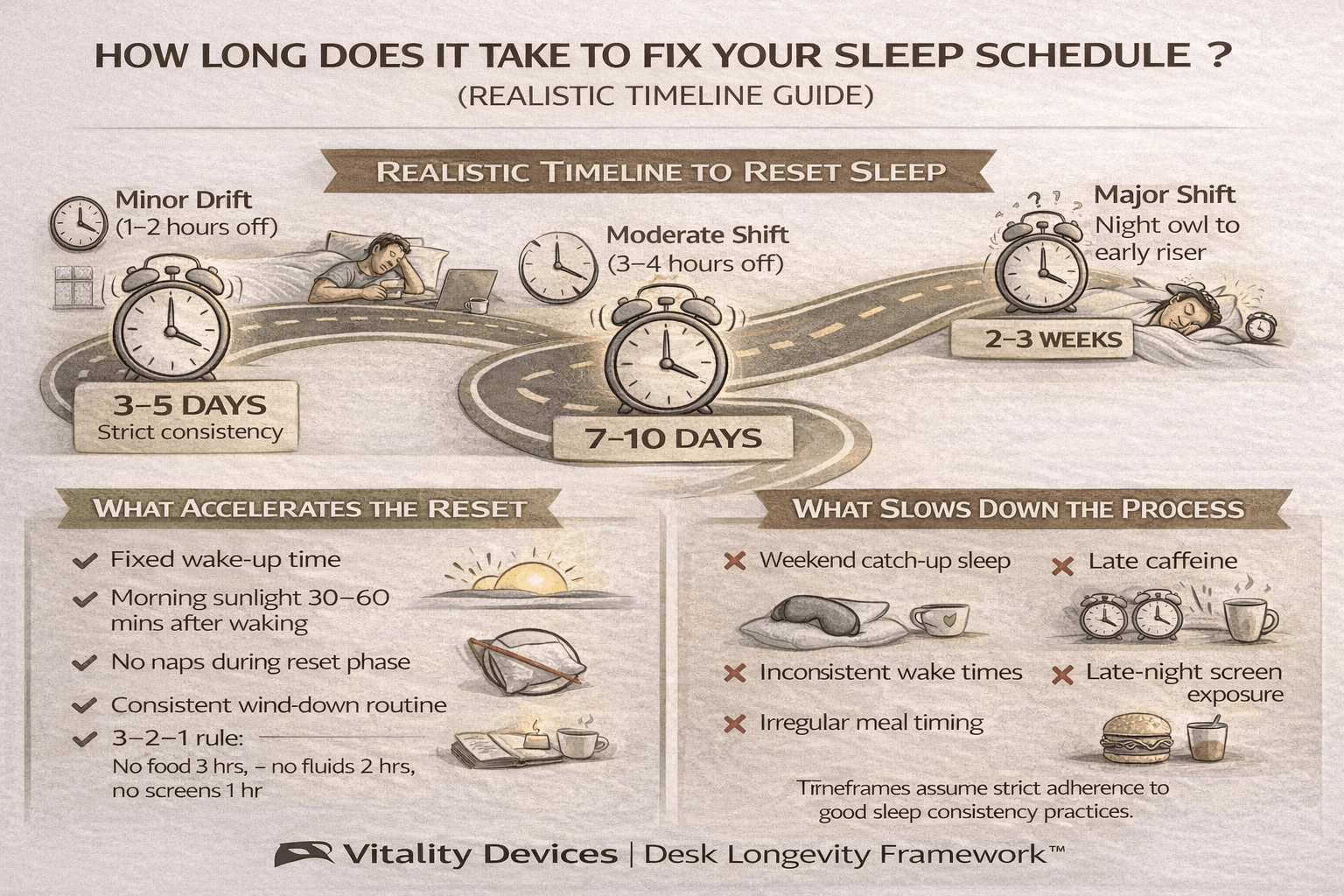
Realistic Timeline to Fix Your Sleep Schedule
- Minor drift (1–2 hours off): 3–5 days of strict consistency
- Moderate shift (3–4 hours off): 7–10 days
- Major shift (night owl to early riser): 2–3 weeks
The key variable is daily repetition. Your body adapts to patterns — not intentions.
What Actually Accelerates the Reset
- Fixed wake-up time (non-negotiable)
- Morning sunlight within 30–60 minutes of waking
- No naps during reset phase
- Consistent wind-down routine
- 3–2–1 rule before bed (no food 3 hrs, no fluids 2 hrs, no screens 1 hr)
If you haven’t read it yet, start with our foundational guide on sleep consistency for professionals.
What Slows Down the Process
- Weekend catch-up sleep
- Late caffeine
- Inconsistent wake times
- Late-night screen exposure
- Irregular meal timing
Trying to “force” sleep earlier rarely works. Instead, anchor the wake-up time and let sleep pressure build naturally.
Reset Strategy for Desk Professionals
If you work at a desk and rely on cognitive performance, your priority is rhythm stability — not just duration.
- Wake at the same time daily
- Morning light exposure
- Short outdoor walk before work
- Reduce evening stimulation
- Cool, dark sleep environment
These habits compound over time — building what we call sleep wealth, not temporary recovery.
Final Takeaway
Most people can meaningfully improve their sleep schedule in 7–14 days with strict consistency.
Sleep timing is trainable. But only if you treat it as a daily investment — not a weekend repair strategy.
For a full structured system, explore the Desk Longevity Framework.
Leave a Reply