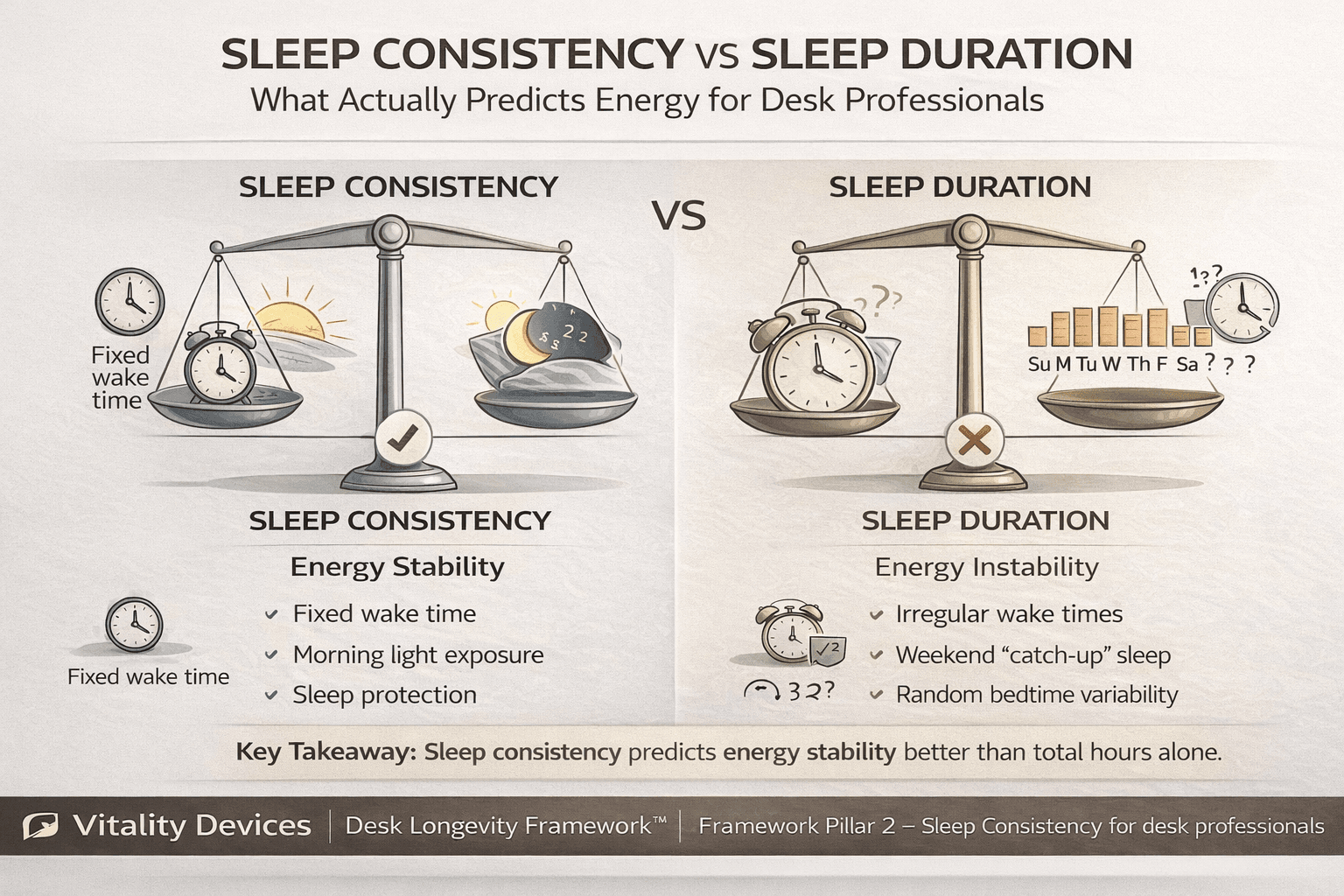
Modern productivity culture often reduces sleep to a single number: “Get 7–8 hours.”
But for desk professionals and knowledge-based workers, the more relevant question is:
Is sleep duration really the main driver of performance — or is sleep consistency more important?
This article explains why regular timing often matters more than raw hours, and how that fits inside the broader longevity framework.
The common mistake: Optimizing only for hours
Many professionals:
- Sleep 5–6 hours on weekdays
- Try to “catch up” on weekends
- Assume average weekly hours is what matters
But this creates instability — something we explained in:
👉 Sleep Debt: Why “Catching Up” Is a Myth & Sustainable Strategies
The problem isn’t just lost hours. It’s circadian instability.
Your brain doesn’t run on totals. It runs on rhythm.
Why consistency often beats duration
1. Circadian stability regulates energy
When you wake up and go to bed at consistent times:
- Cortisol rises predictably in the morning
- Melatonin cycles stabilize
- Body temperature rhythm improves
- Cognitive alertness becomes more predictable
This is why we emphasize fixed wake time in:
👉 Sleep consistency for professionals: the simplest longevity lever
2. Desk work depends on cognitive sharpness
Knowledge work is sensitive to sleep variability. Irregular timing increases:
- Brain fog
- Irritability
- Afternoon crashes
- Stress reactivity
This feeds directly into:
👉 Stress baseline for desk professionals
Sleep instability → higher stress baseline → worse recovery → lower energy.
Sleep duration still matters — but second
This is not an argument for short sleep.
If you consistently sleep 5 hours, performance will degrade.
But the hierarchy looks like this:
- 1️⃣ Consistency
- 2️⃣ Circadian alignment (light + temperature)
- 3️⃣ Adequate duration
The Sleep Wealth Model
Instead of thinking in terms of “sleep debt,” think in terms of sleep capital.
You build sleep capital through:
- Fixed wake time (even weekends)
- Morning light exposure
- Wind-down ritual
- Cool, dark sleep environment
This is integrated inside:
👉 The Desk Longevity Framework
How this connects to recovery
Sleep interacts with:
- Daily movement baseline for desk professionals
- Why recovery tools work better when your movement baseline is in place
- Why recovery routines fail for desk professionals (and what actually works)
Without sleep consistency:
- Recovery tools don’t fix fatigue
- Stretching won’t restore cognition
- Short-term hacks fail long term
Key Takeaway
Sleep consistency predicts energy stability more than occasional long nights.
Duration matters. But rhythm regulates.
Stabilize timing first — performance improves faster than simply adding random hours.
Leave a Reply