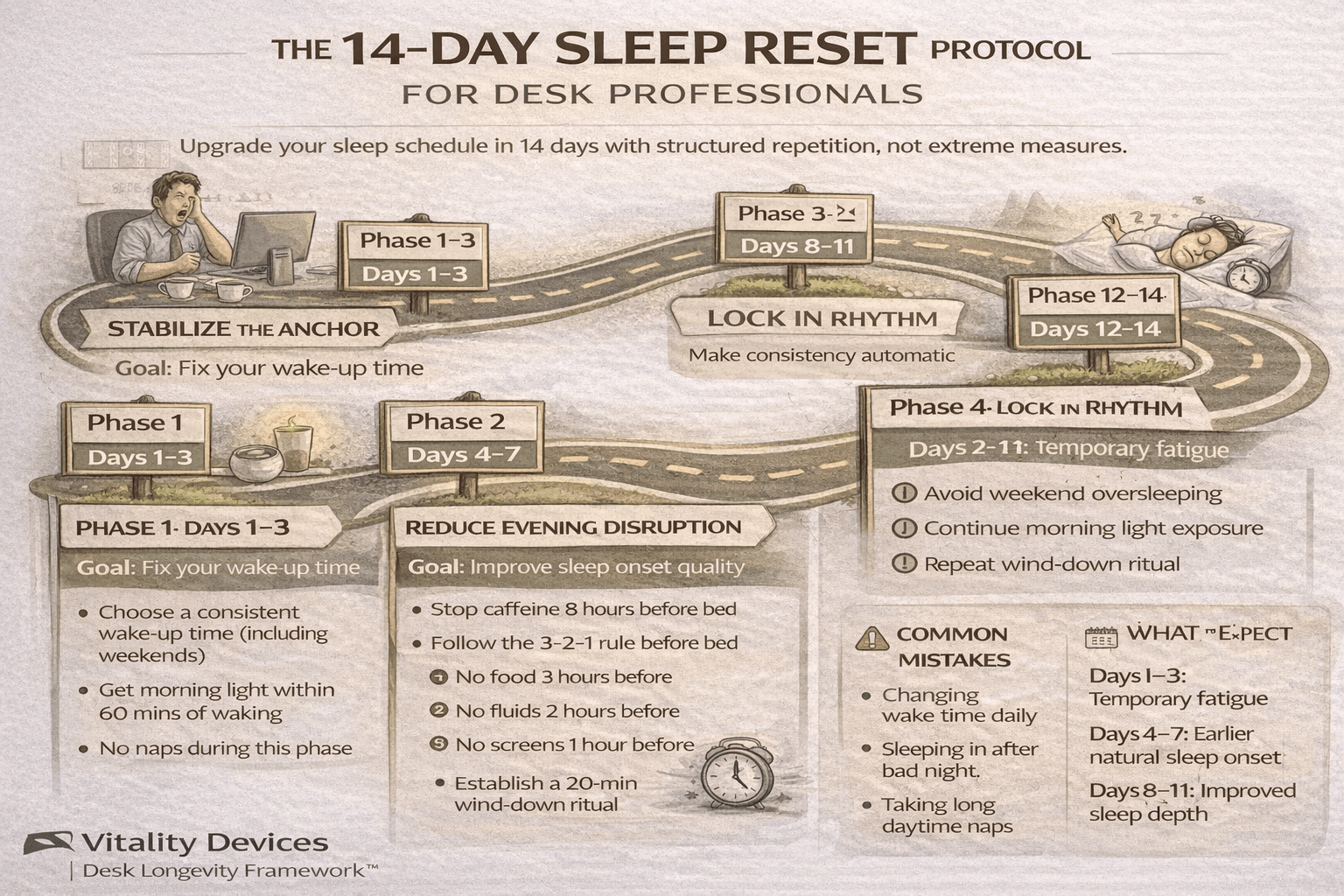
The 14-Day Sleep Reset Protocol (for Desk Professionals)
If you’re waking up tired, relying on caffeine, or stuck in “good sleep / bad sleep” cycles, this is the simplest reset that actually holds.
This protocol is designed for desk professionals: high cognitive load, inconsistent daylight, late screens, and stress carryover.
Important: This is informational and not medical advice. If you have severe insomnia, suspected sleep apnea, or a medical condition, consider professional support.
Start Here (Read This First)
The reset works because it stabilizes the 3 core levers of sleep quality:
- Consistency (same wake time daily)
- Light timing (morning light, lower evening light)
- Stimulation control (caffeine + screens + stress carryover)
If you want the big picture framework, start here:
The Rules (Non-Negotiables for 14 Days)
- Wake time is fixed (same time every day, weekends included)
- Bedtime is flexible (go to bed when sleepy, within a reasonable window)
- No naps (or max 20 minutes before 2 PM if unavoidable)
- Caffeine cutoff: 8–10 hours before bed (most people: stop by 1–2 PM)
- Stop late-night scrolling: no screens 60 minutes before bed (minimum)
Related deep dives you can use inside the reset:
- Why you wake up tired even after 8 hours
- Sleep debt: why “catching up” doesn’t work
- Not late-night scrolling: why it wrecks sleep consistency
- Caffeine timing for professionals: when to stop drinking coffee
How to Pick Your Fixed Wake Time
Pick a wake time you can keep 7 days/week for 14 days. Start with your “workday wake time” and use it every day.
Example: If you normally wake at 07:00 on weekdays, set 07:00 as your fixed wake time for the full protocol.
Your bedtime will naturally shift earlier once your wake time is stable.
The 14-Day Plan
We run this in 3 phases: stabilize → deepen → lock-in.
Days 1–3: Stabilize
- Wake at the fixed time (no exceptions)
- Get 10–15 minutes of outdoor light within 60 minutes of waking
- Stop caffeine by 1–2 PM (or 8–10 hours pre-bed)
- Remove screens 60 minutes before bed
- Keep the bedroom cool, dark, and quiet
Expect: sleepiness shifts, cravings for late screens, and some “early wake-ups.” This is normal recalibration.
Days 4–10: Deepen
- Maintain fixed wake time
- Morning light stays daily
- Evening light gets softer (dim lights 90 minutes pre-bed)
- Keep caffeine consistent (same timing daily)
- Add a 10-minute wind-down routine (same routine every night)
Wind-down routine examples:
- Shower + low light + reading
- Light stretching + journaling (2 minutes)
- Breathing (physiological sigh x 5) + prep clothes for tomorrow
Days 11–14: Lock In
- Keep the same wake time
- Keep the same caffeine cutoff
- Keep screens off 60 minutes pre-bed
- Don’t “celebrate” with a weekend sleep binge
- Measure progress by morning energy, not just hours slept
Goal: You exit with a stable baseline you can maintain with minimal effort.
Common Problems (and Fixes)
Problem: I wake up too early
- Do not stay in bed scrolling
- Keep lights low
- Get up and do a quiet activity (reading) until sleepy
- Keep the wake time fixed
Problem: I can’t fall asleep without my phone
- Replace scrolling with a “bridge habit” (paper book, audiobook, or notes)
- Charge phone outside bedroom if possible
- Lower screen brightness and use warm mode if unavoidable
Problem: Afternoon crash
- Walk outside for 5–10 minutes
- Hydrate
- Short movement break (stairs, light mobility)
- Avoid late caffeine (it extends the cycle)
If this is chronic, it often connects to inconsistent sleep depth:
What Success Looks Like After 14 Days
- You get sleepy at a more predictable time
- You wake with less “sleep inertia”
- Less caffeine dependence
- Fewer nighttime awakenings
- More stable mood and focus
Next Step (Keep It Simple)
If you want the full longevity structure (sleep + stress + movement + recovery), download the framework PDF:
Leave a Reply